

In late September, despite a lack of improvement in fundamentals, iron ore prices gradually recovered and rose by more than 14% in just three weeks.
Iron ore prices maintained a downward trend throughout the first nine months of the year due to pressure from sharply declining demand in China. However, at the end of September, despite no improvement in fundamental factors, iron ore prices gradually recovered and increased by more than 14% in just three weeks. The main reason supporting the price increase was primarily psychological. Therefore, the outlook for iron ore prices in the latter part of the year remains challenging due to significant resistance from consumption factors.
The challenge of Chinese demand is putting pressure on iron ore prices.
After a recovery period at the end of last year, iron ore prices quickly weakened again and have maintained a downward trend since the beginning of this year. According to the Vietnam Commodity Exchange (MXV), from the beginning of this year to mid-September, the price of iron ore listed on the Singapore Commodity Exchange (SGX) has fallen by about 35% to around 91 USD/ton, and at one point even dropped to a nearly two-year low.
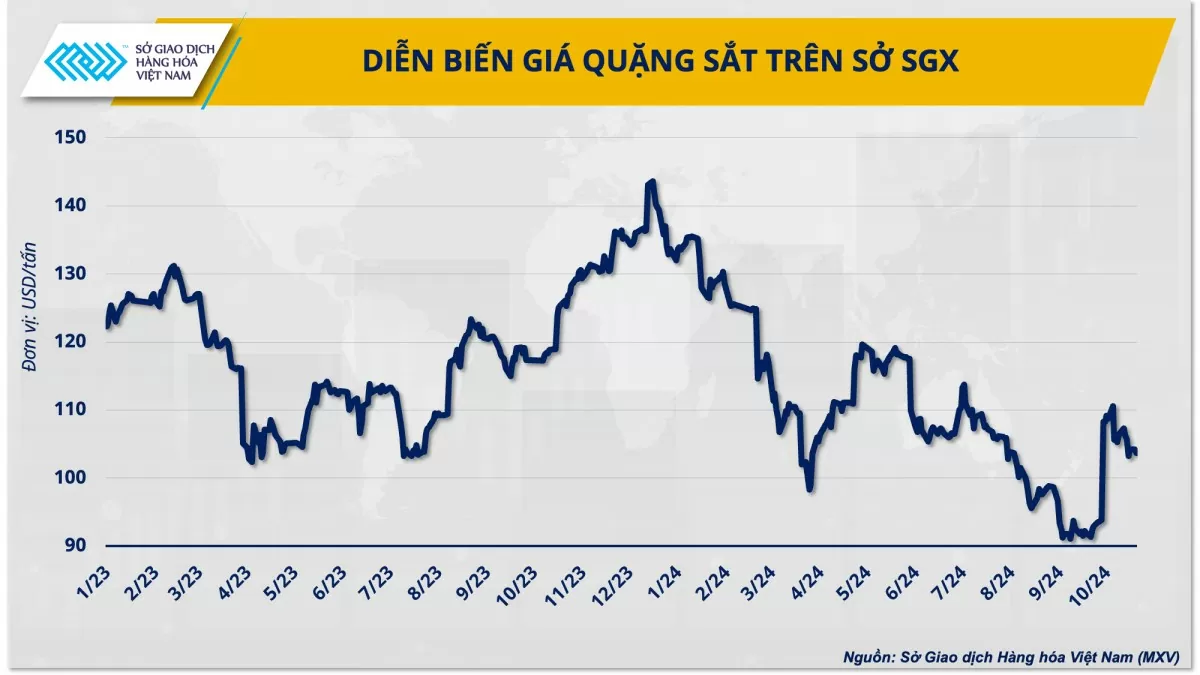 |
| Iron ore price trends (SGX) during the period 2023-2024 |
Explaining this sharp decline, Mr. Duong Duc Quang, Deputy General Director of MXV, said: “The main reason putting pressure on iron ore prices during this period is the sharp decrease in demand in the leading consumer market, China, with the biggest drag coming from the real estate sector. The unresolved steel oversupply crisis in the country has led to a significant surplus of raw materials. Although demand has increased slightly in other sectors such as manufacturing and shipbuilding, this increase is not enough to compensate for the sharp decline in demand in the real estate segment.” Data from the consulting firm SteelHome shows that since falling to a 7-year low in the last week of October last year, iron ore inventories at Chinese ports have continuously increased sharply over the past 12 months and are currently maintaining around 150 million tons, the highest in the last two years.
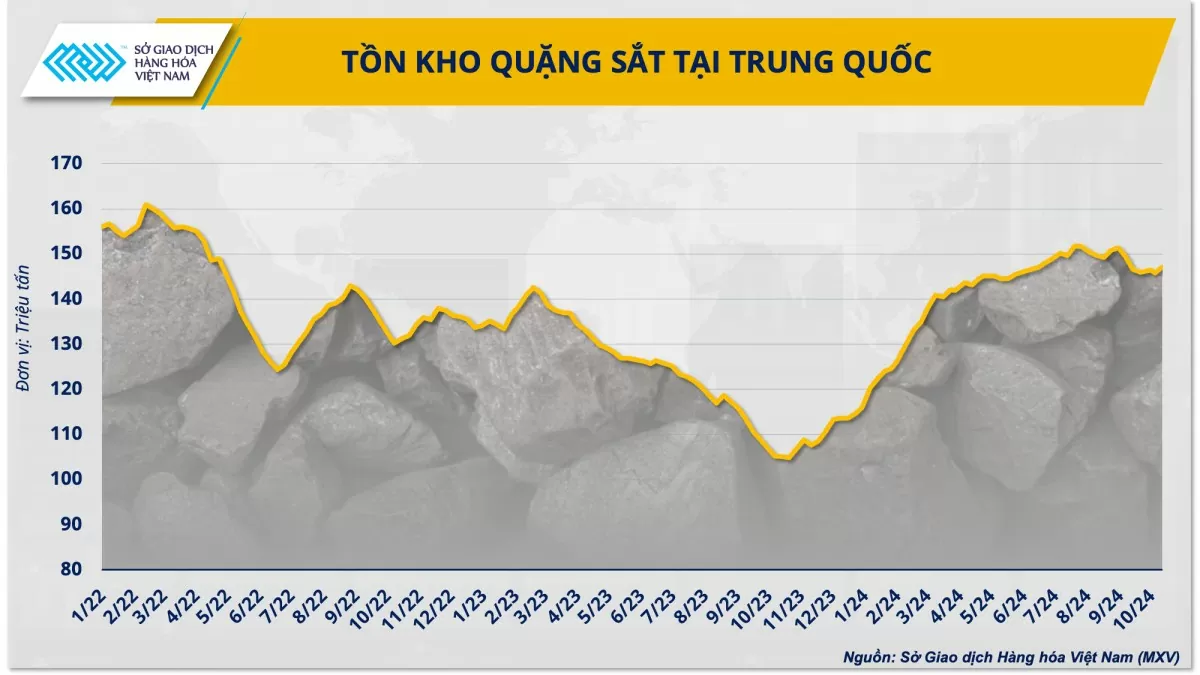 |
| Iron ore inventories in China |
In addition, pressure isn't just coming from weak demand in China; the surplus supply of iron ore is also a significant factor driving prices down. Vale, the world's largest iron ore miner, reported a 4.6% year-on-year increase in production to 242.2 million tonnes in the first three quarters of this year. In the third quarter alone, Vale boosted production to a six-year high of 91 million tonnes. Two other major iron ore producers, Rio Tinto and BHP, also reported strong increases in iron ore production during the first nine months of this year.
However, despite the lack of fundamental changes, iron ore prices recovered and surged strongly in the last week of September. According to MXV, in the three weeks from September 23rd to October 13th, iron ore prices reversed course and rose from a 22-month low to the 105-106 USD/ton range, even briefly reaching a 3-month peak of 110.5 USD/ton. In just these three weeks, iron ore prices regained over 14% of their value. So, has iron ore entered a recovery phase after a prolonged decline?
The price outlook for the end of the year remains challenging.
To answer this question, it's necessary to understand the reasons behind the recent increase in iron ore prices. More specifically, in the last week of September, the Chinese government launched its largest and most significant economic stimulus package since the COVID-19 pandemic to revive its slowing economy.
Since then, the country's leaders have continuously implemented various supportive policies, including commitments to deploy fiscal stimulus packages, demonstrating a strong determination to help the economy achieve its growth target of around 5% this year. These moves have increased expectations of improved iron ore consumption in the country, thereby supporting a sharp price surge. However, since the support is mainly psychological, and these policies need more time to take effect, iron ore prices are unlikely to maintain a sustainable upward trend in the long term without an improvement in supply and demand factors in the market.
Assessing the outlook for iron ore prices in the latter part of the year, Mr. Quang commented: “In the past few weeks, the main reason supporting iron ore prices has been the improvement in market sentiment after China announced a large-scale economic stimulus package. Given the current difficulties facing China's steel industry, this is considered a rare glimmer of hope, giving the market confidence in the recovery of this giant industry. However, since this is largely due to psychological factors, this upward trend in iron ore prices is unlikely to last long. The most important factor for the market to consider currently remains the actual demand in China.”
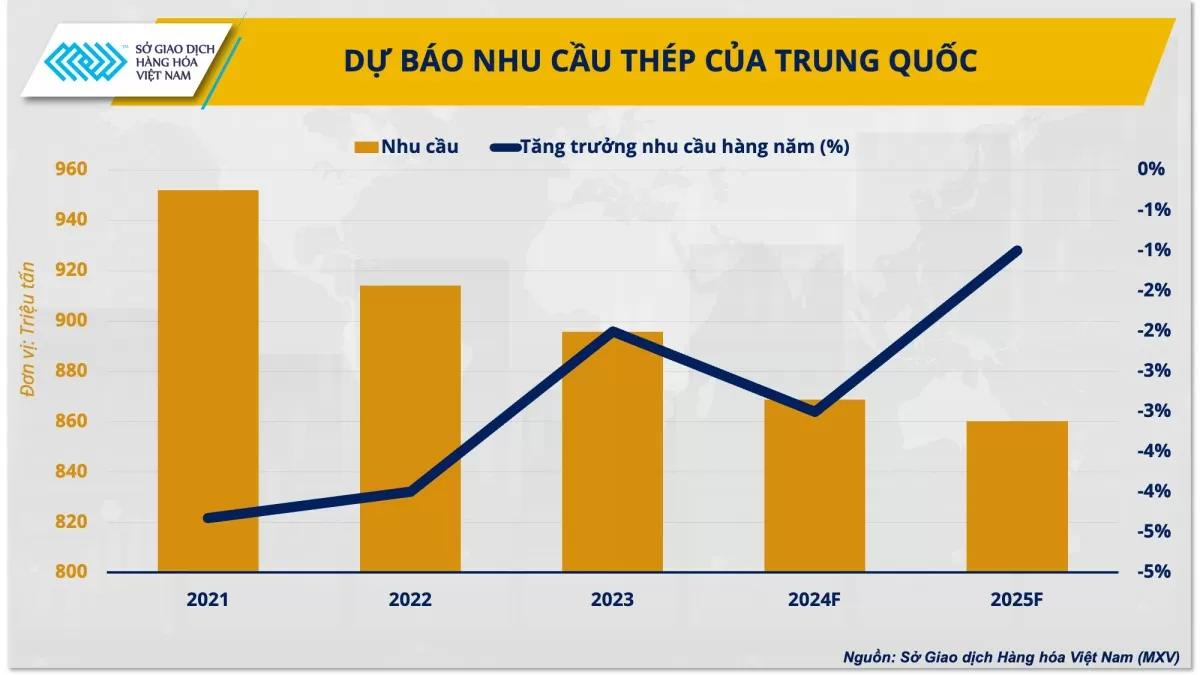 |
| Steel demand forecast for China – WorldSteel |
In the current context, iron ore demand in the country has not improved significantly, mainly driven by seasonal factors. Looking ahead to the final quarter of this year, overall iron ore demand will remain constrained by the gloomy outlook for the steel industry, as the real estate sector continues to be mired in crisis. China Baowu Steel, China's largest steel producer, has warned that the country's steel industry is facing a crisis even more severe than the major recessions of 2008 and 2015.
The World Steel Association (WorldSteel) recently forecast that China's steel demand, the main driver of global steel demand growth over the past two decades, is expected to decline for the fourth consecutive year to 869 million tons this year, threatening demand for iron ore, a key raw material. Therefore, with the demand outlook remaining bleak, iron ore prices are unlikely to reverse into a new upward trend and will struggle to maintain the $100/ton mark by the end of this year. The price outlook is brighter next spring as demand improves during the peak consumption season.
Source: https://congthuong.vn/nhu-cau-yeu-thach-thuc-da-phuc-hoi-cua-gia-quang-sat-354425-354425.html
![[Photo] First session of the 14th Congress of the Vietnam Trade Union](https://vphoto.vietnam.vn/thumb/1200x675/vietnam/resource/IMAGE/2026/06/03/1780465947883_ndo_br_img-3852-jpg.webp)
![[Photo] General Secretary and President To Lam presides over a meeting with the Central Organizing Committee.](https://vphoto.vietnam.vn/thumb/1200x675/vietnam/resource/IMAGE/2026/06/03/1780482764658_a1-bnd-4741-3342-jpg.webp)
![[Photo] Secretary of the National Assembly Party Committee, Chairman of the National Assembly presides over the meeting of the Standing Committee and Executive Committee of the National Assembly Party Committee.](https://vphoto.vietnam.vn/thumb/1200x675/vietnam/resource/IMAGE/2026/06/03/1780480353201_ndo_br_bnd-2585-jpg.webp)












































![[Video] Sunset at Lap An Lagoon – Where the sun sets over the fishing nets](https://vphoto.vietnam.vn/thumb/1200x675/vietnam/resource/IMAGE/2026/05/31/1780192137701_beach-landscape-sea-water-nature-grass-745871-pxhere-com.jpeg)
































Comment (0)