

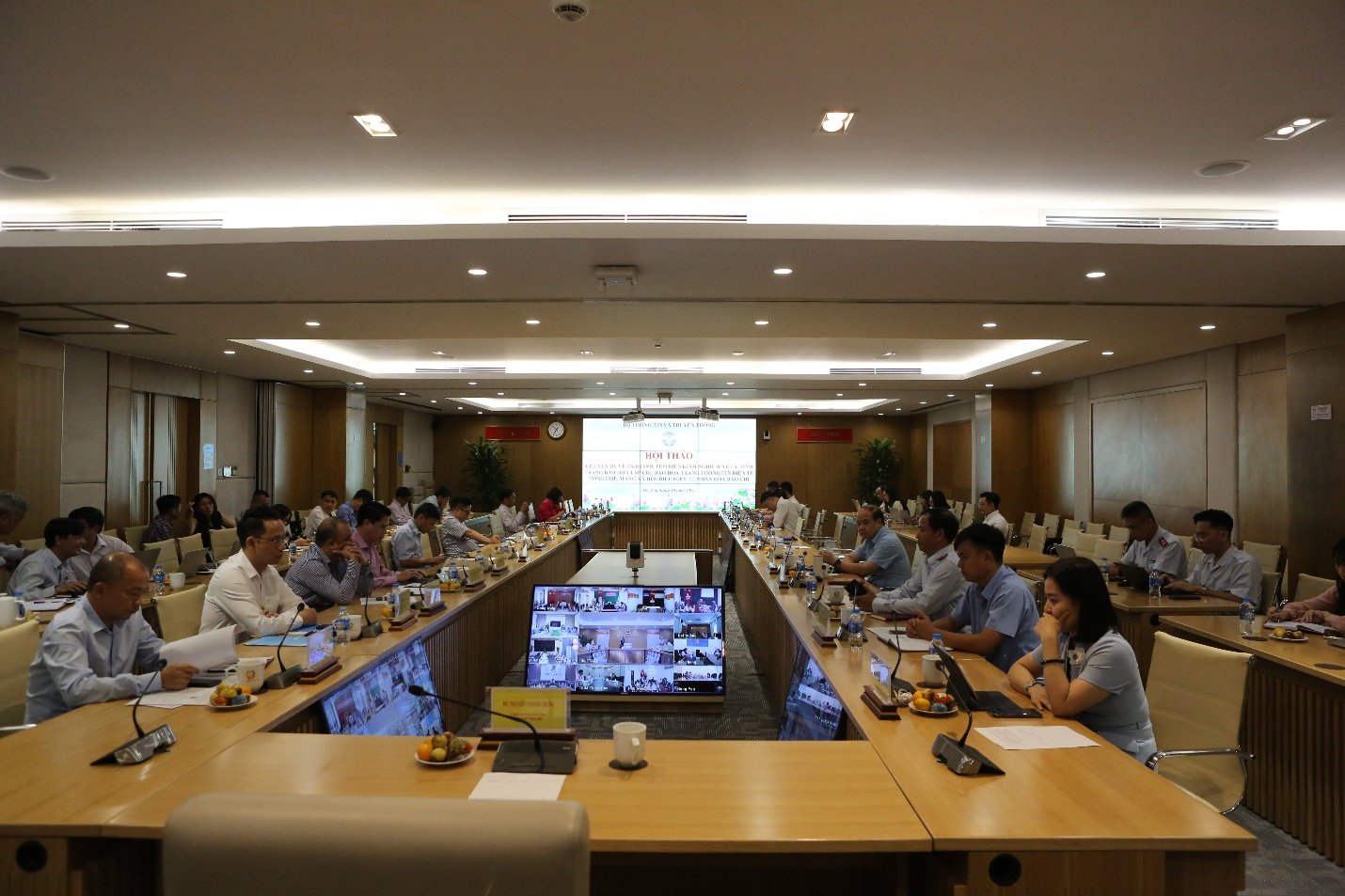
Seminar on exchanging and disseminating experiences in handling the "journalistic" transformation of magazines, general news websites, and social networks, and the "privatization" of the press, October 2024
The reality of magazines and social media becoming like newspapers.
Currently, there are over 800 licensed media outlets (newspapers, magazines) nationwide. Approximately 200 general online information websites and over 1000 licensed social networks exist. In addition, there are countless other similar sites that are too numerous to count.
Among them, some magazines, general information websites, and social networks operate quite effectively. However, many other magazines, general information websites, and social networks are operating without proper licenses, distorting into "journalistic" forms, causing confusion for readers. This situation is currently concentrated in most magazines belonging to associations and organizations with socio-professional activities.
Typical manifestations of the "journalistic transformation" of online magazines include: failing to adhere to or exceeding the stated purpose and objectives in their press operating licenses; scientific magazines presenting factual information with a large disparity between academic and theoretical content; many magazines failing to ensure that articles and news are in-depth and specialized; sending reporters to write articles that do not conform to the stated purpose and objectives, with vague and unclear introductions.
Typical manifestations of "journalistic" online news aggregators and social networks include: presenting information in a way that misleads people into believing they are news agencies; aggregating news and articles from news agencies without citing them verbatim or accurately; online news aggregators "laundering" information from news agencies, and some even producing and publishing their own news and articles as if they were from news agencies; social media users producing news and articles as if they were journalistic works from news agencies and posting them as user-generated content; and social media platforms posting content from administrators in a style that misleads people into believing it to be news articles.
The reality of "privatization" of the press.
This manifestation is disguised in many sophisticated forms, mainly concentrated in the journals of associations and socio-professional organizations; some cases involve historical factors; and it is carried out through partnerships that exceed regulations, allowing partners to manipulate and control the activities of the media outlets.
Typical manifestations of "privatization" of journalism include: Affiliated entities showing signs of easily interfering with server systems, editing, and removing news articles. The media organization issues credentials to its partner's personnel for journalistic work. News articles are published according to the partner's requirements, resulting in an imbalance in information ratios and deviations from the media organization's principles and objectives. The partner has complete control over the news articles without oversight or the media organization's knowledge. In some cases, the private partner invests entirely in the media organization's infrastructure, dominating its operations and preventing the parent organization from exercising its managerial role.
The phenomenon of "journalism" and "privatization" of the press not only distorts the function and mission of journalism but also erodes public trust, seriously affecting the transparency and credibility of the media. To address this issue, stricter management measures are needed: Review and handle press agencies, magazines, and social media platforms that operate contrary to their stated principles and objectives; Strengthen supervision and require online news aggregators and social media platforms to comply with regulations on information aggregation and citation; Tighten regulations related to journalistic partnerships, ensuring that partners do not dominate the operations of press agencies; Promote awareness among social media users about reliable information, helping them clearly distinguish between mainstream journalism and other sources of information.
The current situation of "journalism" and "privatization" of the press is an issue that needs to be addressed promptly to protect the integrity and transparency of Vietnamese journalism. A coordinated effort between regulatory agencies, media organizations, and the public is necessary to build a healthy information environment that fulfills the role and mission of revolutionary journalism.
Source: https://mic.gov.vn/thuc-trang-bao-hoa-va-tu-nhan-hoa-bao-chi-nhung-bieu-hien-dang-lo-ngai-197241224171120767.htm




![[Photo] Standing Committee member of the Party Central Committee Tran Cam Tu working with the Central Inspection Committee](https://vphoto.vietnam.vn/thumb/1200x675/vietnam/resource/IMAGE/2026/05/28/1779969579668_ndo_br_bnd-2495-jpg.webp)






















































































Comment (0)