


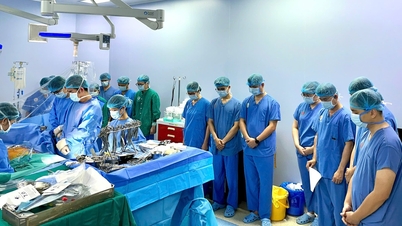
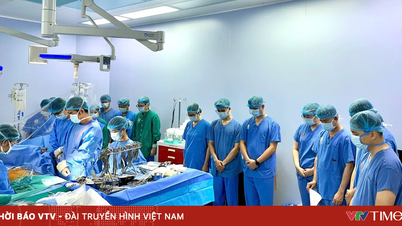
150 medical staff participated in the major organ harvesting and transplant surgery. Photo: Military Central Hospital 108.
With unwavering efforts to fulfill its special mission of caring for the people's health, the health sector has achieved many outstanding accomplishments in recent times, including the spectacular success of doctors and medical staff in many rare and difficult cases.
Establishing our expertise on the world organ transplant map.
A symbolic surgery that clearly demonstrates the top-notch techniques of our country's doctors was the lengthy organ harvesting and transplant operation on the 30th day of the Lunar New Year, performed by hundreds of doctors and medical staff from Military Central Hospital 108, Central Lung Hospital, and many other hospitals.
Specifically, on February 9th (the 30th day of the Lunar New Year), the Central Military Hospital 108 mobilized more than 150 staff members to perform a multi-organ transplant from a brain-dead donor in 11 hours. Prior to this, the hospital received a 26-year-old male patient with severe traumatic brain injury due to a traffic accident. Doctors and nurses made every effort to treat and resuscitate the patient, hoping for a chance of survival, but unfortunately, luck was not on his side.
After three days of treatment, the patient was diagnosed with brain death. Upon receiving information about the patient's condition and with a spirit of charity and humanity, the patient's family agreed to donate tissues and organs to save the lives of many other patients suffering from terminal illnesses.
Major General, Professor, and Doctor Le Huu Song - Director of Military Central Hospital 108, said that for this "major surgery," the hospital took complete initiative in organization, coordination, and execution. The hospital mobilized more than 150 staff members, including experts from various specialties, and personnel from organizational, coordination, logistics, equipment, information technology, and social work departments, to simultaneously harvest and transplant tissues and organs including the heart, lungs, liver, kidneys, pancreas, limbs, and cornea. They also meticulously organized the post-mortem care for the brain-dead patient who donated multiple tissues and organs.
By the afternoon of the 30th of Tet (Lunar New Year's Eve), the first heartbeats of the heart recipients were being monitored continuously, along with other tissues and organs gradually reviving in the bodies of patients receiving liver, kidney, kidney-pancreas, or limb transplants, amidst the joy and happiness of the patients' families and the doctors...
"Perhaps this Lunar New Year's Eve only happens once in a lifetime for a doctor like me at the Central Military Hospital 108, marking the end of the old year and the beginning of a new one, a year in which many lives are reborn," said Major General, Associate Professor, Dr. Pham Nguyen Son - former Deputy Director of the Central Military Hospital 108, visibly moved.
Meanwhile, another life was revived thanks to the efforts of more than 100 doctors and nurses at the Central Lung Hospital, Hospital E, and many other hospitals, using the lungs of the aforementioned brain-dead patient.
Reportedly, the transplant recipient is a university student who had to drop out due to an unfortunate case of end-stage lung disease. The patient's condition was critical, with a high probability of death within months without a lung transplant. The patient had been managed and monitored at the National Lung Hospital since 2020 and had been awaiting a transplant for several months due to severe damage to both lungs, severe respiratory failure, and a high risk of death.
On February 8th, after receiving information about a donated lung from Military Central Hospital 108, the National Lung Hospital urgently activated its lung transplant program and organized a consultation to select a recipient that same night.
The National Lung Hospital mobilized approximately 80 personnel to participate directly (and many others were ready to be deployed and work remotely), and also received coordination and support from the National Organ Transplant Coordination Center, Military Central Hospital 108, E Hospital, Vietnam-Soviet Friendship Hospital, Hanoi Heart Hospital, etc.
The surgery, also performed on February 9th, lasted 12 hours (from 10 AM to 10 PM) and was a resounding success, meeting the highest standards of UCSF. The surgery was meticulously and systematically conducted according to international standard procedures at the UCSF Lung Transplant Center – one of the nine largest and most reputable lung transplant centers in the United States.
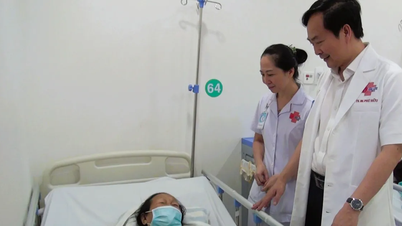
Fourteen hours after the surgery, the young woman woke up and took her first breaths with her new lungs, much to the joy of both the patient and the doctors. On the very first day after the lung transplant, the patient recovered well, with stable respiratory indicators.
Reportedly, this is the 10th lung transplant in Vietnam and the 2nd at the National Lung Hospital. Globally, there are currently over 4,000 lung transplants, with over 2,000 in the US, nearly 2,000 in Europe, and the remainder in Asia, including China, South Korea, and Japan.

Foreign doctors receive training on Dr. Luong's thyroid endoscopy method at the Central Endocrine Hospital. Photo: Provided by the hospital.
Fetal surgery while the fetus is still in the mother's womb.
On January 4, 2024, the interventional cardiac catheterization team of Children's Hospital 1 collaborated with the surgical team of Tu Du Hospital to successfully perform "intrauterine cardiac catheterization" on a fetus with severe congenital heart disease.
Specifically, according to the medical history, pregnant woman L. (27 years old), in her first pregnancy, was transferred to Tu Du Hospital for monitoring because her 32-week-old fetus had severe abnormalities, including congenital heart disease with pulmonary artery valve atresia and right ventricular hypoplasia.
Following a consultation, doctors from Children's Hospital 1 and Tu Du Hospital performed a semi-emergency fetal cardiac catheterization to save the life of the fetus still in the mother's womb.
The two hospitals meticulously planned and prepared a team of more than 15 people from 5 specialties, including obstetrics, neonatology, anesthesiology and resuscitation, cardiology, and diagnostic imaging.
Fetal intervention yields spectacular results, but also carries many risks during and after surgery. Following the intervention, ultrasound revealed that the fetal heart was still functioning well. The pregnant woman continued to be monitored throughout her pregnancy by the two hospitals working together.
"A baby's heart is only the size of a strawberry; absolute precision is crucial because even a small mistake can cause the heart to stop beating immediately," said Dr. Do Nguyen Tin, Deputy Head of the Cardiology Department (Children's Hospital 1), one of the world's leading experts in congenital heart intervention and the person who directly performs cardiac catheterization.
Not stopping there, just 7 days later, on January 12th, the medical team from Tu Du Hospital and Children's Hospital 1 successfully intervened again for a fetus with a very severe congenital heart defect.
Minister of Health Dao Hong Lan assessed that the intervention's 100% success rate opens a breakthrough direction in the implementation of fetal congenital heart disease interventions, bringing happiness to many families, especially those in difficult circumstances. This is also a testament to the talent and tireless efforts in accessing advanced medical techniques and applying modern technology in medicine.
It is known that only a few places in the world, such as Brazil and Poland, have successfully implemented this technique. Countries in the region that have achieved many medical breakthroughs, such as Singapore and Thailand, have not yet implemented fetal cardiac catheterization.
Foreigners come to Vietnam for medical treatment and to learn about medicine.
In recent years, with the remarkable progress of domestic medicine, Vietnam has mastered many techniques, which have been highly appreciated by international experts, attracting Vietnamese people living abroad to return home for examinations as well as foreigners to come to Vietnam for treatment of difficult cases.
For example, over the past year, Viet Duc Friendship Hospital has received many cases of patients who have undergone multiple surgeries for anal abscesses and anal fistulas in countries such as Poland, Hungary, Japan, the UK, and New Zealand, but have not recovered and have experienced recurrence, seeking treatment at Viet Duc Friendship Hospital. Meanwhile, doctors at Saint Paul Hospital also treated a difficult case for a 4-year-old Australian child.
Accordingly, in early October 2023, noticing their 4-year-old daughter was experiencing abdominal pain and pale stools, an Australian family living in Indonesia took her for a medical examination, where a bile duct cyst measuring over 2cm in diameter was discovered.
Later, the family researched the best treatment facilities in Europe, but the incidence of the disease was low in that continent, so they took their child to Singapore to seek treatment because they realized that choledochal cysts were very common in East Asia, South Asia, and Southeast Asia. Without surgery, the patient faced a high risk of developing cholangitis, bile duct obstruction, pancreatitis, and cirrhosis.
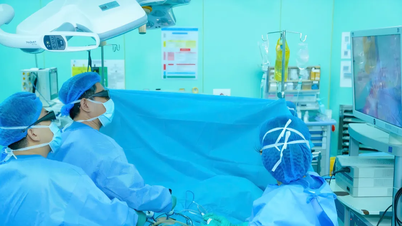
Because they didn't want their child to undergo open surgery, the family took her to the High-Tech Center (Saint Paul Hospital) for single-port laparoscopic surgery. Currently, only Vietnam and China can routinely perform this technique.
Associate Professor Dr. Tran Ngoc Son - Deputy Director of Saint Paul Hospital, who performed this surgery, said: "Laparoscopic single-port surgery to treat choledochal cysts in children marks a step forward in pediatric surgery in our country and has attracted several foreign doctors to Vietnam to consult and learn from it."
It is known that since 2011, Associate Professor Son has successfully implemented the single-port laparoscopic technique for treating choledochal cysts in children. This result has been reported at many surgical conferences worldwide, marking a significant advancement in Vietnamese pediatric surgery and gaining international recognition. To date, Professor Son has performed single-port laparoscopic surgery on over 300 children with choledochal cysts, with a complication rate of infection below 1%.
According to Mr. Son, the fact that foreigners know about and trust Vietnam's healthcare system is a new step forward, a very positive and proud development for the Vietnamese healthcare sector.
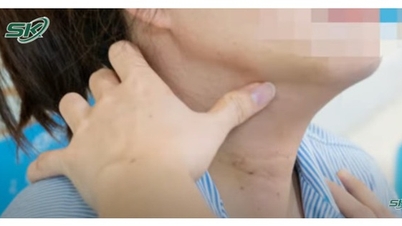
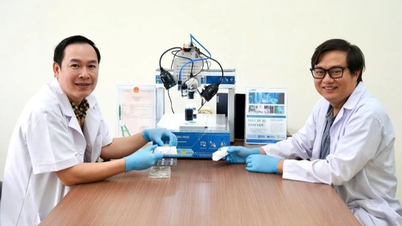
Meanwhile, at the Central Endocrine Hospital, three foreign trainees from Azerbaijan and India have registered to participate in the "Dr. Luong" endoscopic thyroidectomy technique course at this medical facility.
Dr. Pavithra Shanmugam from the Apollo Proton Cancer Center in India, one of the three trainees mentioned above, said that this was her first time in Vietnam and she was "surprised by the professional expertise and modern equipment of Vietnamese healthcare."
“In India, I had the opportunity to learn the ‘Dr. Luong’ endoscopic thyroidectomy method from my professor, who was also trained in Dr. Luong’s techniques. I also learned about this procedure briefly in India, but participating in the direct training course at the Central Endocrine Hospital with the help of Professor Luong, Dr. Hiep, Dr. Son… during actual surgeries on thyroid patients, I learned a great deal of experience and now I am ready to return to Vietnam to implement the Dr. Luong method with what I have learned here.”
Dr. Vallam Karthik Chandra from Medicover Hospital, India, another trainee, shared that the endoscopic thyroidectomy technique used by Vietnamese doctors has many advantages compared to other methods in the region and around the world. "What impressed me is that patients only have to pay a very low cost compared to other methods," this expert said.
The "Dr. Luong" endoscopic thyroidectomy via the axilla was first applied in 2003, and since then, more than 300 professors and doctors from countries in the region and around the world have come to the Central Endocrine Hospital to learn this surgical technique. Currently, the technique has been transferred to many countries in the region and around the world such as Australia, Portugal, Singapore, Malaysia, Indonesia, Philippines, Thailand, Pakistan, India, Turkey, etc.
Every year, Associate Professor Dr. Tran Ngoc Luong - the "father" of this technique - and his colleagues at the Central Endocrine Hospital are invited by many hospitals in the country, region, and around the world to perform demonstration surgeries and lecture on this method.
For the field of organ transplantation in Vietnam, the period from 2023 to the present can be considered a historic milestone. With a series of world-class organ harvesting and transplantation cases successfully performed during this time, the capabilities of Vietnamese doctors and medical professionals have made their mark on the global medical map and are a shining example in the Asian region.
Source
![[Photo] First session of the 14th Congress of the Vietnam Trade Union](https://vphoto.vietnam.vn/thumb/1200x675/vietnam/resource/IMAGE/2026/06/03/1780465947883_ndo_br_img-3852-jpg.webp)
![[Photo] General Secretary and President To Lam presides over a meeting with the Central Organizing Committee.](https://vphoto.vietnam.vn/thumb/1200x675/vietnam/resource/IMAGE/2026/06/03/1780482764658_a1-bnd-4741-3342-jpg.webp)

![[Photo] Secretary of the National Assembly Party Committee, Chairman of the National Assembly presides over the meeting of the Standing Committee and Executive Committee of the National Assembly Party Committee.](https://vphoto.vietnam.vn/thumb/1200x675/vietnam/resource/IMAGE/2026/06/03/1780480353201_ndo_br_bnd-2585-jpg.webp)






























![[Video] Sunset at Lap An Lagoon – Where the sun sets over the fishing nets](https://vphoto.vietnam.vn/thumb/1200x675/vietnam/resource/IMAGE/2026/05/31/1780192137701_beach-landscape-sea-water-nature-grass-745871-pxhere-com.jpeg)
























Comment (0)