

- The ferry trips with "three no's" (no proper infrastructure, no safety nets ...
In March, the weather in Quy Nhon is unpredictable, alternating between sunshine and rain, yet the boatmen at Ham Tu - Hai Minh wharf still diligently wait for customers. Just one small wharf within the Quy Nhon fishing port has more than a dozen boats lined up, waiting their turn to "set sail" and carry passengers across the sea to the villages.
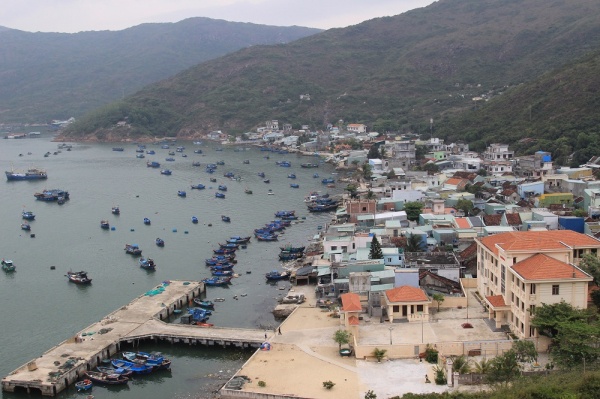 |
The Hai Minh Peninsula, nestled between mountains and the sea, faces numerous economic challenges. |
On the boat numbered BD-0486H, Mr. Do Ngoc Vu (Area 9, Hai Cang Ward), a member of the fishing crew, stepped out with a tanned complexion from days spent at sea. At an age well past half his life, Mr. Vu no longer has the energy to compete in the hustle and bustle of life. Each day he simply sits at the dock waiting for customers, earning extra money to support his family. According to him, in Hai Minh, he can't do anything else besides fishing. "Behind Hai Minh are mountains, in front is the sea; there's no land available, and the economy is tight, so now, besides being friends with the sea, I can't do anything else," he said, gesturing forward.
Opening the bottle cap he carried, Mr. Vu took a sip of bitter tea. Taking a deep breath, he recounted how, in his youth, he followed other young men from his village, venturing out to sea to fish near the shore for a living. Over time, the nearshore seafood resources gradually dwindled. With the money he had saved from years of fishing, he bought an old boat from a local and switched from fishing to sea-going boatman. Every day, he waits at this dock to ferry children to school and transport people to and from the city center for trade, earning extra income for his family. He has been working as a sea-going boatman for nearly 15 years.
“Most of the people here are from the village. Besides that, there are only a few tourists who come to visit the Tran Hung Dao monument; tourism hasn't developed much yet. We guys line up here, and we take turns working whenever there are customers. On busy days, we do 5-6 trips, on slow days, only 1-2 trips. Adults pay 3,000 dong, students 1,000 dong, and those who rent the boat pay 50,000 dong. If we're lucky, we might get hired to transport goods, which is better, otherwise, it's just the same,” Mr. Vu shared.
Despite the difficulties, Mr. Vu still tries his best, hoping to earn extra income to support his family. However, the hardships don't end there; registering and inspecting the boat is a grueling process for Mr. Vu and his fellow boatmen. "I bought this boat secondhand, and now it doesn't meet the requirements for registration and inspection. Moreover, I bought this boat for 15 million VND, and the registration and inspection fees alone cost that much. We don't earn much money carrying passengers each day. If the authorities force us to stop, we'll just have to accept it," Mr. Vu sighed.
In Hai Minh commune, with 458 households and 1,860 inhabitants, 48 people work as ferry operators. Mr. Tran Van Tien, Party Secretary and Head of Area 9, Hai Cang ward, stated that Hai Minh is geographically isolated by the sea and stretches along a small piece of land at the foot of a mountain. Besides a few who work as laborers, the majority of residents engage in small-scale coastal activities, including near-shore fishing, aquaculture, and passenger ferry services. Currently, passenger boats operate in six groups, each run independently by individuals.
Currently, Hai Minh only has one primary school and two kindergartens. Secondary and high school students have to travel to the city center to attend school. “During stormy seasons, boat travel is very difficult, and safety is not guaranteed. However, if people don't use these means of transportation, they have no other way to get out, and students cannot get to school. The local authorities proposed establishing a ferry service, but it has not been implemented for many years. We are very worried about safety, but besides raising awareness, we have no other solutions or measures,” Mr. Tien said.
According to the leaders of Hai Cang Ward People's Committee, the Ham Tu - Hai Minh ferry route was established spontaneously by local residents, existing due to the practical needs of people living and traveling daily. This ferry route is currently known as a "three-no" dock because: the dock itself is not licensed for construction; the boats are not registered or inspected; and the ferry operators do not have professional licenses or certificates.
Mr. Dinh Anh Tuan, Vice Chairman of the Hai Cang Ward People's Committee, shared that the local authorities have long recognized these shortcomings and have petitioned various agencies to find solutions, but there are still many obstacles. Firstly, establishing a wharf requires land; Hai Minh ward has it, but the central area does not, as that area has already been allocated to the Quy Nhon fishing port. Secondly, the passenger boats in this area are all converted from fishing boats, and people buy and sell them using handwritten documents, lacking design plans, making registration and inspection impossible.
Recently, various departments have been seeking solutions, and the Department of Motor Vehicles has facilitated the creation of a common design template for people to register, but the cost is quite high compared to what the people can afford. Because the income from operating boats is not high, each person only earns 1-3 thousand dong. Regarding operators, the Provincial People's Committee is coordinating to support 70% of the cost for people to study for certification, but due to the low level of education, only a few boat operators have obtained certificates to date. Furthermore, a bridge cannot be built in this area because it is a coastal area.
“Now, if these boats are not allowed to operate, people will have no means of transportation. In the short term, the local authorities regularly coordinate with relevant agencies, especially the waterway traffic police, to organize patrols and inspections, and frequently remind people to take measures to ensure waterway safety. In the long term, we hope that the relevant agencies will quickly take measures to resolve the difficulties in this area,” Mr. Tuan expressed.
Standing alongside the people
On the weekend, disregarding even their rest time, officers and soldiers of the Traffic Police Department of Binh Dinh Provincial Police, along with their partner unit - Tan Cang Central Vietnam Joint Stock Company and the People's Committee of Hai Cang Ward - busily carried national flags, lifebuoys, and gifts across the sea to the people of Hai Minh Peninsula. As soon as the speedboat departed, on the other side of the shore, the people of Hai Minh had already gathered to wait.
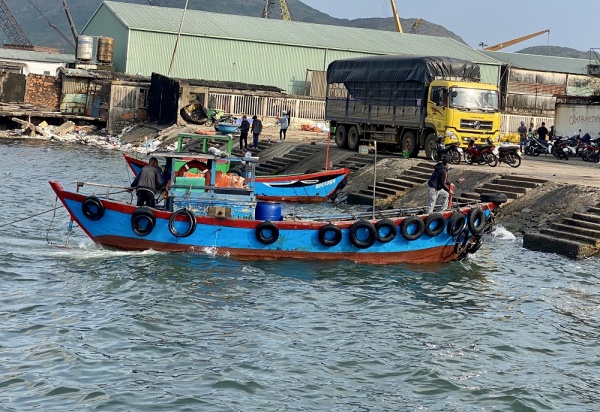 |
Transporting passengers across the sea to the city center. |
At the community center, nearly a hundred women, children, and boat drivers gathered to listen to traffic police officers disseminate information on waterway traffic laws. Lieutenant Colonel Nguyen Thanh Son, Head of the Waterway Traffic Police Team of the Binh Dinh Provincial Police Department, shared the difficulties and shortcomings faced by the people of Hai Minh and the Hai Cang ward authorities; at the same time, he reminded the people that whatever they do, they must do it within the framework of the law and comply with the regulations and rules of the law.
In particular, Lieutenant Colonel Nguyen Thanh Son also educated the public about the benefits of complying with regulations, having adequate life-saving and rescue equipment, and understanding legal regulations in case of accidents. He also emphasized the firm stance of strictly punishing actions that lead to serious consequences when traffic accidents occur.
After listening to the traffic police officers' presentation and signing a commitment, Mr. Diep Van Tao (58 years old, residing in Area 9, Hai Cang Ward), a ferry operator on the Ham Tu - Hai Minh route, understood the legal regulations and promised to strictly comply with the laws on inland waterway traffic. "I promise to ensure safety when participating in inland waterway traffic, provide life jackets for passengers, and strictly adhere to the law," Mr. Tao shared.
In solidarity with the people in protecting the homeland's seas and islands, and to encourage fishermen to maintain their determination to venture out to sea and contribute to the development of the marine economy while upholding the sacred sovereignty of the Fatherland, the Traffic Police Department, along with its partner units, presented 50 national flags to representatives of fishing families living in the area. They also donated 50 life jackets to 50 students in the area to help ensure their safety on their way to school; and presented 10 gift packages, each worth 1.2 million VND, to disadvantaged families in the area.
Lieutenant Colonel Nguyen Hong Vang, Deputy Head of the Traffic Police Department of Binh Dinh Provincial Police, stated that for many years and in 2022, there have been no inland waterway traffic accidents. However, many potential risks to waterway safety remain, such as the lack of buoys and docks, unregistered and uninspected vessels, and operators without professional licenses or certificates. Both the police and local authorities recognize the long-standing difficulties and shortcomings in inland waterway traffic on the Ham Tu - Hai Minh route.
To ensure traffic safety on the Ham Tu - Hai Minh inland waterway route and prevent unfortunate waterway accidents, the traffic police regularly coordinate and exchange information with functional forces such as the Inspectorate of the Department of Transport, border guards, and especially the People's Committee of Hai Cang ward to discuss measures. First, they propose and recommend that the People's Committee of Quy Nhon City, the Department of Transport, the Registration and Inspection Sub-department 4, and the Provincial People's Committee direct relevant units to provide support to vessel owners to build new vessels that meet the necessary operating conditions and ensure safety, preventing traffic accidents on inland waterways.
In addition, the unit also organized for owners of passenger ferries to sign commitments to comply with inland waterway traffic laws. The ferry owners committed to strictly adhering to the regulations of inland waterway traffic laws.
“We have issued numerous warnings, sought solutions, and made recommendations to relevant agencies and levels, but so far there has been no solution. While waiting for supportive measures and solutions, the traffic police will regularly strengthen patrols and controls to ensure the safety of people traveling on the Ham Tu - Hai Minh route. Besides reminding vehicles about registration and inspection violations, we will resolutely and strictly handle behaviors that easily lead to serious consequences in traffic accidents, such as not equipping vehicles with life-saving equipment and not allowing passengers to wear life jackets,” said Lieutenant Colonel Nguyen Hong Vang.
In 2022, the Traffic Police Department of Binh Dinh province deployed 763 shifts, with 2,881 officers and soldiers conducting patrols and inspections on key routes and areas. As a result, they detected, recorded, and processed 57 administrative violations, imposing fines exceeding 100 million VND; recorded and suspended the operation of 4 unlicensed ferry terminals, 15 cases of passenger boats operating outside designated areas, and 50 jet skis that did not meet operating regulations.
"Currently, the Ham Tu - Hai Minh route serves the essential daily needs of the people, but all operating vehicles do not meet the technical requirements for registration and inspection. While revenue from transportation is low and insufficient to cover costs, people cannot afford to buy new vehicles that meet the required operating standards; we propose a plan to purchase new vehicles and organize a suitable management and operation model to serve the needs of the people," the document states.
Source


![[Photo] Prime Minister Pham Minh Chinh attends the Conference on the Implementation of Tasks for 2026 of the Industry and Trade Sector](/_next/image?url=https%3A%2F%2Fvphoto.vietnam.vn%2Fthumb%2F1200x675%2Fvietnam%2Fresource%2FIMAGE%2F2025%2F12%2F19%2F1766159500458_ndo_br_shared31-jpg.webp&w=3840&q=75)















































































Comment (0)