

Ukraine relies on non-fired vehicles such as engineering vehicles, bridge-laying vehicles, and armored tankers to launch its counteroffensive.
In the counteroffensive campaign that Ukraine is conducting, some of its most important military assets are not firing artillery or launching missiles. Instead, they are quietly helping to maintain the operation of combat vehicles and paving the way for Ukrainian forces to advance into Russian lines.
Among these types of military equipment are armored tankers used to transport fuel and water, ambulances, maintenance trucks, and engineering vehicles for building bridges or clearing mines. These vehicles carry ammunition, food, spare parts, and lubricants for heavy mine-clearing equipment.
"It's difficult for the average person to imagine the amount of support required for a mobile assault," remarked Brigadier General Peter DeLuca, a former U.S. Army Corps of Engineers. These support vehicles are few in number, oddly shaped, but play a crucial role on the battlefield.
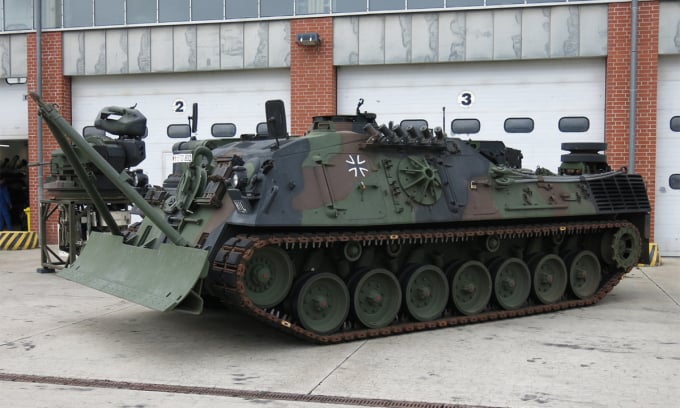
A German Army Bergepanzer 2 recovery vehicle in Viereck, Mecklenburg-Vorpommern, June 2017. Photo: Wikimedia
Over the past year, the West has supplied Ukraine with a significant amount of heavy military equipment, including main battle tanks, self-propelled artillery, armored vehicles, and infantry fighting vehicles. Less prominent on the list are eight logistics support vehicles, 18 bridge-laying vehicles, and 54 armored vehicle recovery and towing vehicles transferred to Ukraine by the United States.
Engineering vehicles, which support and maintain the combat readiness of mechanized units, have become a crucial element in all Ukrainian offensive operations, especially as they seek to break through Russian defenses with their dense systems of trenches, obstacles, and minefields.
"The next phase is penetration, meaning breaking through the defensive lines that Russia has built over months," NATO Secretary General Jens Stoltenberg recently stated. "These advances require more tanks and combat vehicles. Ukraine also needs highly specialized engineering equipment to enable the main battle tanks to operate."
In addition to 14 Challenger 2 main battle tanks, Britain also supplied two Challenger Armored Repair and Recovery Vehicles (CRARRVs), based on the Challenger 1 chassis. The CRARRV is essentially a mobile repair station for the Challenger 2 main battle tanks. Equipped with cranes, winches, and bulldozer blades, the CRARRV can carry replacement engines and gearboxes, along with a team of mechanics, to repair tanks directly on the battlefield.
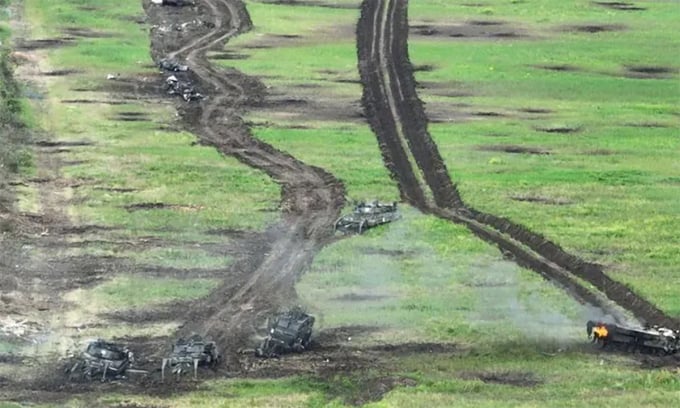
Leopard 2R engineering vehicles, Bergepanzer 2 recovery vehicles, and armored vehicles were abandoned by Ukraine after an unsuccessful attempt to breach Russian lines last week. Photo: Russian Ministry of Defense
Western experts believe that engineering vehicles like the CRARRV play a crucial role in operations like Ukraine's counteroffensive, where speed is key to success. If Ukraine breaks through Russia's defenses, they will need to deploy as many reinforcements as possible before the enemy counterattacks.
Ukrainian counteroffensives were particularly difficult because they had to advance across open ground for much of the front line, lacked air support, and were constantly being monitored by Russia. When encountering obstacles, engineering vehicles became crucial.
To date, Russian minefields remain the biggest obstacle, having halted at least one Ukrainian offensive and neutralized numerous tanks, armored vehicles, and engineering vehicles.
During the counteroffensive in Zaporizhzhia, Ukrainian troops encountered dense minefields and artillery fire from Russian armed helicopters, resulting in heavy losses. Recent images released by Russia show a German-made Bergepanzer 2 recovery vehicle abandoned in a minefield along with three Leopard 2 tanks, seemingly disabled after being hit by mines and missiles.
However, a Ukrainian mechanic said last week that a Bergepanzer 2 recovery vehicle had successfully transported a Leopard 2 tank from the battlefield to the rear. These vehicles could be repaired by Ukraine for use in subsequent counterattacks.
In some areas, Russian forces dug wide trenches to prevent tanks from crossing, so Ukraine needed armored bulldozers or bridge-laying vehicles for tanks to pass through. Some Western intelligence sources suggest that armored bulldozers or tanks fitted with bulldozer blades could push aside the "dragon's teeth" obstacles that Russia has set up if they are not already deeply embedded in the ground.
A frontal assault can last several days or weeks. During this time, the attacking side needs constant resupply of fuel and ammunition. "A main battle tank cannot return to a resupply station to get fuel. Instead, fuel must be transported to the main battle tank," the NATO Secretary General stated.
The US has supplied Ukraine with 89 armored tanker trucks, 105 fuel trailers, and 30 M992 Artillery Fire Supply Vehicles (FAASVs) that share a chassis with the M109 self-propelled howitzer.
The Ukrainian army will face a series of new challenges if it breaks through the Russian lines. Areas behind the Russian lines may no longer have civilian inhabitants, making it difficult for the Ukrainian army to find local supplies, and they may even lack drinking water. "They will have to carry everything they need," said former Brigadier General DeLuca.
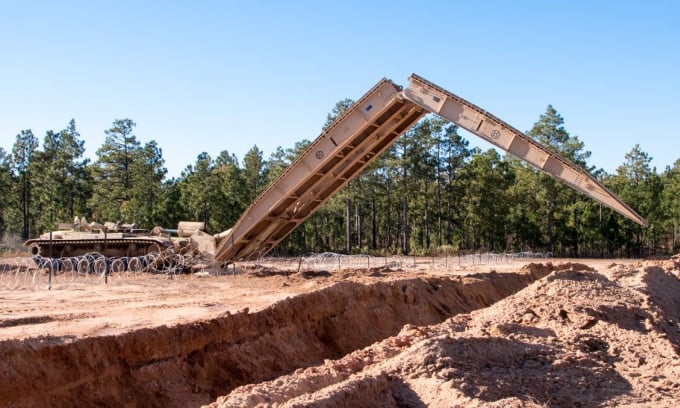
The U.S. Army's M60 Armored Bridging Vehicle (AVLB). Photo: U.S. Army
Even if Ukraine's ideal scenario unfolds with the Russian army withdrawing as it did in the Kharkiv region last year, they will face a host of logistical challenges. Tanks and other heavy combat vehicles consume enormous amounts of fuel. Ukraine's counteroffensive in Kharkiv last year slowed down partly because they ran out of fuel and supplies.
Former Brigadier General DeLuca said that the logistical equipment provided by the US and the West shows they are trying to trigger a Ukrainian offensive on some scale, although the biggest obstacle lies in deployment on the battlefield. "No one should underestimate the task Ukraine faces ahead," DeLuca stated.
Nguyen Tien (According to WSJ )
Source link






























































































Comment (0)