

Beyond offering diverse perspectives on artificial intelligence, neuroscience , and human adaptability in the digital age, these publications also aim to equip young people with critical thinking skills, a foundation of knowledge, and the ability to adapt to the rapid development of AI and technology.
From the human brain to ChatGPT
Of the three new publications, *A Brief History of Intelligence - From Sea Worms to ChatGPT* is a powerfully thought-provoking book, leading readers on a journey to explore intelligence from its earliest life forms to the AI achievements that are changing the world today.
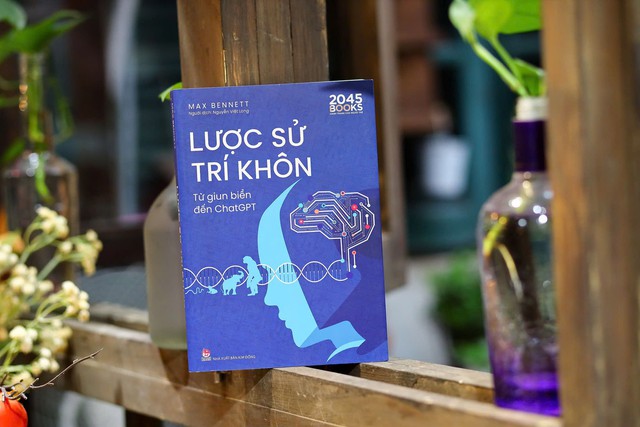
The book *A Brief History of Intelligence - From Sea Worms to ChatGPT*
PHOTO: KIM DONG PUBLISHING HOUSE
Author Max Bennett begins with a seemingly simple question: "Why can AI defeat a chess grandmaster but struggle with everyday tasks like loading dishes into a dishwasher?" From there, the book goes beyond just technology, returning to the roots of intelligence: the human brain.
Through "5 Breakthroughs" in Evolution, the book recounts the journey of the formation of biological intelligence with its many experiments, failures, and turning points. Through this , readers can better understand the human capacity to learn, adapt, and process information in complex environments – something that AI has yet to completely replace.
How should young people live in the age of AI?
While *A Brief History of Intelligence - From Sea Worms to ChatGPT* helps readers better understand the nature of intelligence, * Living Relaxed in the Age of AI* directly addresses a question more relevant to today's life: how should humans learn, work, and adapt as AI changes daily?

The book "Living Relaxed in the Age of AI"
PHOTO: KIM DONG PUBLISHING HOUSE
In recent years, AI has become a frequently discussed topic in education , media, and creative fields. The continuous emergence of new tools has both created opportunities and raised concerns: will humans be replaced? Will individual skills become obsolete? Are young people becoming increasingly dependent on machines?
Instead of shying away from these concerns, the book chooses a calmer and more balanced perspective. Instead of advocating chasing every technological trend, "Living Relaxed in the Age of AI" offers 48 practical suggestions for using AI as a supporting tool, while emphasizing the importance of understanding the nature and limitations of the technology.
According to the publisher, the book can be seen as a "guideline" to help young people avoid confusion in the face of change, avoid over-glorifying AI, but also not turn their backs on technological advancements that are opening up many new possibilities.
When AI impacts psychology and society.
In addition to books that directly discuss AI, Artificial Intelligence Through the Lens of Psychology broadens the perspective to include the psychological and social impacts that the technology is creating.

The book Artificial Intelligence Through the Lens of Psychology
PHOTO: KIM DONG PUBLISHING HOUSE
The book raises many questions relevant to young people today: why are people so easily drawn to AI, who is responsible when AI provides inaccurate data, and how will privacy change as technology increasingly infiltrates our lives and work?
Instead of offering simple answers, the work opens up a space for interdisciplinary thinking between science, philosophy, and psychology. Through this, the book emphasizes that human intelligence lies not only in the speed of information processing, but also encompasses intuition, emotions, memory, life experiences, and empathy – values that define human nature in the technological age.
"Essentials for young people" in the digital age
The publications in the "Preparation for Young People" series from Kim Dong Publishing House aim to equip young readers with a foundation of knowledge, critical thinking, and adaptability in the context of science, technology, and digital transformation that are increasingly impacting social life.
"Beyond providing knowledge about AI, these publications also demonstrate an effort to bring science and technology closer to young people through perspectives on life, psychology, and society; where technology is no longer a story of the future but has become a part of the present."
Source: https://thanhnien.vn/nhung-cuon-sach-giup-hieu-dung-ve-ai-va-cong-nghe-185260518144212243.htm

![[Image] Hanoi's urban life under the challenge of a "scorching hot" environment](https://vphoto.vietnam.vn/thumb/1200x675/vietnam/resource/IMAGE/2026/05/25/1779706979265_nang-nong-t5-2026-minh-duy-7-4636-jpg.webp)



![[Image] Close-up view of the interchange connecting the two expressways and Long Thanh Airport.](https://vphoto.vietnam.vn/thumb/1200x675/vietnam/resource/IMAGE/2026/05/25/1779703378210_ndo_br_z7863716673926-224453a31600126cce10622af6290afd-4549-jpg.webp)



























































































Comment (0)