

The Mariana Trench, with depths reaching approximately 11,000 meters, is home to living organisms and even plastic bags.

Director James Cameron sits inside a miniature model of a train compartment at an exhibition in Sydney in 2018. Photo: Saeed Khan/AFP/Getty
While land boasts colossal mountains and valleys, similar structures exist underwater. One of the most remarkable is the Mariana Trench – a rift in the western Pacific Ocean more than 2,540 km long. It contains the Challenger Deep – the deepest point ever recorded on Earth, at approximately 11,000 meters. This is nearly three times the depth of the Titanic wreck and greater than the height of Mount Everest – the world's highest mountain.
James Cameron is one of the few people who descended into the Challenger Deep.
The first dive to the Challenger Deep took place in 1960 aboard the submersible Trieste. During the dive, passengers Jacques Piccard and Don Walsh were astonished to see living organisms. James Cameron, director of the 1997 film "Titanic," was the next deep-sea explorer. He piloted a submersible to a depth of approximately 10,908 meters, setting a world record in 2012.
According to the U.S. National Oceanic and Atmospheric Administration (NOAA), for every 10 meters below the ocean surface, the pressure increases by 1 atm. Atm is a unit of pressure measurement, equivalent to 14.7 pounds (6.4 kg) per square inch (6.5 cm²). This means that the Challenger Deep dive vessel could withstand pressure equivalent to that of 50 massive Boeing 747 aircraft.
Plastic bags were found.
Another explorer who descended into the Challenger Deep was Victor Vescovo, a Texan investor. He reached a depth of 10,927 meters and set a new world record in 2019. Vescovo brought with him the sad news of the impact of human activity on seemingly inaccessible places: He reported seeing plastic bags and candy wrappers at the bottom of the Mariana Trench.
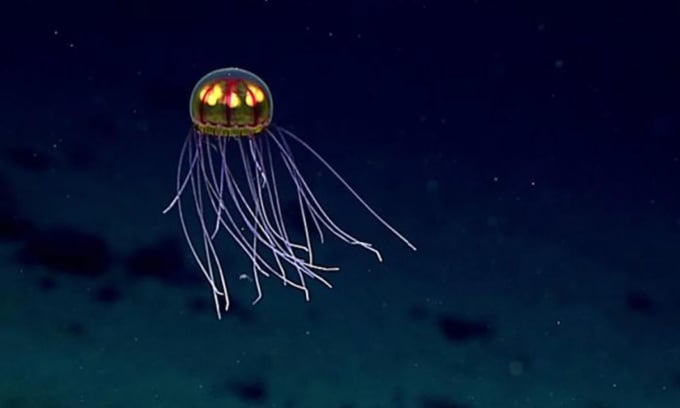
Jellyfish observed during an expedition to the underwater mountain Enigma at a depth of 3,700 meters in the Mariana Trench. Photo: NOAA Office of Operation.
The Challenger Deep is located in the "hadalpelagic zone".
Like Earth's atmosphere, the ocean can be divided into several layers. According to NOAA, the uppermost layer is called the epipelagic zone, or sunlit zone, extending down to 200 meters below the surface. The mesopelagic zone, also known as the twilight zone, begins at the end of the epipelagic zone and extends down to about 1,000 meters. Next is the bathypelagic zone, or midnight zone, and the abyssopelagic zone, or abyssal zone – from 4,000 meters to 6,000 meters. In the abyssal zone, very little life can survive; the water is completely devoid of light and extremely cold.
But at a depth of approximately 11,000 meters, the Challenger Deep lies even deeper, within the hadalpelagic region. This area is named after Hades, the Greek god of the underworld.
The existence of unique aquatic species and mud volcanoes.
The hadalpelagic zone is one of the least explored habitats on Earth. At record depths and without sunlight, scientists once believed nothing could exist there. But this is not accurate.
"Even at the bottom, life exists. In 2005, tiny single-celled organisms called foraminifera, a type of plankton, were discovered in the Challenger Deep," according to NOAA. In addition, experts have also found colorful rock formations and sea cucumbers.
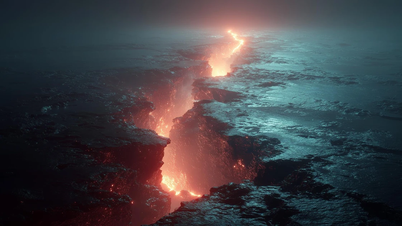
According to NOAA, a series of underwater mud volcanoes and hydrothermal vents in the Mariana Trench also contribute to the existence of unusual life forms. Despite the highly acidic hot water from the hydrothermal vents in the mud volcanoes, many strange animals and microscopic organisms survive. In fact, in the lack of sunlight, they even benefit from the nutrient-rich water from the vents.
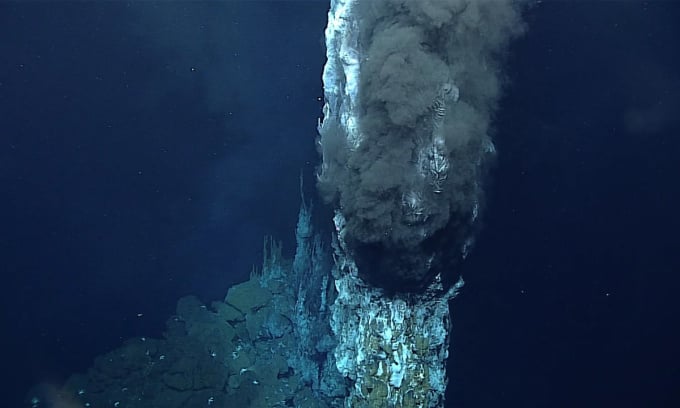
Hydrothermal vents beneath the Mariana Trench in the Pacific Ocean during a 2016 expedition. Photo: NOAA Office of Ocean Exploration and Research
The exact depth is unknown.
Humans have explored the ocean surface for tens of thousands of years, but only about 20% of the seabed has been mapped, according to 2022 NOAA data. Researchers have made numerous efforts to understand the details of the Mariana Trench, but this is not easy. Due to the vastness and record-breaking depth of the ocean floor, they have to rely on sonar technology to try to create a complete picture of the structures beneath.
The first crewed dive in 1960 estimated the Challenger Deep to be 10,911 meters deep, according to the Guinness World Records. With continuously improving measuring equipment and technology, the most recent updated estimate of the Challenger Deep's depth in 2021 is approximately 10,935 meters.
Thu Thao (According to CNN )
Source link






























































































Comment (0)