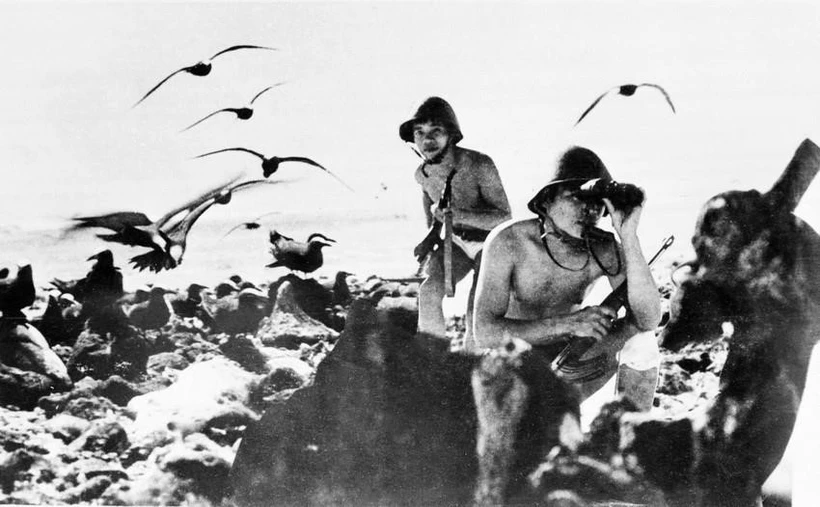
Naval Special Forces Unit 126 liberated Sinh Ton Island in the Spratly Islands on April 28, 1975. (Photo: VNA)
Fifty years after the reunification of the country, the mark of the Special Forces remains deeply imprinted in the golden pages of history.
From the 1948 attack on the Ba Kien bridge watchtower – which laid the foundation for commando tactics – to daring raids at Bien Hoa airport, Nha Be fuel depot, Dong Du (Cu Chi), Bu Bong, Kien Duc, Dau Tieng… and the lightning-fast assaults in the Ho Chi Minh Campaign in 1975, commandos have always been the leading force, striking hard and accurately, achieving resounding victories.
Even in peacetime, these "silent heroes" of yesteryear continue to train diligently, enhancing their combat capabilities, ready to defend sovereignty and fulfill their duty of protecting the nation from early on and from afar.
A series of three articles titled "Ho Chi Minh's Special Forces - 50 Years of Opening Paths and Defending the Nation," produced by VNA reporters, will portray the journey from legendary battles to a modern, courageous, intelligent, and steely-spirited special forces unit.
Lesson 1: Legendary Battles
In 2025, amidst the nationwide jubilation celebrating the 50th anniversary of national reunification, the heroic deeds of the Ho Chi Minh Special Forces are once again being remembered.
But few people know that the foundation for commando tactics was laid in a small battle in Tan Uyen, Binh Duong 77 years ago - the battle at the Ba Kien bridge watchtower on March 19, 1948.
The premise is an unexpected, bold style of play…
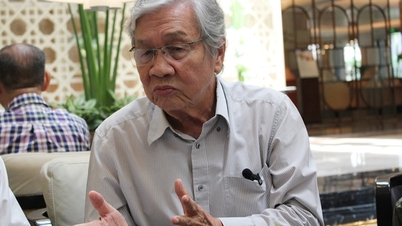
In the historic month of April, under the scorching sun of the Southeast region, we followed Mr. Hoang Van Hien, a former Captain of Battalion 368 in Binh Long province, to visit the Monument commemorating the Victory of March 19th in Tan Uyen (Binh Duong). At 71 years old, his physique remains robust, his voice deep and warm, his eyes distant, as if reflecting the memories of the past.
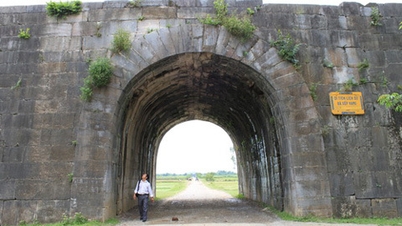
Stopping in front of the historical site, he slowly gestured towards the recently reconstructed Ba Kien Bridge watchtower, his voice firm: "The Ba Kien Bridge watchtower is not just a landmark, but also the birthplace of a legendary military tactic - the commando fighting style."
A native of Thanh Phuoc, Tan Uyen (Binh Duong), Mr. Hien fought on the Binh Long liberation front (Binh Phuoc) and participated in numerous fierce battles in the Southeast region, coordinating with the 429th Special Forces Brigade. For him, the Battle of Ba Kien Bridge was a turning point in military tactics, emphasizing surprise and boldness.
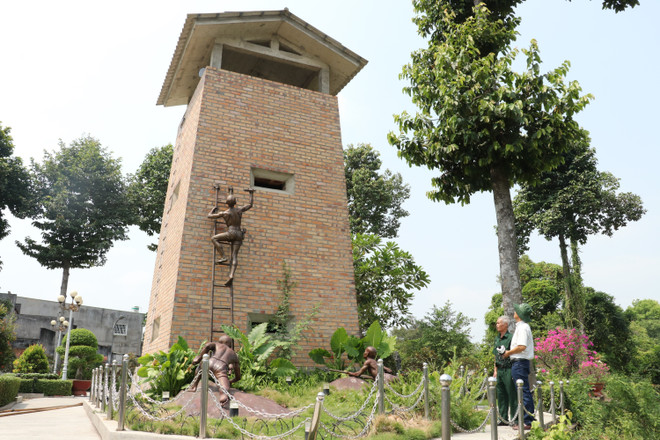
In the historic month of April, under the scorching sun of the Southeast region, we followed 71-year-old Hoang Van Hien, a former Captain of Battalion 368 in Binh Long province, to visit the Monument commemorating the Victory of March 19th in Tan Uyen (Binh Duong). (Photo: Duong Chi Tuong/VNA)
In 1948, the French colonialists built the Cau Ba Kien watchtower in Tan Uyen – a fortified stronghold 12 meters high, with 40-centimeter-thick brick walls, machine guns mounted at all four corners, and guards patrolling day and night. However, the soldiers and people of Tan Uyen remained steadfast and refused to surrender.
On the night of March 18th and the early morning of March 19th, 1948, three guerrilla fighters, Tran Cong An, Ho Van Lung, and Nguyen Van Nguyen, were assigned the task of attacking a watchtower. Their only equipment was a rifle, a bamboo ladder, and 10 grenades (9 homemade). Taking advantage of the enemy changing guards, they crept along the Dong Nai River bank, silently approaching their target. With courage and skillful tactics, they climbed to the upper level and threw the grenades inside.
An explosion ripped through the night; 10 French soldiers were killed, the ammunition depot exploded, the watchtower was engulfed in smoke and flames; the enemy's fortified defenses were breached. Before reinforcements could react, the guerrilla unit retreated safely, taking with them eight rifles and 20 grenades.
For the first time, a group of soldiers with rudimentary weapons destroyed a fortified French stronghold with a surprise, secret, and daring attack. This victory laid the foundation for the birth of the Special Forces.
The origins of special forces
Dr. Nguyen Van Thuy (Binh Duong Historical Science Association) commented: "The victory at the Cau Ba Kien watchtower was not only a successful battle, but also laid the foundation for the art of special forces warfare."
The victory at Ba Kien Bridge is considered the cradle of special forces tactics, opening up a flexible and insidious fighting style. Exactly 19 years later, on March 19, 1967, President Ho Chi Minh signed a decree establishing the Special Forces Corps. Since then, March 19 has become the Traditional Day of the Vietnamese Special Forces.
Based on practical experience, special forces became the spearhead of the offensive in the two resistance wars. They achieved many resounding victories: attacking the Nha Be fuel depot (1963), Bien Hoa airport (1964), the Independence Palace (1968), Dong Du (1969)... Particularly, in the Ho Chi Minh Campaign of 1975, special forces were a crucial spearhead, contributing to the liberation of Saigon and the reunification of the country.
Time has passed, and the old battlefield has changed. The watchtower at Ba Kien Bridge is now located in Du Khanh hamlet, Thanh Phuoc ward, Tan Uyen city, Binh Duong province.
In 2009, the People's Committee of Binh Duong province recognized this place as a provincial-level historical site. The memorial plaque commemorating the victory of March 19th was erected on a 1,800m2 plot of land, becoming a significant site for traditional education. On the plaque, President Ho Chi Minh's words of praise are solemnly inscribed: "Exceptionally elite; Outstandingly brave; Resourceful and daring; Striking decisively and achieving great victories."
The people of Tan Uyen proudly say: "Ba Kien Bridge is not only a historical site, but also reflects the indomitable spirit of the people, and is the birthplace of heroic special forces soldiers."
Today, amidst the tranquility of a young, developing city, the victory of yesteryear still resonates, not only as a glorious chapter in history but also deeply ingrained in the hearts of generations as an enduring symbol of the Ho Chi Minh Special Forces.
The era of Ho Chi Minh's Special Forces
Under the scorching sun of the Southeast region, we visited the 429th Special Forces Brigade, stationed in Phu Giao district, Binh Duong province. Colonel Hoang Van So, the Brigade's Political Commissar, greeted us with a firm handshake and a resolute voice: “Special Forces soldiers are born from hardship, grow up in war, and are tempered through every battle. Steel spirit, masterful technique, and unwavering will – these are the qualities that define the 429th Special Forces.”
“From the early days of hardship to the glorious victories, the Special Forces have always fought under the leadership of the Party, President Ho Chi Minh, and the support of the people. This is what has forged an elite force, capable of covert and surprise operations, making a significant contribution to the nation's victories,” Colonel So shared.
According to him, commando tactics are a continuation of the finest aspects of Vietnamese military art, from Trieu Quang Phuc's "daytime concealment, nighttime attack" strategy, the lightning-fast tactics of the Tay Son rebels, to Yet Kieu's army specializing in riverine raids. However, it was only during the resistance against French colonialism that this method of warfare was established as an independent military branch.
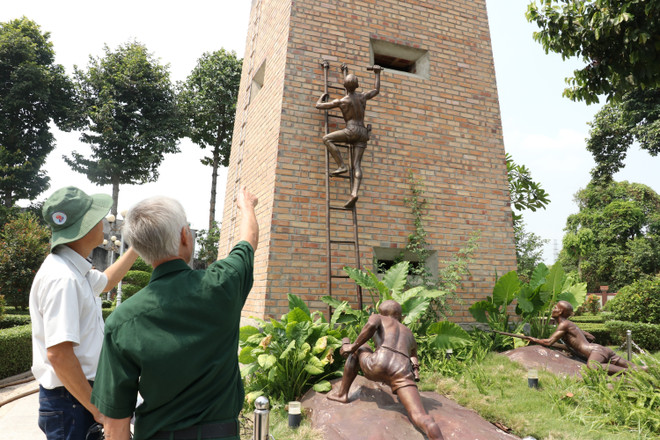
The Ba Kien Bridge watchtower is not just a landmark, but also the birthplace of a legendary military tactic – commando warfare. (Photo: Duong Chi Tuong/VNA)
From the Battle of Ba Kien Bridge in 1948, where guerrilla fighters silently infiltrated deep into enemy territory and threw grenades to completely destroy a French military stronghold, the commando tactics were officially born. These small but daring battles laid the foundation for a unique military strategy.
From then on, the Special Forces became increasingly well-organized, transforming into a primary strike force. They fought according to the principles of "secrecy, surprise, deep penetration, and decisive attack," utilizing the element of surprise to achieve victory with a lean but highly effective force.
Today, the Ministry of Defense continues to build its special forces in a way that is elite, lean, and high-quality. This is a highly elite force, with carefully selected personnel, modern equipment, and rigorous training.
Special forces are distinguished by their flexible combat methods, launching lightning-fast raids on key targets within enemy combat formations, operational deployment areas, and rear-areas.
Not only were they outstanding warriors in the resistance war, but today the Special Forces continue to play a core role in protecting the Fatherland, ready to carry out the task of defending the country early and from afar.
"The spirit of the special forces is to not shy away from difficulties, not fear hardship, and to be determined to complete every mission," Colonel So affirmed.
Half a century after reunification, the value of special forces tactics—strategic, swift, and precise—is clearly evident, contributing significantly to the great victory of Spring 1975. That spirit still burns brightly, forging a modern special forces force ready to firmly defend the nation.
Lesson 2: The Spearhead of the Shock
(VNA/Vietnam+)
Source: https://www.vietnamplus.vn/nhung-tran-danh-huyen-thoai-cua-bo-doi-dac-cong-cu-ho-post1024239.vnp



![[Photo] Secretary of the National Assembly Party Committee, Chairman of the National Assembly presides over the meeting of the Standing Committee and Executive Committee of the National Assembly Party Committee.](https://vphoto.vietnam.vn/thumb/1200x675/vietnam/resource/IMAGE/2026/06/03/1780480353201_ndo_br_bnd-2585-jpg.webp)
![[Photo] General Secretary and President To Lam presides over a meeting with the Central Organizing Committee.](https://vphoto.vietnam.vn/thumb/1200x675/vietnam/resource/IMAGE/2026/06/03/1780482764658_a1-bnd-4741-3342-jpg.webp)
![[Photo] First session of the 14th Congress of the Vietnam Trade Union](https://vphoto.vietnam.vn/thumb/1200x675/vietnam/resource/IMAGE/2026/06/03/1780465947883_ndo_br_img-3852-jpg.webp)







































![[Video] Sunset at Lap An Lagoon – Where the sun sets over the fishing nets](https://vphoto.vietnam.vn/thumb/1200x675/vietnam/resource/IMAGE/2026/05/31/1780192137701_beach-landscape-sea-water-nature-grass-745871-pxhere-com.jpeg)



























Comment (0)