

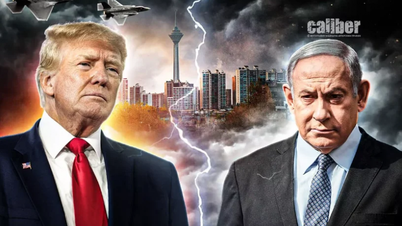
Commenting to Arab News (arab.news) recently, Saudi Arabian researcher Hassan Al-Mustafa, an expert on Islamic movements and relations between Gulf states and Iran, stated that the preliminary "memorandum" between the US and Iran represents a real test of the difficult path toward peace in the Gulf, especially in the context of the current political and security stalemate.
 |
A fuel depot in Tehran, Iran, was hit by an Israeli airstrike on the evening of June 15, 2025. |
This situation puts the Gulf economy , Iran, and even the global economy at risk, potentially causing consequences beyond the energy sector, affecting food, fertilizers, medicines, and many other industries.
Main content of the potential memorandum
According to Al Arabiya, the "memorandum" focuses on several core provisions: strengthening a potentially renewable ceasefire; reopening the Strait of Hormuz within 30 days; removing naval mines; allowing commercial ships and oil tankers to pass through without fees; gradually easing some economic restrictions on Iran, while allowing it to sell some of its oil and potentially access a small portion of its frozen assets abroad. Notably, the memorandum postpones detailed nuclear negotiations to a later stage.
According to researcher Al-Mustafa, this memorandum is not a final peace formula, but rather an attempt to establish a safe path for all parties to transition from war to negotiations. The immediate goal for key regional powers, including Saudi Arabia and Qatar, is to de-escalate the situation and reopen the Strait of Hormuz to ensure the safety of oil tankers and commercial vessels.
A notable development is that the diplomatic process has not stalled despite the US continuing limited attacks on Iranian targets in the south of the country. Washington describes these as "defensive" operations related to threats to US maritime operations or forces, intercepting five attack drones in and around the Strait of Hormuz, and preventing another launch from a ground control station in the Bandar Abbas port area. This indicates that the US continues negotiations while maintaining calculated pressure to assert its strong position.
From Iran's perspective, the country recognizes that continuing to blockade or threaten the Strait of Hormuz would escalate from a bilateral dispute into an international crisis, impacting the energy, insurance, and shipping sectors, and drawing international criticism of Tehran.
The roles of Saudi Arabia, Qatar, and Pakistan
According to expert Al-Mustafa, Saudi Arabia's involvement creates regional balance and establishes a safety net to prevent the Gulf from descending into a new war. Riyadh is interested in preventing the escalation of conflict, protecting Gulf security, and reaffirming freedom of navigation.
Saudi Arabian Crown Prince Mohammed bin Salman participated in a phone call with US President Donald Trump and the leaders of Qatar, the United Arab Emirates (UAE), Bahrain, Jordan, Egypt, Turkey, and Pakistan's military commander, Marshal Asim Munir, to ensure that any agreement with Tehran would be part of an integrated regional security framework, and not simply a deal between the US and Iran.
Saudi Arabia's efforts "resonated" with Qatar's diplomatic activism as a mediator. Discussions between Qatar's Prime Minister and Foreign Minister Sheikh Mohammed bin Abdulrahman Al-Thani and Saudi Arabia's Foreign Minister Faisal bin Farhan focused on achieving a ceasefire and addressing the root causes of the crisis through peaceful means. This meant that Qatar was not acting outside the Gulf framework, but within an integrated approach in which Riyadh provided the broader political framework, while Doha opened channels of communication and managed complex issues with Tehran and Washington.
For Pakistan, its primary mediating role stems from the fact that it is a large country sharing land and sea borders with Iran, as well as its ability to negotiate with Tehran on the basis of "Islamic friendship" and with Washington on the basis of "security interests," while maintaining close ties with Saudi Arabia and Qatar.
Obstacles and the road ahead
Amidst these diplomatic developments, several issues have emerged: First, will Iran's reopening of the Strait of Hormuz happen completely and immediately, or gradually? Second, will the easing of US sanctions, oil restrictions, and the partial lifting of freezes on Iranian assets precede any nuclear commitments from Tehran, or will they be tied to specific steps?
Third, will Iran commit to restraining pro-Tehran militias in Iraq, Lebanon, and Yemen, or will the agreement remain limited to the Hormuz and nuclear issues? And fourth, will President Trump succeed in separating the Iran issue from his desire to expand the Abraham Accords, especially as Saudi Arabia links the recognition of Israel to a credible roadmap toward establishing a Palestinian state as part of a two-state solution consistent with UN resolutions?
Expert Al-Mustafa noted that the roadmap ahead needs to be addressed in stages: first, consolidating the ceasefire and reopening the Strait of Hormuz under international supervision; next, economic solutions to incentivize Iran; then conducting nuclear negotiations with technical guarantees from the International Atomic Energy Agency (IAEA); and finally, building a broader regional framework encompassing ballistic missiles, non-state armed groups, and energy security.
Source: https://baobacninhtv.vn/nhung-tro-ngai-lon-voi-hoa-binh-trung-dong-postid446799.bbg
![[Image] Nearly 125,000 Hanoi students completed the Literature exam for the 10th grade entrance exam.](https://vphoto.vietnam.vn/thumb/1200x675/vietnam/resource/IMAGE/2026/05/30/1780117233041_ndo_br_thiet-ke-chua-co-ten-2-png.webp)
















![[Photo] Admire the coral "masterpiece" amidst the million-year-old heritage of Dak Lak province.](https://vphoto.vietnam.vn/thumb/1200x675/vietnam/resource/IMAGE/2026/05/30/1780107638639_y25-jpg.webp)


































































Comment (0)