

- Nghe An : Two children tragically drowned.
- Minimize drowning accidents among children and students.
- Two male students awarded certificates of merit for saving a young child from drowning.
- Turning a child upside down is a mistake when providing first aid for a drowning child.
Only 8.63% of schools have swimming pools.
According to a report by the Ministry of Labour, Invalids and Social Affairs , between 2015 and 2020, an average of 2,000 children died from drowning each year in Vietnam. Although the number of drowning deaths among children has decreased in recent years, it remains one of the leading causes of death among children.
Between 2020 and 2022, over 500 drowning incidents occurred nationwide, resulting in the deaths of 1,956 preschool and schoolchildren. The 10 localities with the highest drowning rates during this period were: Nghe An, Thanh Hoa, Bac Giang, Quang Ninh, Kon Tum, Dak Lak, Quang Binh, Bac Ninh, Dong Thap, and Hung Yen.
Many factors contribute to drowning accidents among children and students. Besides objective causes such as terrain, floods, and natural disasters, some subjective factors include: children and students lacking water safety skills, and lax or inadequate supervision from family, elders, and schools.
According to statistics from 59 out of 63 Departments of Education and Training, as of the end of 2022, the total number of swimming pools in schools was 2,184 out of 25,307 schools, accounting for 8.63% of schools with swimming pools.
Many localities have invested in building swimming pools in schools, with a considerable number of pools such as: Bac Giang (129 pools); Bac Ninh (80 pools); Lam Dong (80 pools), Ben Tre (75 pools)...
Mr. Nguyen Nho Huy, Deputy Director of the Department of Physical Education (Ministry of Education and Training), said that the investment and use of swimming pools in schools has basically proven effective, gradually meeting the requirements for teaching swimming and water safety skills in some schools. Some schools with swimming pools have flexibly utilized legitimate socialized funding sources for investing in water sources, water treatment, and coordinating the organization of swimming lessons for students according to regulations.
However, many localities still have too few swimming pools in schools. Many pools are dilapidated, the water quality is not guaranteed, and there is a lack of funding and qualified staff to operate them. In some places, the mechanism for attracting private investment in school swimming pools is unclear, and some schools do not have enough land to build a pool…
According to reports from the Departments of Education and Training, the vast majority of physical education teachers are capable of teaching swimming. Currently, nearly 70% of physical education teachers have received training in swimming instruction and drowning prevention and first aid skills. However, the percentage of teachers with certificates/certifications of completion of swimming instructor training issued by the Ministry of Culture, Sports and Tourism is still low compared to the actual needs in many places. This is a common situation in many localities, especially in disadvantaged and mountainous provinces.
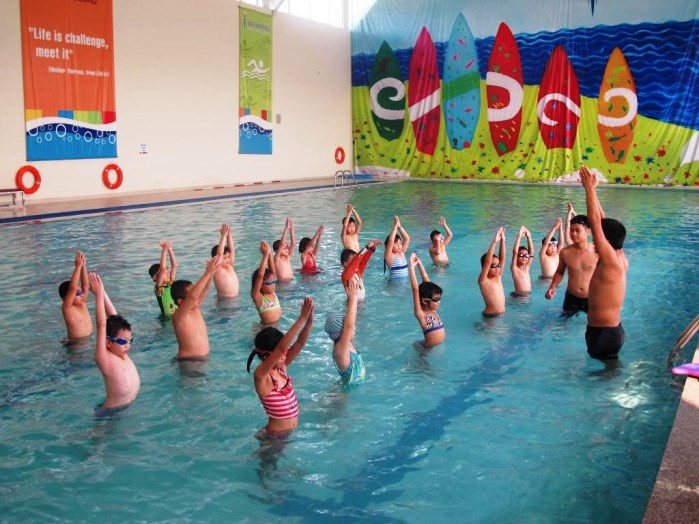
Organize safe swimming lessons and drowning prevention programs in schools.
Introduce swimming into schools.
Despite facing numerous challenges regarding resources and the necessary conditions for organizing swimming lessons for students in schools, localities and educational institutions have devised many creative approaches to incorporate swimming into regular school hours and extracurricular activities.
Some schools with swimming pools have developed specific plans to organize swimming lessons for students as an elective subject in Physical Education during off-hours or extracurricular activities; while also effectively utilizing the swimming pool outside of regular school hours.
Some schools, unable to schedule swimming lessons during regular class hours, organize free swimming classes for students outside of school hours or during extracurricular activities. Swimming instruction has been implemented by schools as part of the elective sports curriculum, and teaching plans are maintained, ensuring the content complies with regulations.
In addition to organizing swimming lessons for students within schools, localities and schools have actively promoted, encouraged, and coordinated with parents to register their children for swimming lessons at off-campus swimming facilities, and assigned teachers to regularly monitor and keep track of students' swimming progress.
Communication and education efforts to prevent drowning have been fully implemented, thereby contributing to raising awareness among parents and students themselves about preventing drowning accidents.
Participating in the implementation of the drowning prevention program for children in 12 provinces and cities, Ms. Doan Thi Thu Huyen, Director of the Campaign for Tobacco-Free Kids in Vietnam (Global Health Policy Advocacy Program), suggested that there is a need for standardized guidelines and materials on teaching safe swimming; guidance to ensure accident and injury prevention for students before, during, and after swimming lessons. In addition, she emphasized the need to promote the teaching of water safety skills, integrating it into formal subjects and extracurricular activities at all levels, prioritizing primary and secondary schools. Simultaneously, she stressed the importance of improving policies and flexible mechanisms for managing, operating, maintaining, and maximizing the capacity of swimming pools, and potentially collaborating with private organizations to implement safe swimming lessons during the summer months when students are on school break. Furthermore, she stressed the need for regular communication to raise awareness and change safe behavior among parents and caregivers, not just during peak periods in the summer months.
Deputy Minister of Education and Training Ngo Thi Minh, Head of the Physical Education Subcommittee of the National Council for Education and Human Resource Development, stated: Teaching safe swimming and preventing drowning in schools is a matter of concern for the whole society. To successfully implement this, the responsibility lies not only with the Ministry of Education and Training but also requires close coordination between schools, families, and society, as well as decisive cooperation and involvement from the education sector and other ministries, sectors, and localities…
Deputy Minister Ngo Thi Minh also noted that the socialization of education needs to be further promoted so that safe swimming instruction and drowning prevention in schools can be implemented more effectively, minimizing drowning accidents among children and students.
Source link



















































































Comment (0)