

A country for cars
Gasoline prices in the U.S. have surpassed the psychologically significant $4 per gallon mark in all 50 states as the repercussions of the Iran war continue to spread.
The United States is perhaps the only country where fluctuations in gasoline prices become news. Monitoring gas prices at gas stations is a characteristic American pastime and often takes on political overtones.
Americans drive a lot because they have to. The new highway system allows for rapid car travel nationwide, but it also reinforces the trend of population decentralization: If you can drive everywhere, you don't need to live near anything.
The lives of the American middle class are inextricably linked to suburban life. Meanwhile, reliance on cheap gasoline is psychologically tied to the middle class's mobility and suburban expansion.
The numbers
Gasoline prices in the US are significantly cheaper than in Europe, where taxes are very high. It's also the cheapest relative to wages among several major countries.
However, this relatively lower price is offset by the much higher consumption of Americans. On average, an American driver consumes nearly 575 gallons per year, about three times more than the average driver in Germany.
For this reason, it is a much more sensitive indicator and has more significant economic implications.
With gasoline prices at $3 per gallon—the average before the Iran war—the annual gas bill would be around $1,725, or $144 per month.
If gasoline prices remain at the current national average of $4.56, that figure would rise to $2,622 per year, or $219 per month.
Thus, the difference between the two options is approximately $900 per driver per year, a significant economic hurdle.
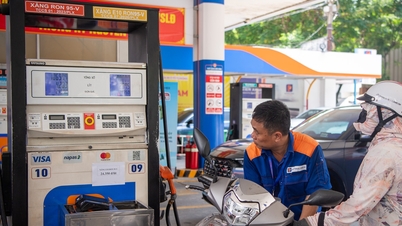
However, the numbers don't tell the whole story. A unique characteristic of America is that gasoline prices are publicly displayed everywhere. Americans frequently encounter giant, illuminated price signs.
The constant presence and attention surrounding gasoline and oil costs make them far more important than other expenses. Rent, health insurance premiums, and grocery bills all rise and attract public attention, but these changes receive less emphasis.
However, gasoline prices have become a constant indicator of economic sentiment. American journalist Ian Bogost described gas station signs as "economic scorecards placed a few blocks apart" and even called gas price signs "a kind of key to understanding American life."
Politics
It's impossible to discuss gasoline prices without mentioning the political aspect. The event that gave gasoline prices their political character was the oil crisis of the 1970s, which was, of course, caused by events in the Middle East.
The 1973 Arab oil embargo and the 1979 Iranian Revolution led to fuel shortages and limited distribution in the United States. There were even odd-numbered license plate rules to determine who could buy gasoline on which days.
These devastating events in a nation heavily reliant on automobiles have sown the ever-present anxieties about energy into American politics.
The memory of those events still resonates in rhetoric today, especially in the context of recent events.
Jimmy Carter is often remembered as a quintessential example of a president during a "gasoline crisis." However, the long lines at gas stations were also associated with presidential incompetence.
Gasoline prices remained high throughout George W. Bush's presidency. By 2008, fuel prices had become a prominent part of the US presidential election debate.
There were even congressional hearings on energy prices and campaign slogans like "Drill oil, drill oil." Both Barack Obama and Joe Biden witnessed soaring gasoline prices during their terms.
The predecessor was in power during the post-2011 price surge following the Arab Spring, while the latter took power during the Russia-Ukraine war and the surge in demand following the Covid-19 pandemic.
That trend may now apply to President Donald Trump as well. A new Fox News poll shows that 58% of respondents consider the cost of living their top economic concern.
Rising gasoline prices will only add to the anxieties. With Trump's overall approval ratings already low, this could cause problems for the President and the Republican Party in the upcoming midterm elections.
This is all the more concerning given that a large proportion of Trump's voters live in rural areas, and therefore rely heavily on cars.
Source: https://giaoducthoidai.vn/noi-am-anh-ky-la-cua-nuoc-my-post779483.html


![[Photo] The heat at the fireworks display site on the opening night of the Da Nang International Fireworks Festival 2026](https://vphoto.vietnam.vn/thumb/1200x675/vietnam/resource/IMAGE/2026/05/27/1779889741485_ndo_br_z7872039145157-fecaba5112f39e8352544099d7ef4738-5140-jpg.webp)
![[Photo] Life on both banks of the river returns to its bustling pace on the day the Long Bien Bridge opens to traffic.](https://vphoto.vietnam.vn/thumb/1200x675/vietnam/resource/IMAGE/2026/05/28/1779949763708_cau-long-bien-minh-duy-7-3610-jpg.webp)
![[Image] Checking the security conditions at the exam site, ready for the 10th grade exam.](https://vphoto.vietnam.vn/thumb/1200x675/vietnam/resource/IMAGE/2026/05/28/1779943458889_z7872507660648-d764421a26e8cd7b61d70d142a48a685-jpg.webp)

































































































Comment (0)