

Context of loosening real estate credit
Facing the risk of overheating real estate credit, the State Bank of Vietnam, from the beginning of the year, has required commercial banks to strictly control the rate of credit growth. According to the operational guidelines, outstanding credit in the first quarter must not exceed 25% of the annual growth target, while the overall credit growth target for the entire system this year is set at around 15%.
However, according to a recent announcement by the State Bank of Vietnam, from January 1st to December 31st, credit institutions will not have to include the additional outstanding loan balance compared to the end of 2025 for loans related to social housing, industrial parks, and export processing zones in the total outstanding real estate loan balance when controlling the credit growth rate in this sector.
The policy aims to facilitate banks in expanding credit capital into priority real estate segments, in line with the policy of developing social housing, industrial infrastructure, and promoting socio -economic growth.
The list of 25 commercial banks subject to this mechanism includes many large banks such as VietinBank, Agribank, BIDV, MSB, Sacombank, Eximbank, Nam A Bank,ACB , Saigonbank, Techcombank, and several others. Data from the first-quarter financial reports of 14 listed commercial banks, which include explanations of their loan portfolios, shows that real estate loans at this group of banks continue to expand strongly, but the allocation strategies of each bank differ significantly.
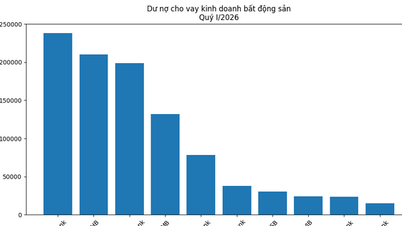
Specifically, in just the first three months of this year, the total outstanding real estate loans (including real estate business loans and construction loans) reached over 1.58 trillion VND, an increase of nearly 7% compared to the end of 2025. This figure reflects the continued attractiveness of the real estate sector to bank capital, despite the market still facing numerous challenges.

Of the total outstanding loans mentioned above, loans for real estate business reached VND 1 trillion (accounting for 63.2%), while loans for construction reached VND 581,068 billion, equivalent to the remaining 36.8%. The top 5 banks, includingSHB , VPBank, Techcombank, MB, and HDBank, held a total of nearly VND 1.18 trillion in outstanding loans, accounting for 74.4% of the total size of the 14 banks surveyed.
Risk awareness
Speaking with a reporter from Tien Phong newspaper , Associate Professor Dang Ngoc Duc, Director of the Institute of Financial Technology at Dai Nam University, analyzed that the decision to expand the credit "room" for real estate stems from the fact that the real estate market is showing signs of slowing down again after a recovery period from the end of 2024 to 2025. Market liquidity has decreased, many projects continue to face difficulties in implementation, while the trend of rising interest rates and strict control of capital flows into real estate from the beginning of 2026 has narrowed the ability of businesses to access capital.

Expanding credit limits for banks with high capital adequacy ratios and strong risk management capabilities is seen as a solution to increase funding for social housing projects, affordable commercial housing projects, and urban infrastructure projects. The goal is not only to support market recovery but also to boost economic growth and mitigate the risk of asset bubbles through selective capital allocation.
According to Mr. Duc, from a macroeconomic management perspective, the Government and the State Bank of Vietnam are striving to balance the goals of growth and financial stability. Expanding credit limits is not being applied universally but only to banks with strong financial capacity, low non-performing loan ratios, and high capital adequacy ratios. This approach aims to support GDP growth while still controlling risks arising from the real estate market.
The real estate market has also seen improved liquidity, enabling businesses to continue project implementation and boost new supply. Simultaneously, the recovery of the real estate sector will create a ripple effect on the construction, materials, interior design, and labor markets, thereby contributing to overall economic growth.
However, Mr. Duc believes that potential risks still need to be closely monitored. "If the market recovers more slowly than expected, the rapid increase in real estate debt could put pressure on the asset quality of banks and increase bad debts. Besides, the abundant credit flow could also lead to localized price increases in some areas, thereby putting pressure on inflation and macroeconomic stability," Mr. Duc said.
Associate Professor Dang Ngoc Duc believes that the State Bank of Vietnam is pursuing a "controlled easing" strategy, both supporting economic recovery and ensuring the safety of the financial system. This approach is consistent with international standards, especially the Basel III risk management framework. However, long-term effectiveness will depend on the supervisory capacity of the regulatory body as well as the market discipline of commercial banks.
To maximize the effectiveness of the policy, Mr. Duc proposed clearly classifying real estate credit according to its intended use, prioritizing capital for social housing and commercial housing serving actual housing needs, and limiting the flow of funds into speculative activities. He also suggested increasing capital requirements and risk provisions for loans related to high-end real estate or projects with incomplete legal documentation. Improving market transparency will help regulatory agencies and credit institutions more accurately assess potential risks, thereby ensuring growth goes hand in hand with financial stability.
Source: https://tienphong.vn/noi-room-tin-dung-bat-dong-san-kiem-soat-the-nao-post1848045.tpo



![[Photo] General Secretary and President To Lam presides over a meeting on preparations for the review of one year of operation of the three-tiered government system.](https://vphoto.vietnam.vn/thumb/1200x675/vietnam/resource/IMAGE/2026/06/02/1780391821195_a1-bnd-4595-9717-jpg.webp)

































































































Comment (0)