

The State Bank of Vietnam (SBV) has recently sent a document to 25 commercial banks regarding the adjustment of the method for determining credit growth for certain priority real estate sectors, including social housing, industrial parks, and export processing zones.
Social housing and industrial zones will benefit.
Accordingly, from January 1st to December 31st, 2026, any additional credit outstanding compared to the end of 2025 for loans in the three aforementioned sectors will not be included in real estate credit outstanding when determining and controlling the credit growth rate of this sector.
This move is considered a significant adjustment in the context of increasing capital demand for social housing and production infrastructure projects. Excluding priority loans from real estate credit limits will create more room for banks to increase lending, thereby supporting social welfare goals, industrial development, and attracting investment.
Ms. Huynh Thi Thu Thao, an analyst at Mirae Asset Vietnam Securities Company (MAS), commented that the State Bank of Vietnam's relaxation of the loan calculation method for some priority real estate segments not only supports capital flows to these sectors but also contributes to improving the liquidity of the entire market.
According to Ms. Thao, the policy's objective is to reallocate capital towards segments serving production, attracting foreign direct investment (FDI), and meeting practical housing needs, instead of flowing heavily into commercial or speculative real estate. This is seen as a positive sign in the context of continued pressure on credit growth across the entire sector. Banks are encouraged to increase lending to social housing, industrial parks, and production infrastructure, but must still comply with the overall credit growth limits controlled by the State Bank of Vietnam.
Data from the State Bank of Vietnam shows that by May 31, 2026, credit across the entire system will increase by 10.4% compared to the end of the previous year, while the increase in the same period of 2025 will only be 7.1%. Despite this, the regulatory body still aims for a credit growth of approximately 19% for the whole year, thereby creating room for the economy to access capital for production, business, and priority sectors. "This policy is seen as a solution to remove bottlenecks for segments in need of capital, while still ensuring risk control for commercial real estate and speculative activities. This is an appropriate regulatory approach in the current context," commented Ms. Thu Thao.
From a business perspective, the general director of a real estate company that is restarting a project after a period of legal complications believes that this information could initially create a positive psychological effect on the market.
According to this expert, the direct impact will primarily affect businesses developing social housing, industrial parks, and export processing zones – sectors that benefit from the new policy. Meanwhile, commercial housing projects are not yet among the priority groups. "However, overall, when credit becomes more active, regardless of the segment, it will spread and have a positive impact on the entire market. This is still a good sign for real estate in the current period," the businessman commented.
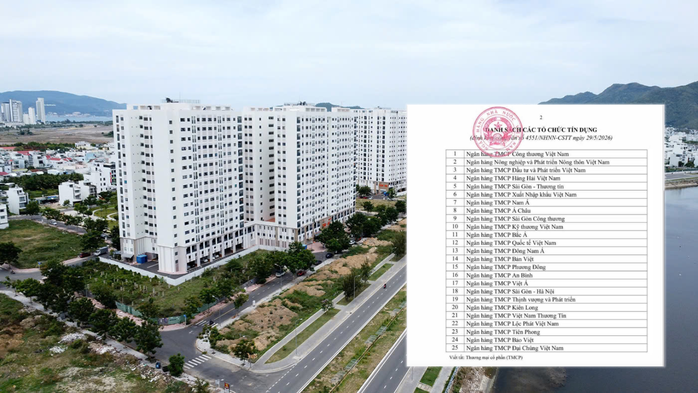
A social housing project in Khanh Hoa . (Small image: List of 25 banks that have been granted increased credit for certain priority real estate sectors. Photo: KY NAM)
Do not exceed the allocated limit.
Speaking with a reporter from Nguoi Lao Dong newspaper, a senior leader of Vietnam Industrial and Commercial Bank ( VietinBank ) said that in 2025, many banks have tightened real estate lending activities, focusing only on disbursing funds for projects with high feasibility and clear effectiveness in order to limit credit risk while the market is still in the recovery process.
However, since the end of 2025, many credit institutions have petitioned the State Bank of Vietnam (SBV) to reconsider the method of determining real estate loan balances. According to the banks, including loans for investment in social housing, industrial parks, and export processing zones in the total real estate loan balance is not entirely appropriate. These are all sectors encouraged by the State to serve social welfare goals, attract investment capital, promote production and business, and boost economic growth. "Perhaps based on this reality, the SBV has adjusted its guidelines in 2026 to exclude the additional loan balance for social housing, industrial parks, and export processing zones from the real estate credit loan balance target," a VietinBank leader commented.
According to him, the new calculation method will give banks more room to lend in the real estate sector. In case they face difficulties expanding credit in other sectors, banks can consider providing funding for real estate projects that are profitable and have a good return on investment.
According to experts, this adjustment to the calculation of real estate credit outstanding may not create a sudden impact on the entire market, but it signals that capital is being directed more towards sectors capable of creating added value for the economy. This is also a step to balance the goal of supporting growth and controlling risks in the context of a real estate market that is still in the process of recovery.
However, relaxing the calculation method does not mean that credit institutions can expand lending without limits. Banks must still strictly adhere to the overall credit growth limits set by the State Bank of Vietnam at the beginning of the year.
According to Circular No. 11686 dated December 31, 2025, from the State Bank of Vietnam, the credit growth target for each bank is determined based on a rating score from 1 to 5, multiplied by a general coefficient of 2.6% applied in 2026. This means that, even with expanded lending space for certain priority segments, the total outstanding credit balance of a bank cannot exceed the allocated limit. For example, if a bank is assigned a maximum credit growth rate of 13% in 2026, its total outstanding loans, including real estate loans, can only increase by a corresponding 13% compared to the end of the previous year. For instance, if the outstanding real estate loan balance at the end of 2025 reached VND 100 billion, the maximum limit in 2026 would only be approximately VND 113 billion. This regulation aims to control risk, prevent excessive capital inflow into real estate, and ensure the stability of the banking system and the financial market.
No more mass credit granting.
According to Mr. Nguyen Le Nam, Director of the Individual Customer Division at Asia Commercial Bank (ACB), the State Bank of Vietnam (SBV) continues to maintain a strict but more flexible approach to credit control in the real estate sector. Mr. Nam emphasized that the current market is no longer suitable for mass credit granting. Instead, banks will focus on developing loan packages tailored to specific customer groups and projects. Appraisal will be based on investment efficiency, repayment capacity, and project feasibility, rather than applying a general template. "ACB is designing credit solutions that meet the actual needs of businesses and individuals. The bank prioritizes projects that are efficient and meet the real needs of the market, rather than expanding credit at all costs," Mr. Nam stated.
Source: https://nld.com.vn/noi-tin-dung-cho-phan-khuc-bat-dong-san-thiet-thuc-196260602211048755.htm
![[Photo] First session of the 14th Congress of the Vietnam Trade Union](https://vphoto.vietnam.vn/thumb/1200x675/vietnam/resource/IMAGE/2026/06/03/1780465947883_ndo_br_img-3852-jpg.webp)
![[Photo] General Secretary and President To Lam presides over a meeting with the Central Organizing Committee.](https://vphoto.vietnam.vn/thumb/1200x675/vietnam/resource/IMAGE/2026/06/03/1780482764658_a1-bnd-4741-3342-jpg.webp)


![[Photo] Secretary of the National Assembly Party Committee, Chairman of the National Assembly presides over the meeting of the Standing Committee and Executive Committee of the National Assembly Party Committee.](https://vphoto.vietnam.vn/thumb/1200x675/vietnam/resource/IMAGE/2026/06/03/1780480353201_ndo_br_bnd-2585-jpg.webp)


























































![[Video] Sunset at Lap An Lagoon – Where the sun sets over the fishing nets](https://vphoto.vietnam.vn/thumb/1200x675/vietnam/resource/IMAGE/2026/05/31/1780192137701_beach-landscape-sea-water-nature-grass-745871-pxhere-com.jpeg)





































Comment (0)