

In Kien Giang , using SUMITRI microbial products to treat rice straw helps supplement nutrients for the fields, reduce costs, protect the environment, and farmers earn nearly 47 million VND/ha in profit.
Add organic matter to the soil.
The Southern Permanent Office (National Agricultural Extension Center) recently collaborated with the Kien Giang Agricultural Extension Center and Phuong Nam Agricultural Development Co., Ltd. to organize a workshop evaluating a model for processing rice straw into fertilizer directly in the field using Crowel M+ organic fertilizer combined with SUMITRI microbial preparation. The model was implemented during the 2024 summer-autumn rice crop at the Vinh Phu Agricultural Cooperative (Vinh Phu commune, Giong Rieng district, Kien Giang province) on a 5-hectare scale, using the OM18 rice variety.
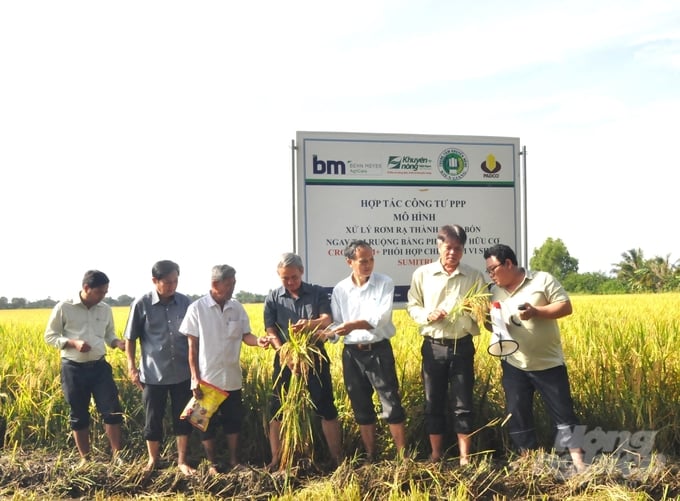
The model of processing rice straw into fertilizer directly in the field using Crowel M+ organic fertilizer combined with SUMITRI microbial preparation in Vinh Phu commune (Giong Rieng district) is very useful and highly effective. Photo: Trung Chanh.
Vinh Phu is a region specializing in rice cultivation with two harvests per year. Farmers often face difficulties in handling rice straw after harvest, leading to organic poisoning. Furthermore, burning rice straw to clean the fields further degrades the soil, affecting productivity, economic efficiency, and causing environmental pollution.
The model using SUMITRI biological products has helped farmers quickly process rice straw in the fields, creating a source of organic fertilizer to supplement soil nutrients and improve rice production efficiency. Accordingly, after harvesting the 2023-2024 winter-spring rice crop, farmers treated the rice straw with SUMITRI at a dosage of 3 kg/ha (selling price 200,000 VND/kg). After 15 days of treatment, the rice straw had decomposed by about 70-80%, becoming a source of organic matter to supplement the fields.
Mr. Pham Xuan Hung, Director of Phuong Nam Agricultural Development Co., Ltd. - the producer and supplier of SUMITRI biological products - said that each kilogram of rice straw, after processing, yields about 0.6 kg of organic fertilizer. Each hectare of rice after harvest leaves about 8 tons of rice straw in the field; processing it will yield nearly 5 tons of organic fertilizer to supplement soil nutrients. Therefore, it helps farmers reduce chemical fertilizer use by about 30% and reduce pesticide spraying by 2-3 times because the rice is less susceptible to pests and diseases.
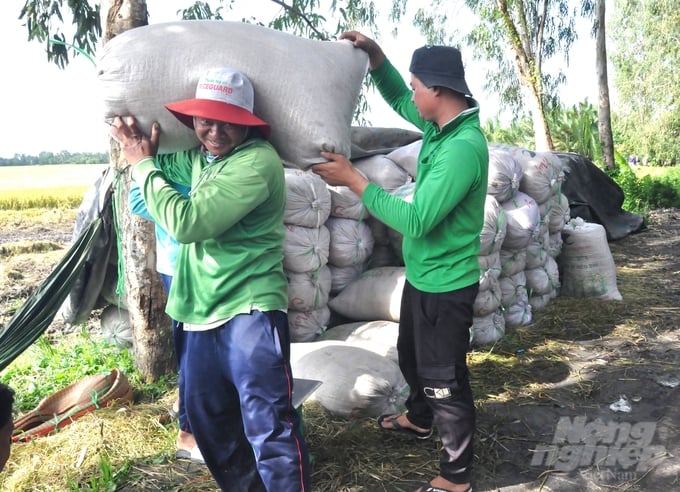
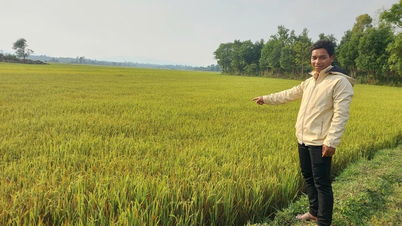
Thanks to the application of SUMITRI microbial products to treat rice straw and supplement organic nutrients to the soil, farmers in Vinh Phu had a hugely successful summer-autumn rice crop, achieving the highest profits. Photo: Trung Chanh.
The results of the 2024 summer-autumn rice crop have brought great joy to the farmers. Field visits revealed a significant difference between fields treated with SUMITRI biological products and untreated fields. The rice plants grew vigorously, forming thick clumps with many effective tillers, producing large, firm grains with a bright yellow color. The rice did not lodge, making it easier to harvest mechanically.
Mr. Du Van Kieu, Director of Vinh Phu Agricultural Cooperative, happily reported that the rice yield in fields treated with SUMITRI biological product reached 7.2 tons/ha (fresh rice harvested by machine), fields combined with additional organic fertilizer reached 8.5 tons/ha, and the control field reached 7.2 tons/ha.
Production costs in the model fields were 20 and 18.5 million VND/ha respectively, thanks to reduced use of chemical fertilizers and pesticides, while the control fields cost 22.2 million VND/ha. The price of rice (OM18 variety) purchased by traders at the field was 7,700 VND/kg. After deducting costs, the model fields achieved profits of 40 and nearly 47 million VND/ha respectively, while the control fields only achieved nearly 33.2 million VND/ha.
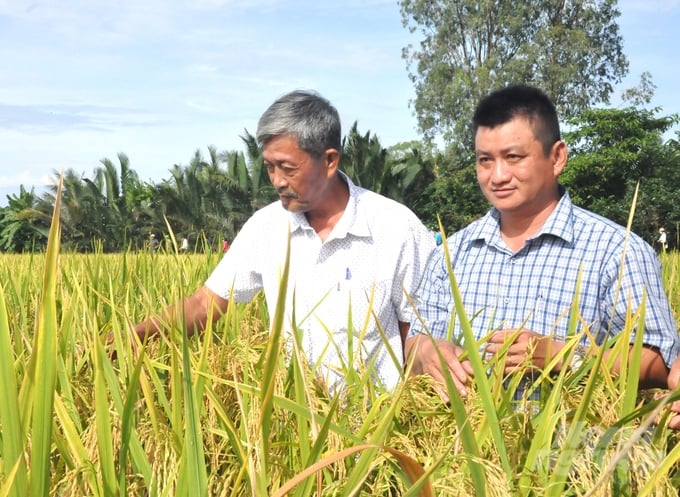
The model of treating rice straw in the field using SUMITRI microbial preparations has provided organic matter to the soil, helping rice grow well, reducing pests and diseases, lowering costs, and achieving high yields. Photo: Trung Chánh.
"Thanks to the application of several techniques in rice production, the fields in the model have reduced production costs, increased productivity, and helped increase profits by 6.8 - 13 million VND/ha, reaching nearly 47 million VND/ha. This is the highest level achieved by farmers here for the summer-autumn rice crop," Director Du Van Kieu said enthusiastically.
Burning straw is like burning money.
Mr. Nguyen Van Kia, a member of the Vinh Phu Agricultural Cooperative, shared: "We farmers have become aware that selling straw is like selling blood, and burning straw in the fields is like burning money. However, because there is no effective method of disposal, we have no choice but to burn it, even though it's heartbreaking to waste it."
After using SUMITRI biological products to quickly process rice straw in the fields, creating a source of organic fertilizer to supplement soil nutrients, the results were clearly visible. Rice production costs decreased, harvest yields increased, and profits were higher. Therefore, Mr. Kia and many other members said they are ready to buy and use SUMITRI biological products to process rice straw instead of burning it as they did before.
Giồng Riềng is a district located in the Western Hau River region, with nearly 47,000 hectares of rice cultivation area, divided into 3 sub-regions. The land here is fertile alluvial soil, with year-round freshwater resources and a complete irrigation system, giving it the potential to develop intensive rice cultivation with 3 harvests per year. For the 2024 autumn-winter rice crop, Giồng Riềng planned to sow 25,000 hectares, but farmers have already planted over 31,000 hectares.
According to Mr. Le Van Chi, Deputy Head of the Agriculture and Rural Development Department of Giong Rieng district, the area planted with autumn-winter rice is mainly in the sub-regions of the district that produce three rice crops per year. Because they grow three rice crops per year, the time between crops is short, putting pressure on farmers to handle rice straw, so they often choose to burn the fields. However, during the rainy season, farmers face difficulties in handling the straw, having to bury it in water, causing environmental pollution. The straw decomposes slowly, leading to organic poisoning for the next rice crop.
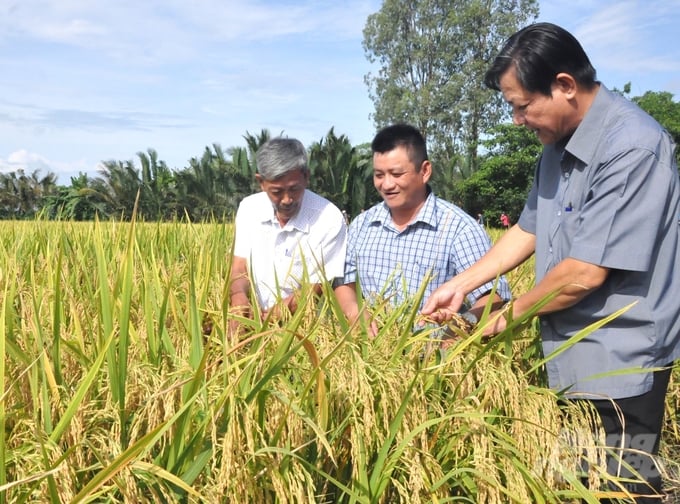
Mr. Nguyen Van Hien (far right), Deputy Director of Kien Giang Agricultural Extension Center, along with farmers, assesses the effectiveness of the model for treating rice straw in the field using SUMITRI microbial products. Photo: Trung Chanh .
According to Mr. Chi, the practical application of the SUMITRI biological product model for rapid straw treatment in the fields of Vinh Phu shows that this is an effective and useful solution, and therefore needs to be replicated and farmers in the district encouraged to adopt it.
Giồng Riềng district has also developed a plan for organic rice production and has policies to support farmers in implementing it. In addition, the district is participating in the project to develop 1 million hectares of high-quality, low-emission rice cultivation linked to green growth in the Mekong Delta by 2030, therefore effective straw disposal solutions and greenhouse gas emission reductions are urgently needed.
According to Nguyen Van Hien, Deputy Director of the Kien Giang Agricultural Extension Center, the agricultural sector has now shifted from production to agricultural economics and responsible agriculture. To implement the agricultural value chain, farmers need to participate in production linkages through farmers' organizations to ensure sufficiently large areas of land, standardized processes, and a large enough volume of goods to meet the needs of businesses.
Therefore, farmers must follow recommended production processes and attend technical training sessions organized by the agricultural sector and extension officers. They should change outdated and environmentally harmful production practices such as burning fields or plowing straw into water for decomposition. Farmers need to keep production diaries to account for costs, calculate efficiency, and determine profits for each crop.
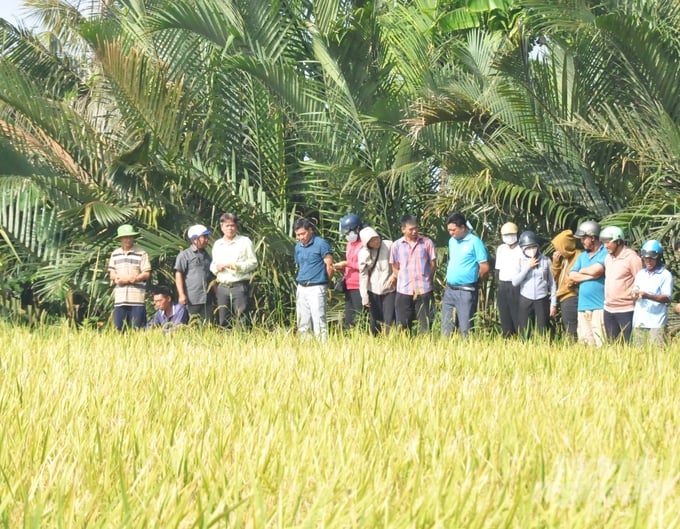
The model of treating rice straw in the field using SUMITRI microbial preparations helps reduce environmental pollution, decrease greenhouse gas emissions, increase rice production efficiency, and improve farmers' income. Photo: Trung Chánh.
One of the requirements of the 1 million hectare high-quality rice project is to remove rice straw from the fields for mushroom cultivation, animal feed, or to implement effective microbial treatment solutions directly in the fields to produce organic fertilizer without emitting greenhouse gases. Therefore, the model of using SUMITRI biological products to quickly treat rice straw in the fields is a new approach that requires technical training for farmers to apply effectively.
Dr. Nguyen Van Bac, Deputy Head of the Southern Permanent Office (National Agricultural Extension Center), assessed: “SUMITRI biological products not only help farmers quickly process rice straw in the fields without causing environmental pollution, but also create a source of supplementary nutrients for the soil to produce rice more efficiently in the next crop. Therefore, local authorities, the agricultural sector, and agricultural extension services need to have policies to support and train farmers' organizations to apply this product to reduce emissions and ensure sustainable rice production.”
Source: https://nongsanviet.nongnghiep.vn/nong-dan-da-y-thuc-dot-rom-la-dot-tien-d394694.html


![[Image] Nearly 125,000 Hanoi students completed the Literature exam for the 10th grade entrance exam.](https://vphoto.vietnam.vn/thumb/1200x675/vietnam/resource/IMAGE/2026/05/30/1780117233041_ndo_br_thiet-ke-chua-co-ten-2-png.webp)


















![The Essence of Viet Bac Villages: [Part 3] The Precious Fragrance of Nghinh Tuong](https://vphoto.vietnam.vn/thumb/402x226/vietnam/resource/IMAGE/2026/05/29/1780020600366_5237-tinh-tuy-ban-lang-viet-bac-bai-3-chuyen-o-nghinh-tuong-050626_700.jpeg)
![The Quintessence of Northern Vietnam's Villages: [Part 2] The Famous Cassava Noodles of Kunming](https://vphoto.vietnam.vn/thumb/402x226/vietnam/resource/IMAGE/2026/05/28/1779937455892_3929-3144-mien-dong-15-nongnghiep-023138.jpeg)
![The Essence of the Village: [Part 1] Wine on the mountain, tea in the clouds - Bang Phuc](https://vphoto.vietnam.vn/thumb/402x226/vietnam/resource/IMAGE/2026/05/27/1779841729178_3821-1jpg-nongnghiep-103814.jpeg)
































































Comment (0)