

Banh Trach commune (Ba Be district) is a mountainous commune with complex terrain. The total length of commune roads, inter-commune roads, and roads from the commune center to the district road is 13.6 km, while the length of inter-village and main village roads is 30 km. Some roads have been concreted, but some village lanes remain dirt roads, making travel difficult during the rainy season. The road system leading to production areas does not yet meet the requirements of production and people's lives.
In particular, despite many difficulties, the households in the commune have united and voluntarily donated land and labor to participate in the construction of local social welfare projects, contributing to the fulfillment of criteria in building new rural areas, especially the rural transportation infrastructure criterion.
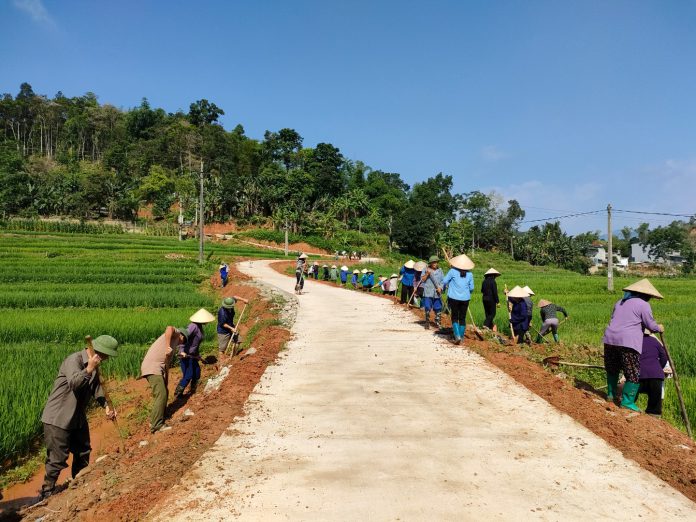
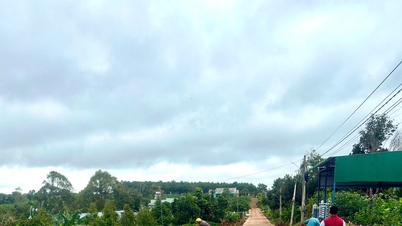
Residents of Ba Be district actively participate in road construction as part of the new rural development program. Photo: Hoang Chuc
According to Mr. Hoang Van Hoan, Chairman of the People's Committee of Banh Trach commune, since starting the New Rural Development program, the commune has only met 5 criteria. However, with the strong determination of the Party committee and government, and the consensus of the people in implementing policies and guidelines, the New Rural Development program in the locality has achieved many remarkable results.
Among the dozens of households that donated land for road construction, it is worth mentioning Mr. Duong Van The (Ban Hon village, Banh Trach commune, Ba Be district), an exemplary Party member who voluntarily donated hundreds of square meters of rice paddies and hillside land to the village for road construction. Mr. The said that his family also donated more than 500 square meters of rice paddies and more than 400 square meters of hillside land to the village to expand the road, helping people transport agricultural products more conveniently.
Speaking to us about the movement to donate land for rural road construction, Mr. Nguyen Van Chung, Head of Ban Hon village, said: "The village has more than 90 households, but they have all set a good example by taking the lead in the rural development movement. What is commendable here is the solidarity and unity; many households, despite being poor or near-poor, still actively participate because of the common goal of 'leading the way, opening the path out of poverty'."
Sharing the same vision of contributing to building a more prosperous and beautiful homeland, Mr. Duong Van Quy (Khuoi Shang village, Banh Trach commune, Ba Be district) voluntarily donated hundreds of meters of land from National Highway 279 into the village. In addition to donating land, Mr. Quy also provided financial support for renting trucks and excavators to transport soil for road construction within the village.
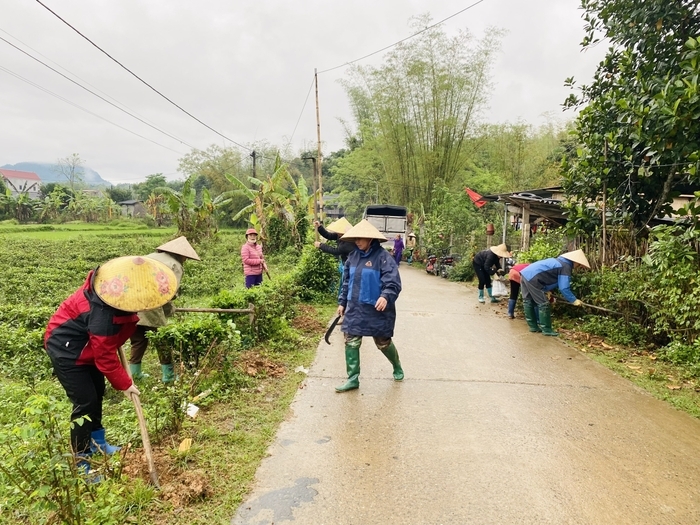
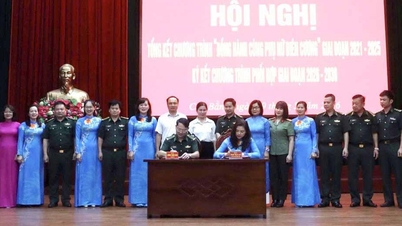
The Women's Association of Bac Kan province is working together to build a model "flower road" in an effort to achieve the goal of becoming a new rural area.
Mr. Quy shared that the lack of a road made travel very difficult. It was manageable in sunny weather, but when it rained, the steep, slippery road made it hard for children to go to school, and even those with vehicles couldn't get to work. To clear the land, his family divided the work into several stages, initially building a road wide enough for two motorbikes to pass easily, then expanding it to accommodate cars. The total cost was over one hundred million dong. Many households in the village are still struggling, so he just kept doing what he could, saving up to build the road. First, it would benefit his family's transportation and goods delivery, and then the villagers would benefit, which made him happy.
According to the leaders of the Ba Be District People's Committee, in the coming time, Ba Be district will continue to focus on investing in opening inter-village roads and forest roads in remote and particularly difficult areas to create favorable conditions for farmers to boost production, especially to promote the development of forest economy and farm economic models. This will create stable jobs and income for farmers, contributing effectively to the socio-economic development of the locality.
Leaving Ba Be district, we arrived in Pac Nam district, where the movement of donating land for road construction and the emulation of working together to build new rural areas are spreading widely, making an important contribution to the results of building new rural areas in the locality.
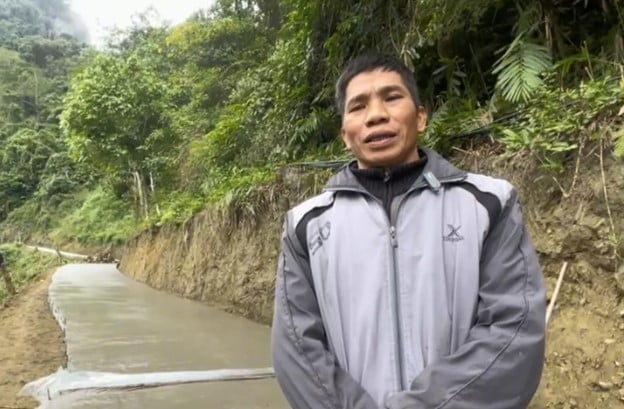
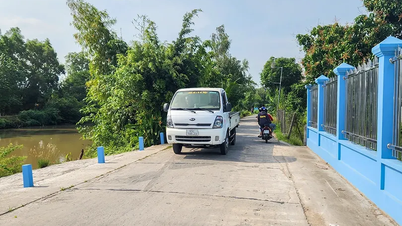
Mr. Ma Van Trinh, Party Secretary of Coc Lai village (Cao Tan commune, Pac Nam district, Bac Kan province), stands beside the newly concreted Coc Lai - Ta Dao inter-village road.
In Cao Tan commune (Pac Nam district, Bac Kan province), we were amazed by the transformation of this new rural area, with investments in electricity, roads, schools, and health stations. The roads from the commune center to the villages have been widened, creating a new look for the place.
Mr. Hoang Van Minh, Chairman of the Vietnam Fatherland Front Committee of Cao Tan commune, said: "Although there are still many difficulties, the commune's new rural development program has received enthusiastic support from the people. The people in the commune have actively built economic development models, self-governance models in residential areas, contributed labor days and cash, and voluntarily donated land for building cultural houses and rural roads..."
For example, recently, the construction of the 1.2km inter-village road connecting Coc Lai and Ta Dao required the acquisition of a significant area of land, over 49,000 square meters, from households in Coc Lai village. However, thanks to effective communication and mobilization efforts, along with a correct understanding of the New Rural Development Program, the villagers wholeheartedly supported the project. To date, the project has been completed and put into use, facilitating travel, trade, and economic development for the people.
According to Mr. Ma Van Trinh, Secretary of the Party Branch of Coc Lai village (Cao Tan), previously the road from Coc Lai village to Ta Dao village was just a dirt path for villagers to travel on. However, after receiving funding from the National Target Program for New Rural Development, along with the contributions and land donations of more than 10 households, the road has been widened to 3 meters. In addition to this road, the village is also building another road in the commune, 5-6 km long, with more than 30 households donating land for its construction.
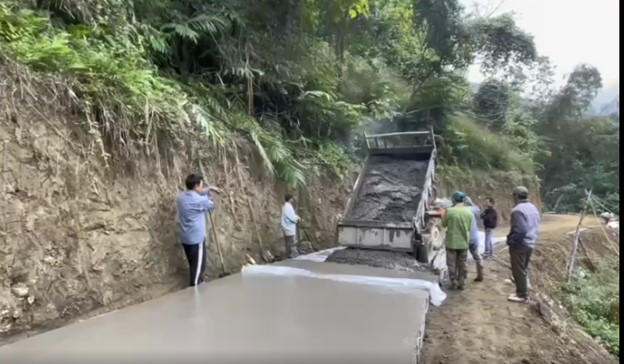
Concrete pouring for the inter-village road connecting Coc Lai and Ta Dao villages in Cao Tan commune.
As one of the households willing to donate land and cut down trees for road construction, Ms. Ma Thi Chuyen shared: "Although every inch of land is precious, I think having a wide, concrete road makes travel easier and promotes economic development, which is far more profitable than donating the land and trees to the village. Therefore, in addition to donating land, my family also voluntarily cut down four teak trees that had been planted for over 10 years to help clear the land for the village to build the road."
The success achieved today is thanks to several pioneering households in the movement to donate land for road construction, such as the families of Ms. Ma Thi Chuyen and Mr. Ma Chu Chinh (Coc Lai Village). In particular, Mr. Chinh's family not only donated a plot of residential land to the village but also contributed an additional 2 tons of cement to help the village complete the road.
"The implementation of the New Rural Development program has brought many practical benefits to our people. Rural and inland transportation infrastructure has been continuously improved and newly constructed, making it convenient for people to develop agricultural economy. As a result, the material and spiritual lives of the people have been constantly improved," Mr. Ma Van Trinh affirmed.
Source: https://danviet.vn/bac-kan-nong-dan-vung-cao-gop-suc-xay-dung-nong-thon-moi-20240622125258735.htm
![[Photo] General Secretary and President To Lam presides over a meeting on preparations for the review of one year of operation of the three-tiered government system.](https://vphoto.vietnam.vn/thumb/1200x675/vietnam/resource/IMAGE/2026/06/02/1780391821195_a1-bnd-4595-9717-jpg.webp)

























































Comment (0)