

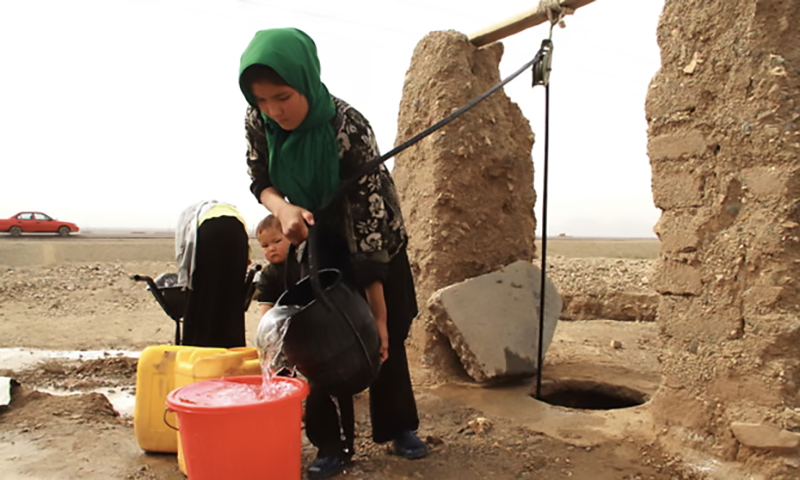
Clean water is becoming increasingly scarce in Afghanistan. Photo: EPA
Analysis shows that high-tech industries are dramatically increasing global water demand. A semiconductor chip manufacturing plant can use approximately 37.8 million liters of ultrapure water per day, equivalent to the needs of about 33,000 American households. TSMC is estimated to have used around 101 million cubic meters of water in 2023, and the demand for water to serve the global chip industry could double by 2035.
In addition, AI and cloud computing data centers are also consuming increasingly large amounts of water. It is estimated that global data centers used approximately 560 billion liters of water in 2024 and this could increase to 1,200 billion liters by 2030.
According to the United Nations, global freshwater demand could exceed supply by approximately 40% by 2030. The Middle East and North Africa, in particular, will face "extreme water stress" by the middle of this century. The World Bank estimates that water scarcity could reduce the region's GDP by 6-14% by 2050.
Alarming global groundwater depletion
An international study based on monitoring data from nearly 43,000 monitoring points in 47 countries has just been published, showing that the world's groundwater resources are severely depleted and imbalanced due to the impacts of climate change and excessive human exploitation.
According to the study, at least half of the monitoring sites showed a disruption in the natural patterns of groundwater. Of these, 29% recorded a decline in groundwater levels, particularly severe in countries like Jordan and India. Scientists warn that this situation could lead to a range of environmental, economic , and social consequences, from water shortages and reduced agricultural production to damage to infrastructure.
Research shows that the main causes stem from the over-exploitation of groundwater to serve agricultural production, industrial needs, and urban living requirements, while climate change is causing erratic rainfall patterns and more prolonged droughts.
Afghanistan is suffering from a severe water shortage.
A report recently released by the United Nations Development Programme (UNDP) indicates that the water crisis in Afghanistan will worsen by 2025, with droughts nearly doubling compared to 2024. According to the UNDP, the number of reported non-functioning or dried-up water sources will triple between 2024 and 2025, and the national rate of access to drinking water will fall from 59% to 44%.
The report states that drought has become the primary environmental stressor across most parts of Afghanistan, affecting the lives of 92% of households.
Most of Afghanistan's 44 million people depend on agriculture, so water scarcity could have devastating consequences in a country already facing widespread poverty, food insecurity, and conflict.
The national crisis in South Africa
South African President Cyril Ramaphosa recently stated that water supply challenges constitute a "national crisis." Ramaphosa emphasized that the urgent goal for all levels of government is to find solutions to the water shortage.
Similar to the rolling blackout measures aimed at reducing the load on the power grid, South Africa is now also implementing a timed water allocation system in certain areas. Many major cities such as Johannesburg, Pretoria, and Nelson Mandela Bay frequently experience prolonged water supply disruptions.
BOX:
Invest heavily in water infrastructure.
Gulf countries are expected to invest approximately $76 billion in the water sector, while desalination capacity in the region could increase by 37% over the next five years. Total public-private spending related to water in the Gulf could reach around $100 billion, with desalination alone accounting for approximately $32 billion by 2027.
Meanwhile, Israel has emerged as a hub for water technology, with its water technology exports worth approximately $2 billion annually.
NATIONAL DAY (Compilation)
Source: https://baocantho.com.vn/nuoc-tai-san-chien-luoc-toan-cau-a205404.html


![[Image] Hanoi's urban life under the challenge of a "scorching hot" environment](https://vphoto.vietnam.vn/thumb/1200x675/vietnam/resource/IMAGE/2026/05/25/1779706979265_nang-nong-t5-2026-minh-duy-7-4636-jpg.webp)
![[Image] Close-up view of the interchange connecting the two expressways and Long Thanh Airport.](https://vphoto.vietnam.vn/thumb/1200x675/vietnam/resource/IMAGE/2026/05/25/1779703378210_ndo_br_z7863716673926-224453a31600126cce10622af6290afd-4549-jpg.webp)



























































































Comment (0)