

 |
Jensen Huang, CEO of Nvidia, attends an event in Taipei on May 27. Photo: Bloomberg . |
Scheduled to take place in Taiwan starting June 2nd, Computex 2026 is one of the biggest technology events globally. This year, Computex's focus continues to revolve around AI, prominent issues such as the chip supply crisis, and the challenge to Nvidia's dominance.
Once a hub for major computer companies, Computex has now become a showcase for many new AI trends. Hardware companies are receiving massive investments from companies like Meta and OpenAI, creating the next generation of leaders and billionaires.
Despite its positive impact, the AI boom has also raised concerns that profits will be concentrated in small businesses and highly skilled workers, while the rest of the sector may fall behind.
Challenging Nvidia's reign.
Intel is experiencing a resurgence under CEO Lip-Bu Tan. He has forged a close relationship with U.S. President Donald Trump, helping Intel rebuild its position as a leading chip manufacturer in the United States. The company's stock price has increased sixfold over the past year.
According to Bloomberg , Intel's return could threaten Nvidia's leading position. This isn't the only competitor, as Cristiano Amon, CEO of Qualcomm, will announce new plans in the AI field.
Previously, Qualcomm reached an agreement to supply data center chips to ByteDance. This is Qualcomm's latest move to expand its business from smartphone chips to AI infrastructure.
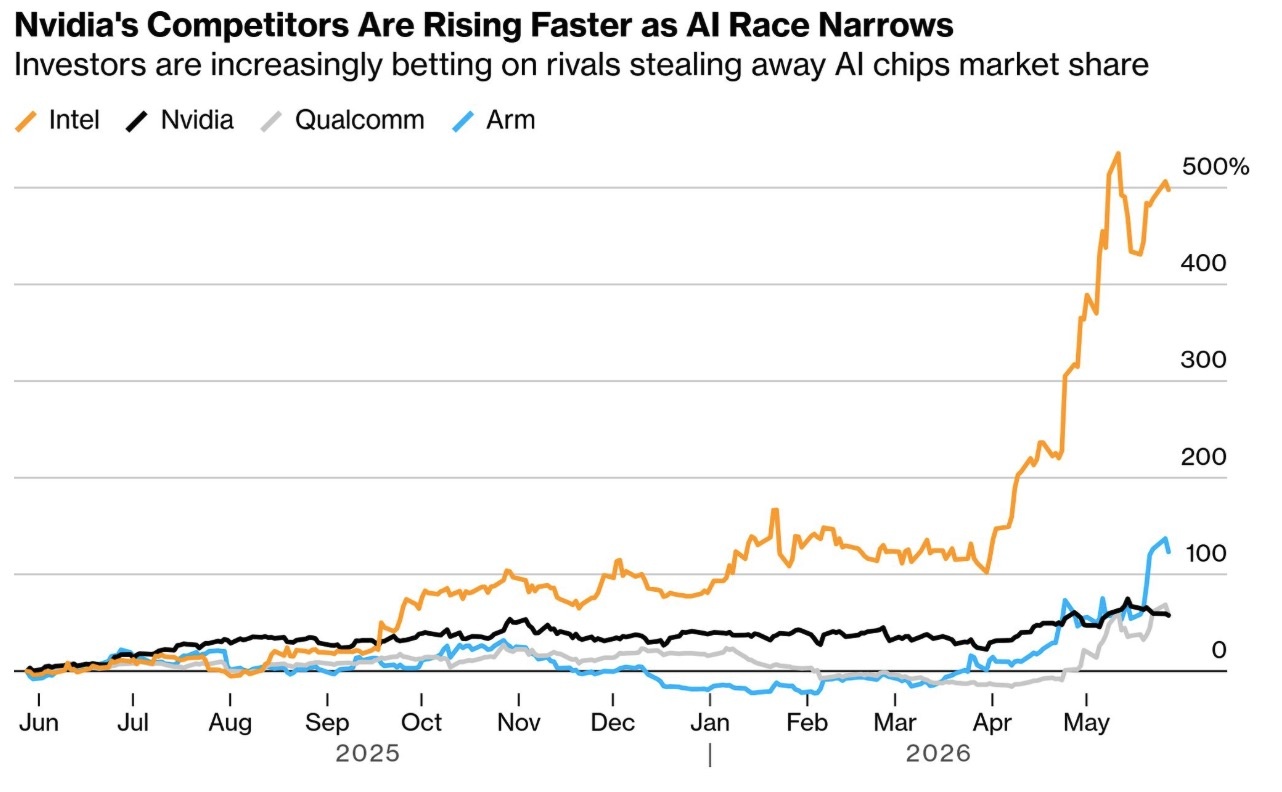 |
Stock growth of Nvidia and some competitors over the last 12 months. Photo: Bloomberg . |
Arm is also joining the race, with CEO Rene Haas expected to announce plans to sell chips developed in-house. Having previously designed semiconductor blueprints and architectures for Qualcomm, Apple, and MediaTek, Arm's move to manufacture its own chips shows it will compete directly with major clients.
The supply chain crisis shows no signs of ending. On May 28th, Emily Hong, President of Wiwynn Corp, one of Nvidia's largest server manufacturers, emphasized that the situation could last until the end of 2027. She assessed that demand for data center hardware will remain very high for the next 3-5 years.
Speaking to Bloomberg , Hong said that production disruptions haven't occurred yet, but costs are rising sharply. The company needs more capital to keep its business running.
According to data from IDC , the memory chip market is expected to double in revenue, reaching $595 billion this year. Large-scale cloud service providers are willing to pay high prices to secure supply.
 |
Micron has just joined the group of companies with a market capitalization of $1 trillion thanks to high demand for memory chips. Photo: Bloomberg . |
The surge in profits helped Micron and SK Hynix reach a market capitalization of $1 trillion , along with Samsung Electronics, but it also caused significant discord among the workforce, who felt their bonuses were not commensurate with the growth rate.
Beyond memory, industry leaders are also concerned about CPU shortages due to the proliferation of inference AI and agent platforms, in addition to network chips for data transmission.
Optical connectivity is becoming the new trend in the market. Nvidia's upcoming Vera Rubin platform could boost the demand for high-speed data transmission. This has caused the stock prices of some companies, such as Nokia, to surge, even those previously unrelated to AI infrastructure.
"We'll see AI infrastructure and physical AI dominate the show. This is a combination of diversification and a desire to capture the rapidly growing AI market," commented analyst Anshel Sag from Moor Insights & Strategy .
The problem for computer manufacturers
Geopolitics also became an "undercurrent" at the exhibition, although it was unlikely to be mentioned by the leaders on stage.
According to Bloomberg , China's future role remains uncertain. The ambitions of the world's most populous nation in AI and chip manufacturing are causing concern within the US administration amid escalating geopolitical tensions.
On May 26th, Huawei attracted attention when it announced a roadmap to narrow the gap with TSMC. This achievement was made despite the US restricting China's access to advanced chip manufacturing equipment.
This will be a topic of great interest at the exhibition, with questions likely revolving around Huawei's ability to compete with TSMC and Nvidia.
The AI wave has also helped computer companies grow. Thanks to expansion into infrastructure, Dell's stock recorded its strongest gain since returning to the stock market in December 2018.
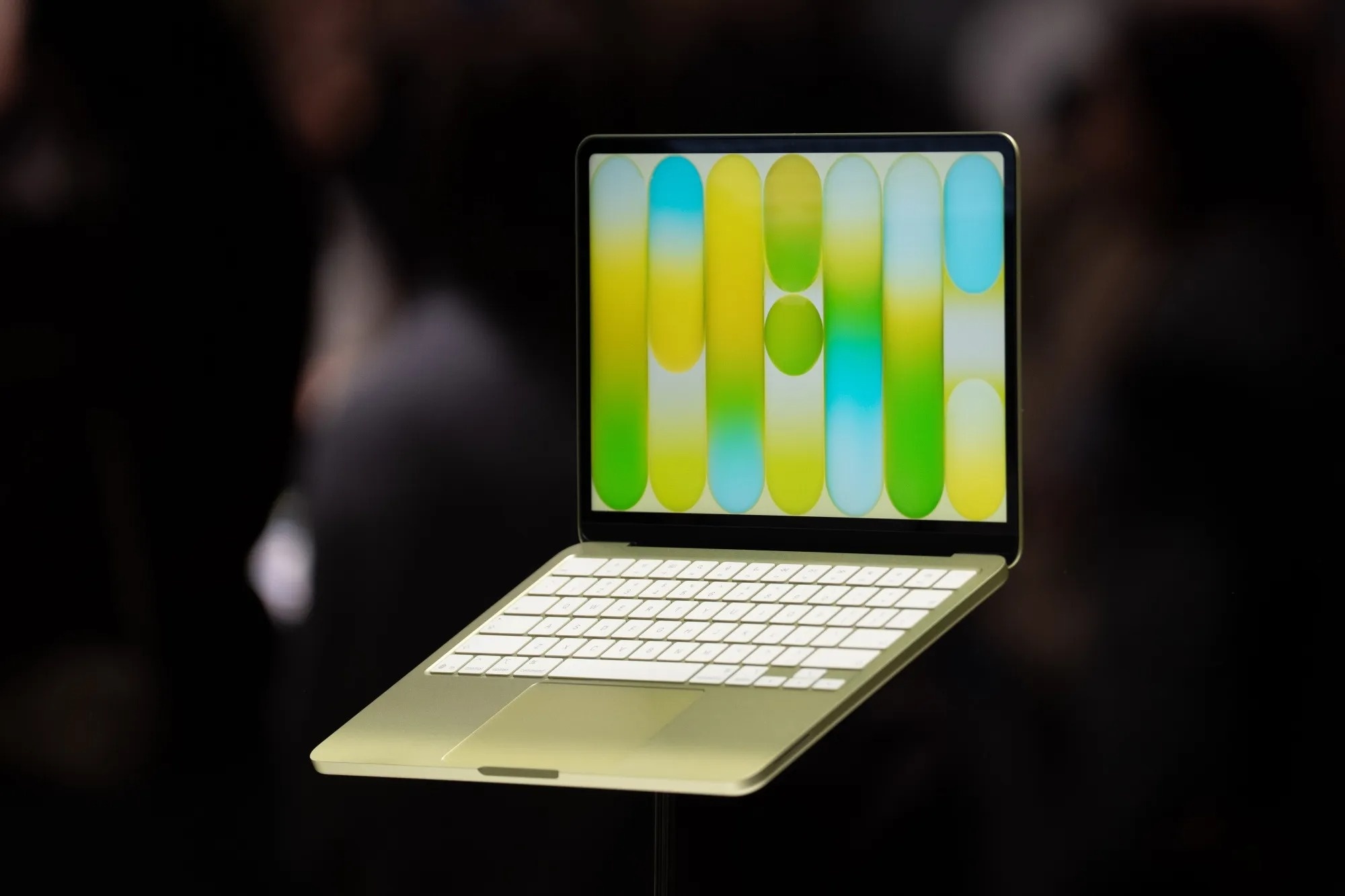 |
The MacBook Neo has become a problem for the PC industry. Photo: Bloomberg . |
In May, Lenovo's stock price surged 105%, its largest monthly increase since 1999. This growth was driven by strong AI revenue, offsetting pressure from rising component costs.
The traditional personal computer market is attracting attention as Apple unexpectedly enters the budget laptop segment. The $600 MacBook Neo initially recorded good sales, putting pressure on competitors in a context where profit margins for low-cost products are quite low.
Data from inSpectrum shows that the spot price of some memory products has increased by more than 600% over the past year. Only a few large companies like Apple or Lenovo have been able to control costs and keep prices stable.
"The MacBook Neo is a major problem for the PC industry. PC manufacturers are expected to respond at the show," said Bryan Ma, research director at IDC .
Source: https://znews.vn/cho-doi-gi-tai-computex-2026-post1655460.html
![[Image] Hanoi Police officially crowned champions of V-League 2025/2026](https://vphoto.vietnam.vn/thumb/1200x675/vietnam/resource/IMAGE/2026/05/31/1780244769054_ndo_br_039d561b692be875b13a-jpg.webp)
![[Photo] Admire the coral "masterpiece" amidst the million-year-old heritage of Dak Lak province.](https://vphoto.vietnam.vn/thumb/1200x675/vietnam/resource/IMAGE/2026/05/31/1780221235105_anh-man-hinh-2026-05-31-luc-16-53-27.png)

![[Photo] Solemn bathing ceremony and Buddha procession in Hue](https://vphoto.vietnam.vn/thumb/1200x675/vietnam/resource/IMAGE/2026/05/31/1780228263543_1-jpg.webp)

![[Photo] The General Secretary, President and his wife begin their state visit to the Philippines.](https://vphoto.vietnam.vn/thumb/1200x675/vietnam/resource/IMAGE/2026/05/31/1780230559452_anh-man-hinh-2026-05-31-luc-19-28-11.png)








![[Video] Sunset at Lap An Lagoon – Where the sun sets over the fishing nets](https://vphoto.vietnam.vn/thumb/340x192/vietnam/resource/IMAGE/2026/05/31/1780192137701_beach-landscape-sea-water-nature-grass-745871-pxhere-com.jpeg)






































![[Photo] Admire the coral "masterpiece" amidst the million-year-old heritage of Dak Lak province.](https://vphoto.vietnam.vn/thumb/402x226/vietnam/resource/IMAGE/2026/05/31/1780221235105_anh-man-hinh-2026-05-31-luc-16-53-27.png)






























Comment (0)