
This is a 4-star OCOP product from Cu Nham Fish Sauce Co., Ltd.
Nowadays, with an increasingly competitive market and constantly changing consumer behavior, the OCOP (One Commune One Product) designation is no longer a "guaranteed ticket" for product sales. After the initial phase of the OCOP program, businesses are forced to enter a new race in terms of quality, branding, technology, and market capacity if they want to go further, especially in non-traditional markets.
After more than 7 years of implementing the "One Commune, One Product" program, Thanh Hoa has gradually formed an ecosystem of distinctive products bearing the strong imprint of the locality. Many businesses and cooperatives have boldly invested in technology, improved packaging, and standardized production processes to enhance the competitiveness of OCOP products.
With the desire to bring teas with natural flavors closer to consumers, in 2022, Anh Khoi Trading and Manufacturing Joint Stock Company invested in a modern production line to develop tea products that meet OCOP 3-star standards, such as centella tea, thorn tea, and gynostemma tea.
Currently, the company's products are available at over 8,000 points of sale through supermarket and post office systems in the Southern region. By 2025, the company aims to produce and sell over 50,000 products through direct distribution channels and e-commerce platforms. In particular, to target demanding markets such as Japan, the Philippines, and Northern Europe, the company is focusing on developing standardized raw material areas to ensure traceability.
Mr. Le Tam Son, Director of Anh Khoi Trading and Manufacturing Joint Stock Company, said: “The company is currently capable of exporting to smaller markets, but the goal is to target larger markets. Therefore, we are completing a raw material area of about 5 hectares and investing in a standard factory to meet export requirements.”

The tea bag production line of Anh Khoi Trading and Manufacturing Joint Stock Company.
While Anh Khoi chose to upgrade the quality of its raw material sources and invest in technology, Fuwa Biotech Co., Ltd. made its mark by exploiting the value of agricultural by-products. Utilizing the abundant pineapple peel resources in Thanh Hoa, the company transformed what would otherwise be discarded into environmentally friendly biological products using Korean production technology.
After a three-month biological fermentation process combined with natural ingredients, Fuwa Biotech has developed more than 20 essential household products. To date, the company's products have achieved OCOP 3-star and 4-star ratings and have been exported to 11 countries, including the United States and Japan. Currently, the company has developed three branches in Hanoi, Ho Chi Minh City, and the Federal Republic of Germany.
According to Mr. Le Duy Hoang, Director of Fuwa Biotech Co., Ltd., the company is continuing to complete international certifications to expand its market to Europe, South Korea, and many other countries.

A production area of Fuwa Biotech Co., Ltd.
Notably, many OCOP entities currently experiencing strong growth no longer view OCOP merely as a title, but rather as a "passport" to enter a larger competitive arena.
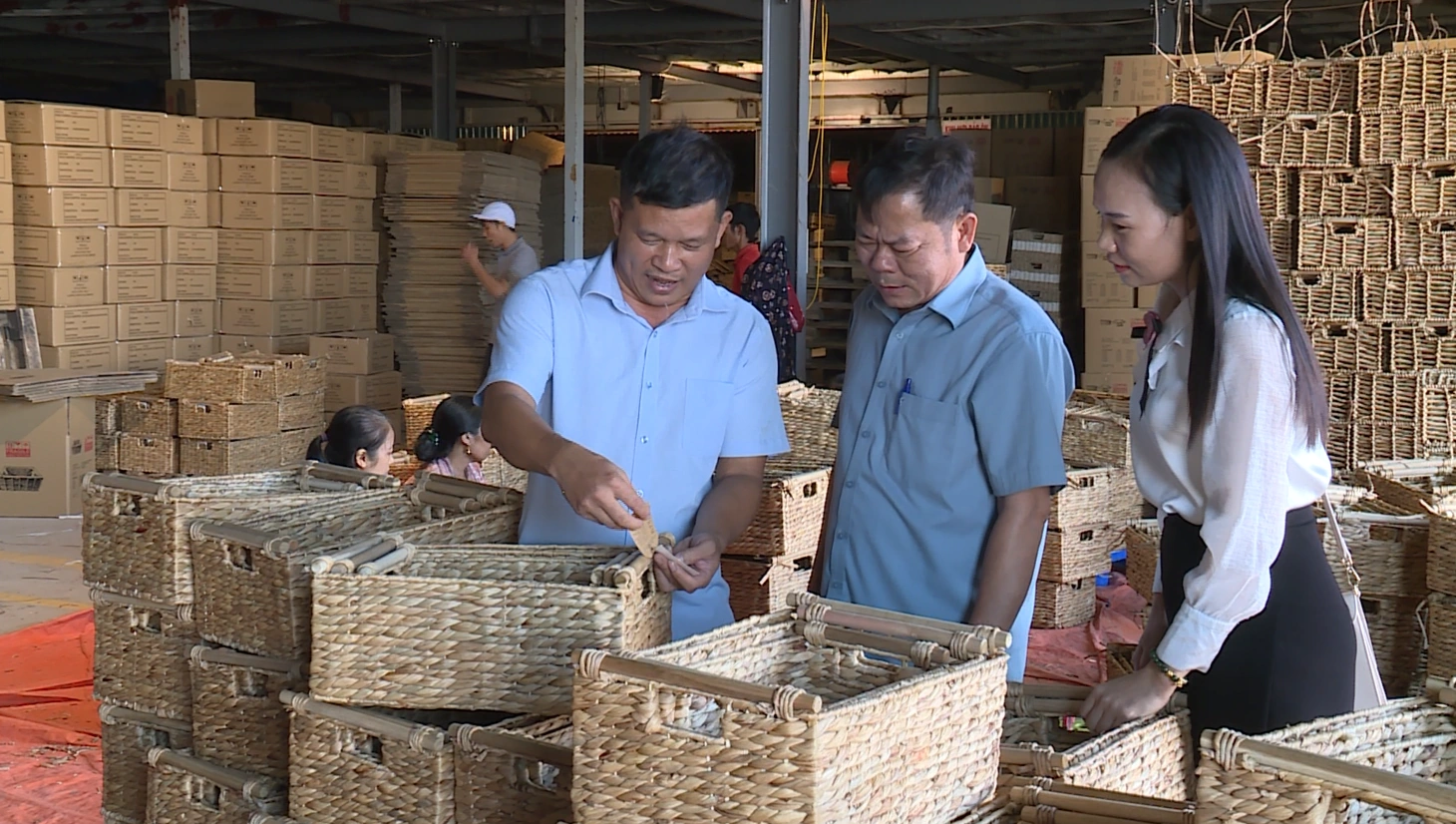
From another perspective, agricultural processing businesses view investment linkages and deep processing as key to enhancing competitiveness. Mr. Le Truong Tung, Director of Trung Thanh Agricultural Processing Joint Stock Company in Te Loi commune, shared: "Our company's main markets are Russia and Romania. We have year-round contracts with supermarkets; the cost isn't high, but it's consistent. In reality, to enter international markets, our products must meet standards – standards to compete globally, standards that ensure we are at least on par with, if not better than, other countries. I really like going to demanding markets; their strict standards guide us towards achieving excellence, from input to output, from product quality to packaging and even the labels." Therefore, for OCOP products to have the potential to reach a wider market, more large enterprises need to partner in investing in raw material areas and modern processing technology.

Canned pineapple production by Trung Thanh Agricultural Products Processing Joint Stock Company.
The OCOP program has given a significant boost to Thanh Hoa's rural economy. Hundreds of products are effectively exploiting the advantages of local raw materials, linked with geographical indications, collective trademarks, and local cultural values to expand their consumer markets.
However, the biggest bottleneck currently remains market capacity and digital transformation capabilities. The majority of OCOP (One Commune One Product) entities are small businesses, cooperatives, or household producers with limited scale; they lack human resources in e-commerce, digital marketing, and branding. Many units are still struggling to build product image on digital platforms, lack multi-platform sales skills, and have not yet created a sustainable customer ecosystem.
Notably, while consumer behavior is changing dramatically, many OCOP products are still promoted in traditional ways. Today's consumers not only buy products but also care about the brand story, digital experience, and cultural value behind the product. Without creating sufficiently deep interaction in the digital environment, OCOP products can easily get lost in the "sea" of online goods.
To promote and spread OCOP products, Thanh Hoa province has maximized the effectiveness of its digital infrastructure and modern communication channels to bring OCOP products closer to consumers. Promotion through electronic screens and large billboards in many provinces, cities, tourist areas, and airports, combined with digital platforms such as social media and e-commerce sites, has helped local products reach a wide domestic market and gradually expand internationally.
Traceability labels for orders shipped to the US by Viet Anh Export Processing and Manufacturing Joint Stock Company.
According to a survey of 32 OCOP products promoted on large screens, many products recorded impressive growth in both revenue and volume. For example, Le Gia fish sauce saw a 57% increase in revenue and a 42% increase in customers outside the province; Le Gia shrimp paste saw a 42% increase in revenue and a 74% increase in customers outside the province. TH fish sauce concentrate also achieved a growth of approximately 30% in revenue, while the number of customers outside the province increased by about 50%.
In the race for the digital market, the OCOP program cannot simply focus on increasing the number of products that receive star ratings. What the market needs more are brands with genuine identity, competitiveness, and the capacity to enter the global value chain.
As the market becomes increasingly demanding, "reinventing oneself" is no longer an option, but a survival requirement for OCOP producers. Only by overcoming the limitations of small-scale production thinking, boldly investing in technology, digital transformation, and building long-term brands, can Thanh Hoa's OCOP products truly "reach the global market."
Thuy Luong
Source: https://baothanhhoa.vn/ocop-lam-moi-minh-de-ra-bien-lon-288591.htm


























![[Infographics] List of diseases requiring vaccines and biological products in mandatory immunization.](https://vphoto.vietnam.vn/thumb/402x226/vietnam/resource/IMAGE/2026/05/23/1779529325271_infographics-da-w1200t0-di2620d272d6160707t11600l1-cover8.webp)


























































Comment (0)