

Preserve the greenery under the canopy of the ancient forest.
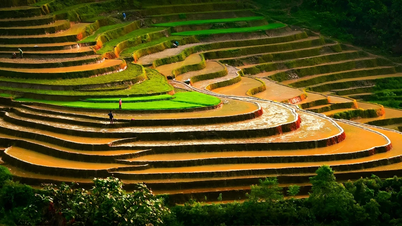
The road leading to Panhou Retreat winds through bamboo forests, terraced rice fields, and houses peeking through the mist. The deeper you go, the more tranquil the atmosphere becomes. The scent of damp earth, wood, and medicinal leaves mingled with the mist, giving you the feeling of having escaped the hustle and bustle of life and returned to pristine nature.
Panhou Retreat is located in Lang Giang village, Thong Nguyen commune, Tuyen Quang province. This resort was recently honored by the World Travel Awards as the "Leading Green Resort in Asia 2025," surpassing many candidates from Japan, Thailand, and Indonesia.
But what many visitors remember about Panhou is not its international accolades, but the rare sense of peace amidst the vast wilderness.
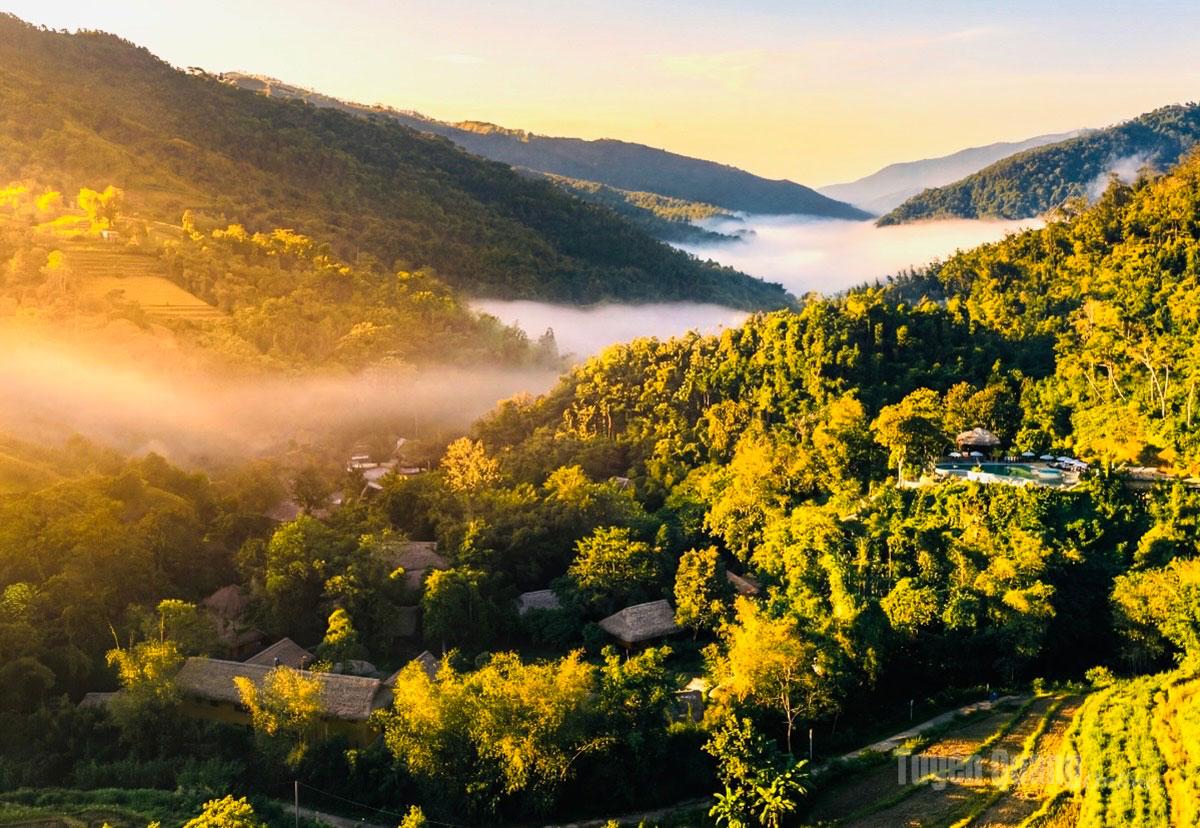 |
| Panhou Retreat is nestled amidst the vast pine forests in the early morning mist. |
The entire resort is designed based on the traditional architecture of the Red Dao people. The thatched-roof bungalows, earthen-walled houses, and small stone-paved pathways winding around tree trunks all utilize local materials such as bamboo, wood, stream stones, compacted earth, and thatched roofs. The open spaces welcome natural light and mountain breezes, creating a rustic yet sophisticated atmosphere.
What's even more remarkable is its operating philosophy, which is closely tied to nature. Panhou prioritizes the use of solar energy, wastewater treatment using eco-friendly technology, minimizing plastic waste, using locally sourced organic agricultural products, and pursuing the 3R model: reduce, reuse, recycle.
At Panhou, the naturally growing trees are preserved, and the pathways are designed to "huddle" with the forest's contours rather than clearing the forest to expand the space. In the morning, from the veranda of the guesthouse, visitors can see the mist lingering over the terraced rice fields. In the afternoon, sunlight filters through the bamboo forest, casting a golden glow on the small stone paths. At night, the sound of the stream blends with the chirping of insects, creating a peaceful symphony that many city dwellers have long forgotten.
Few people know that behind that peaceful setting lies a journey of over 20 years pursuing a sustainable tourism model in the high mountains by the founders of Panhou Retreat. Instead of rapid expansion, the resort chooses a slow growth approach, preserving the original landscape as much as possible and prioritizing harmony with nature.
According to Mr. Vu The Phuong, Chairman of the People's Committee of Thong Nguyen commune, many years ago, the people here mainly relied on agricultural production and natural resource exploitation. With the development of ecotourism, especially with models like Panhou Retreat, people have gradually changed their perceptions, understanding that preserving the forest is also about preserving a long-term livelihood for the community.
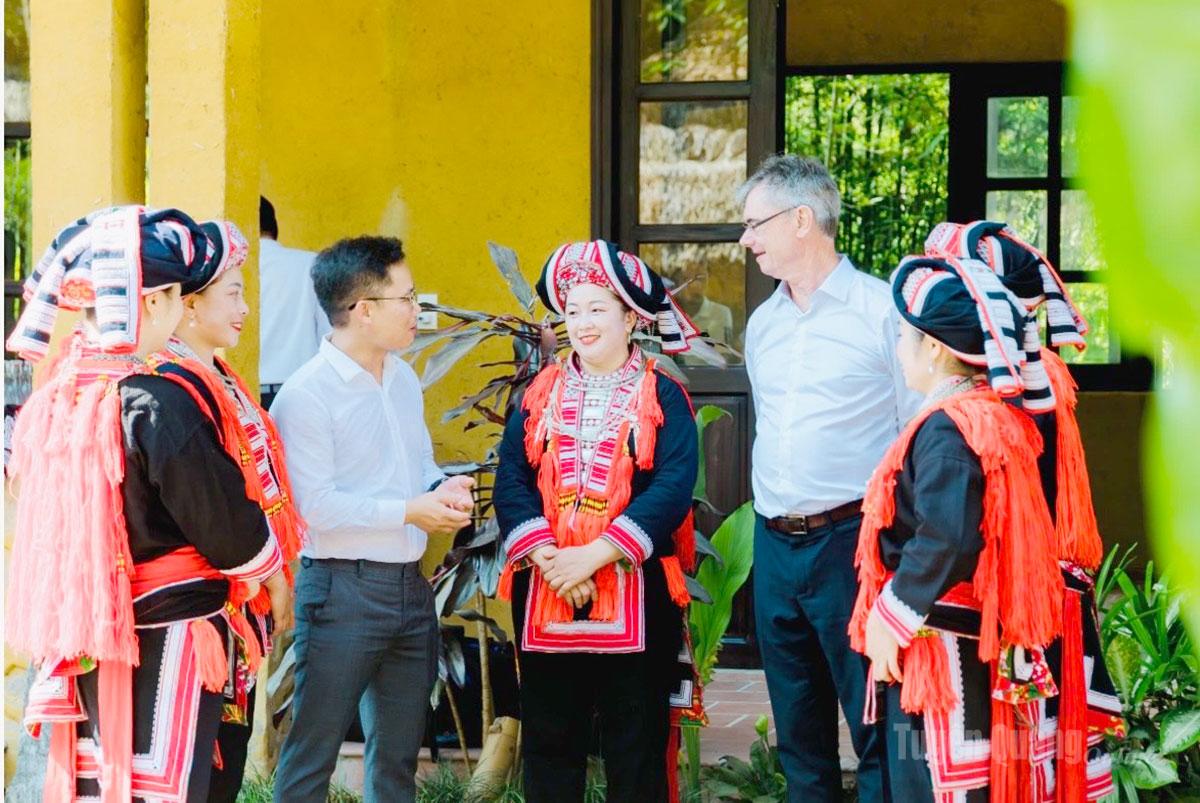 |
| Guests staying at the resort are warmly and attentively welcomed by the local reception staff. |
According to Mr. Phuong, the most valuable aspect of this model is that it develops tourism without sacrificing the environment. The forests, water sources, indigenous knowledge, and traditional architecture of the Red Dao people are not lost; on the contrary, they are becoming core values to attract tourists.
Perhaps that's why, amidst the modern tourism landscape with its many concrete structures, Panhou still chooses to quietly nestle itself in the ancient forest.
Mr. Le Quang Huy, Operations Manager of Panhou Retreat, said that what the resort has pursued for many years is not rapid development, but harmonious development with nature and the local community. According to Mr. Huy, tourists come to Panhou not only for relaxation but also to experience a living space close to nature, where the culture of the Red Dao people is still present in every house, dish, traditional medicine, and daily life. Therefore, preserving the forest, the landscape, and the local identity is also a way for tourism to thrive sustainably.
The Dao people preserve the forest through their indigenous way of life.
If nature creates the beauty of Panhou, then people are the soul of this place.
For generations, the Red Dao people in Thong Nguyen have lived off the forest. The forest provides them with medicinal plants, water sources, building materials, and even customs and traditions deeply rooted in their community life. For them, the forest is not just a resource but also an integral part of their culture.
In addition to creating jobs for local people, Panhou Retreat also allocates a portion of its accommodation revenue to a Sustainable Development Fund, supporting activities such as tree planting, water resource protection, livelihood support, and skills training for the local community. For many people in Thong Nguyen, tourism is no longer separate from village life, but has become a driving force for preserving the forest and maintaining traditional culture.
At Panhou Retreat today, 100% of the staff are local ethnic minorities. From Red Dao girls who were once only familiar with farming, they can now communicate with international tourists, guide them through local cultural experiences, and tell stories about their homeland with confidence and pride.
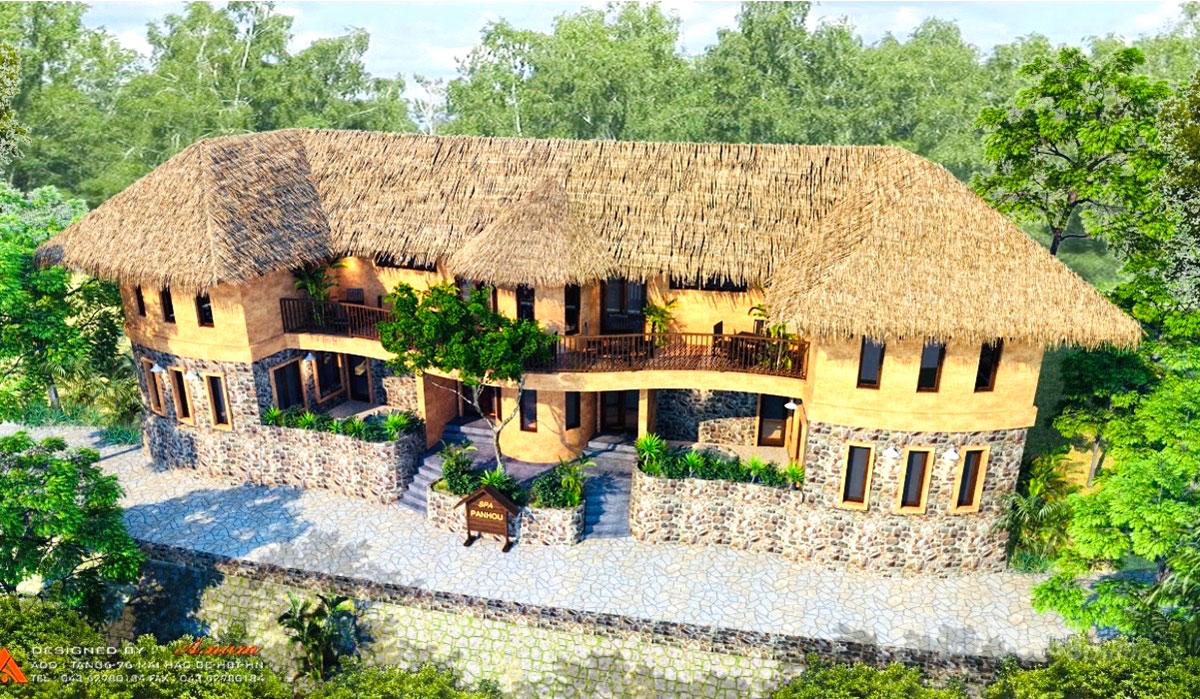 |
| This holiday home is as beautiful as something out of a fairy tale, located in the Panhou Retreat Thong Nguyen resort. |
The Red Dao woman gently prepares a pot of steaming herbal medicine. The leaves, harvested from the forest and dried to the perfect degree, are blended according to a secret recipe passed down through generations. Visitors immerse themselves in the warm herbal water, inhaling the earthy aroma of the mountains and forests, and feeling relaxed in the tranquil surroundings.
Besides bathing in herbal remedies, visitors can also make traditional handmade paper, learn to cook ethnic dishes, enjoy herbal tea, trek through the forest, or sit by the campfire listening to the Dao people tell stories about the mountains, forests, and villages. Each experience is not simply a tourist service but also a way to preserve indigenous knowledge that is facing the risk of disappearing.
Mr. Trieu Menh Quyen, Head of the Culture and Social Affairs Department of Thong Nguyen commune, shared that since Panhou Retreat came into operation, many traditional cultural values of the Red Dao people have been strongly revived. The people no longer feel ashamed of their indigenous culture, but instead are increasingly proud of it.
According to Mr. Quyen, the resort creates jobs for many local workers, encourages people to develop handicrafts, grow organic vegetables, preserve traditional festivals, and protect the natural landscape. "Tourists come here because they want to see the green forest and experience the authentic culture. If the forest is gone, tourism will also cease," Mr. Quyen said.
Preserving identity amidst the flow of modern tourism.
The space at Panhou is therefore not just a resort but resembles a miniature "Dao village" amidst the vast forest. The distinctive red patterns on the Dao people's clothing become a highlight in the architecture. Local dishes are cherished as a part of cultural memory. The sound of the flute and songs around the campfire in the evening allow visitors to feel the true essence of the mountainous region.
Many visitors come to Panhou not to "check-in," but to slow down and immerse themselves in nature. Some spend entire mornings walking through bamboo forests, listening to the sound of flowing water and breathing in the mountain air. Others sit for hours on the porch watching the mist dissipate over the terraced rice fields. And some return repeatedly simply because they miss the peaceful feeling of this place.
In Thong Nguyen today, the green forests are preserved not only by forest protection regulations, but also by the very livelihoods of the local people.
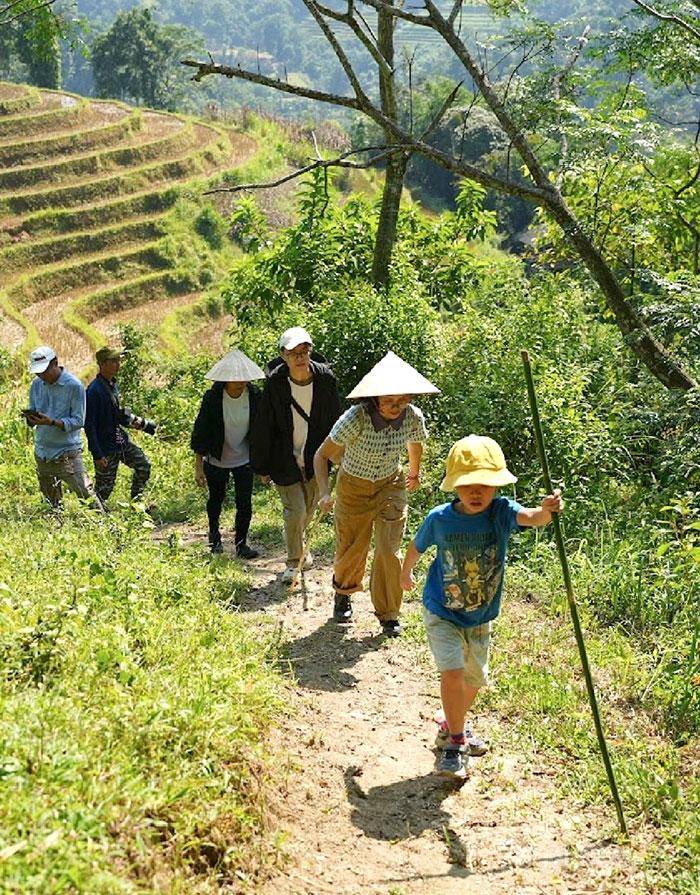 |
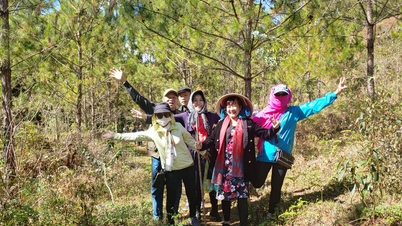
| Tourists enjoy hiking and experiencing the scenery amidst the mountains and forests of Thong Nguyen. |
Tourism has opened up a different path for the people in the highlands: instead of exploiting the forest in a way that leads to unsustainable growth, they preserve the pristine beauty of nature to develop sustainable tourism. And in this journey, Panhou Retreat is becoming a clear example of tourism based on nature conservation and the preservation of local culture.
Nestled amidst the vast Thông Nguyên forest, Panhou resembles a tranquil "green oasis," quietly nestled beneath the canopy of ancient trees. Not isolating itself from the community, the resort chooses to live alongside the village, surrounded by the sounds of streams, traditional houses, terraced rice fields, and the rhythm of life of the Red Dao people. Perhaps that's why many visitors, even after leaving, still fondly remember the indescribable sense of peace they experienced there.
As evening falls amidst the vast Thông Nguyên forest, smoke from cooking fires drifts gently from the roofs nestled under the trees, the stream still murmurs in the deep woods, and the sound of someone's flute echoes from the firelight… One suddenly understands that the greatest beauty of tourism lies not in glamour, but in its ability to preserve the soul of a land.
And in Panhou, the Red Dao people are doing just that in the simplest way: preserving the forest through tourism, and preserving their culture through their own way of life.
Text and photos: Duc Quy
Source: https://baotuyenquang.com.vn/van-hoa/du-lich/202605/panhou-noi-nguoi-dao-giu-rung-bang-du-lich-3bf4b78/
![[Image] Hanoi's urban life under the challenge of a "scorching hot" environment](https://vphoto.vietnam.vn/thumb/1200x675/vietnam/resource/IMAGE/2026/05/25/1779706979265_nang-nong-t5-2026-minh-duy-7-4636-jpg.webp)


![[Image] Close-up view of the interchange connecting the two expressways and Long Thanh Airport.](https://vphoto.vietnam.vn/thumb/1200x675/vietnam/resource/IMAGE/2026/05/25/1779703378210_ndo_br_z7863716673926-224453a31600126cce10622af6290afd-4549-jpg.webp)















































































Comment (0)