

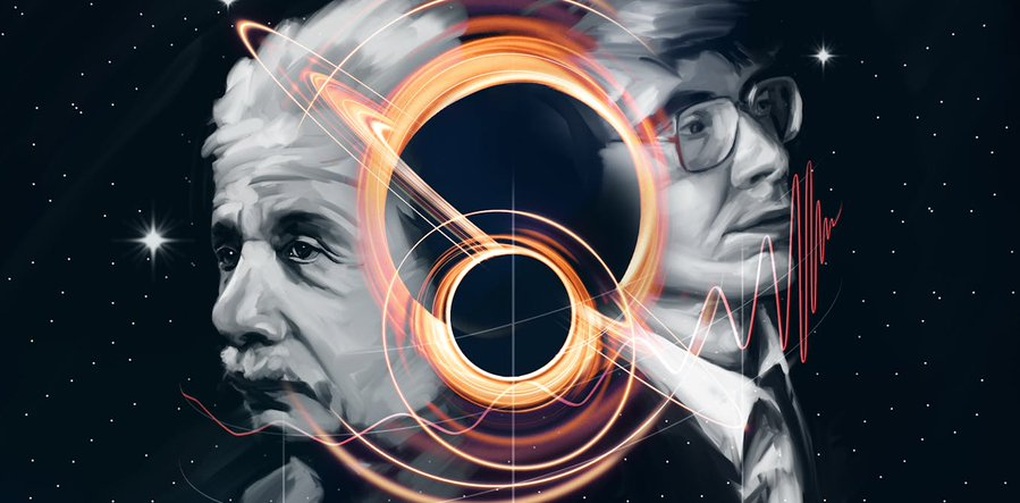
That was the first discovery of gravitational waves. It proved a key prediction of Einstein's general theory of relativity. More recently, a new discovery about gravitational waves has validated a theory by Stephen Hawking – another "giant" in the field of astronomy.
What are gravitational waves?
Gravitational waves are "ripples" in the fabric of spacetime that propagate at the speed of light. They are created by massive objects that are accelerated to extremely high speeds, such as colliding black holes or the merger of massive stellar remnants called neutron stars.
These ripples propagating in the universe were first directly observed on September 14, 2015, by two detectors at the Laser Interferometer Gravitational-Wave Observatory (LIGO) in the United States.
That first signal, known as GW150914, originated from the collision of two black holes, each with a mass more than 30 times that of the Sun and located more than a billion light-years from Earth.
This was the first direct evidence of gravitational waves, exactly as predicted by Einstein's theory of relativity 100 years earlier. For this discovery, three scientists, Rainer Weiss, Barry Barish, and Kip Thorne, were awarded the 2017 Nobel Prize in Physics.
Simulations show that gravitational waves are generated by two black holes orbiting each other ( Video : MPI).
Hundreds of signals in less than a decade.
Since 2015, LIGO has observed more than 300 gravitational waves, along with Italy's Virgo detector and Japan's KAGRA.
Just a few weeks ago, the international LIGO/Virgo/KAGRA collaborative project announced the latest results from their fourth observation, more than doubling the number of known gravitational waves.
Ten years after the initial discovery, an international collaboration including Australian scientists from the Centre for Gravitational-Wave Discovery (OzGrav) of the Australian Research Council recently announced a new gravitational wave signal, GW250114.
This signal is an almost perfect replica of the first gravitational wave signal, codenamed GW150914.
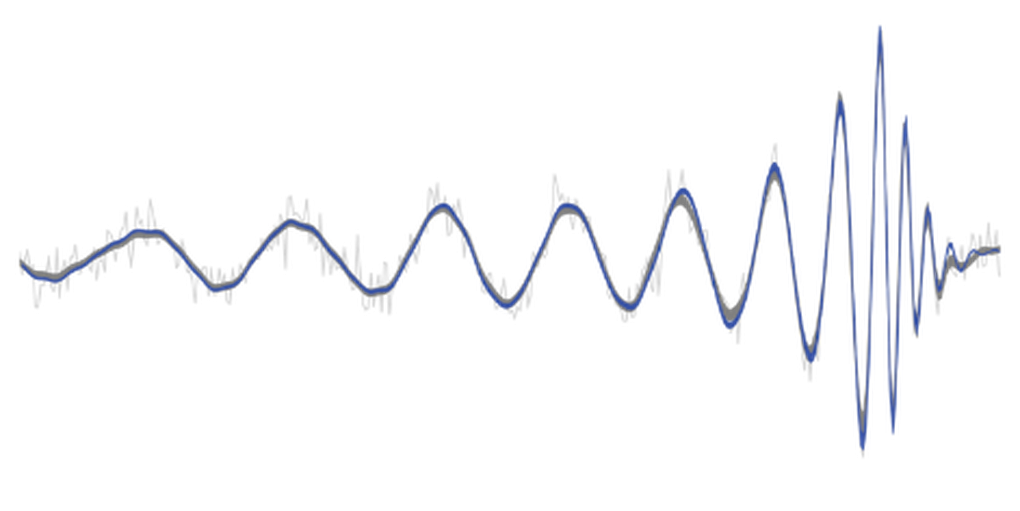
The black hole collision that caused GW250114 has very similar physical properties to GW150914. However, thanks to significant upgrades to gravitational wave detectors over the past ten years, the new signal is seen much more clearly (almost four times stronger than GW150914).
Interestingly, it allows us to test the ideas of another pioneering physicist: Stephen Hawking.
Hawking was also right.
Over 50 years ago, two physicists, Stephen Hawking and Jacob Bekenstein, formulated a set of laws describing black holes.
Hawking's second law of black hole mechanics, also known as Hawking's area theorem, states that the event horizon area of a black hole must always increase. In other words, black holes cannot shrink.
Meanwhile, Bekenstein demonstrated that the surface area of a black hole is directly related to its entropy (or degree of chaos). The second law of thermodynamics tells us that entropy must always increase: the universe is always becoming more chaotic. Since the entropy of a black hole must also increase over time, it tells us that its surface area must also increase.
How can we test these ideas? It turns out that collisions between black holes are the perfect tool. The accuracy of the new measurement allows scientists to perform the most precise test of Hawking's area theorem to date.
Previous experiments using the initial detection GW15091 showed that this signal was consistent with Hawking's law, but could not be definitively confirmed.
Black holes are surprisingly simple objects. The area of a black hole's horizon depends on its mass and rotation, the only parameters necessary to describe an astronomical black hole. In turn, mass and rotation determine the shape of the gravitational waves.
By separately measuring the mass and spin of the two colliding black holes, and comparing them to the mass and spin of the final black hole remaining after the collision, scientists were able to compare the surface area of the two colliding black holes to the surface area of the final black hole.
The data shows excellent agreement with theoretical predictions that the area will increase, strongly supporting Hawking's law.
Future observations of gravitational waves will allow us to test even stranger scientific theories, and possibly even explore the nature of the missing components of the universe: dark matter and dark energy.
Source: https://dantri.com.vn/khoa-hoc/phat-hien-mo-ra-ky-nguyen-moi-trong-thien-van-hoc-20250930235223429.htm


![[Photo] General Secretary and President To Lam presides over a meeting on preparations for the review of one year of operation of the three-tiered government system.](https://vphoto.vietnam.vn/thumb/1200x675/vietnam/resource/IMAGE/2026/06/02/1780391821195_a1-bnd-4595-9717-jpg.webp)





























































































Comment (0)