

Scientists have calculated that time passes faster on Mars than on Earth by an average difference of 477 microseconds (477 millionths of a second) per day.
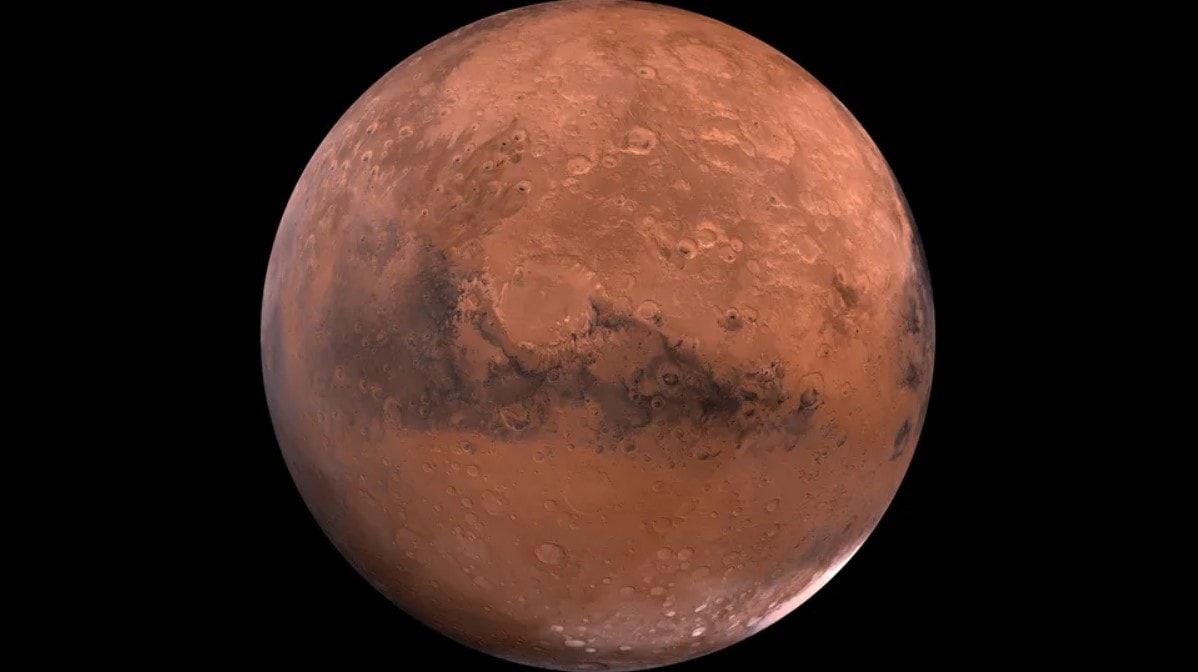
This discrepancy, caused by the time dilation effect in Albert Einstein's General Theory of Relativity, will have important implications for future interplanetary navigation and communication networks.
The study considered key factors to calculate the time difference: the roughly five times weaker gravity on Mars, orbital velocity, the eccentricity of Mars' orbit around the Sun, as well as the gravitational effects of its nearest celestial bodies.
Time dilation according to general relativity
Einstein's General Theory of Relativity describes how clocks can run faster or slower, depending on the gravitational field and velocity they are exposed to. This phenomenon is called time dilation.
As an object moves closer to the speed of light, its clock ticks more slowly compared to a stationary observer. This is the principle that explains the twin paradox.
Time passes more slowly near a stronger gravitational field so clocks will tick more slowly in strong gravity environments.
Mars is farther from the Sun than Earth, so it orbits the Sun more slowly. This should make clocks on Mars tick more slowly than on Earth. However, because Mars' orbit is more eccentric, Mars's speed in orbit varies, speeding up as it gets closer to the Sun and slowing down as it gets farther away.
The distance of Mars from the Sun's gravitational field and from the Earth-Moon system also changes throughout a Martian year.
Combined, these factors result in clocks on Mars ticking faster than on Earth.
To an astronaut on Mars, a second is still a second. But to an observer on Earth, that second passes a little faster.
Future Impact
Although the difference is not as great as in the extreme environments near black holes or on high-speed spacecraft, it is enough to affect future navigation and telecommunications systems.
For example, modern technologies like 5G require precision down to tenths of a microsecond.
Understanding the time difference would help synchronize clocks between Earth and Mars, thereby improving the accuracy of interplanetary data transmission.
Source: https://congluan.vn/nguoi-song-tren-sao-hoa-se-gia-nhanh-hon-o-trai-dat-10321723.html






















































































Comment (0)