

(NLĐO) - Mesosaur monsters roamed the Earth tens of millions of years before the earliest dinosaurs appeared.
According to Sci-News, paleontologists have discovered large skulls and some bones of a new species belonging to the Mesosaur family of monsters.
This new species is twice the size of other previously discovered Mesosaur species, preserved in Dichotomous rock slabs in Uruguay's Mangrullo Formation and Brazil's Iratí Formation.
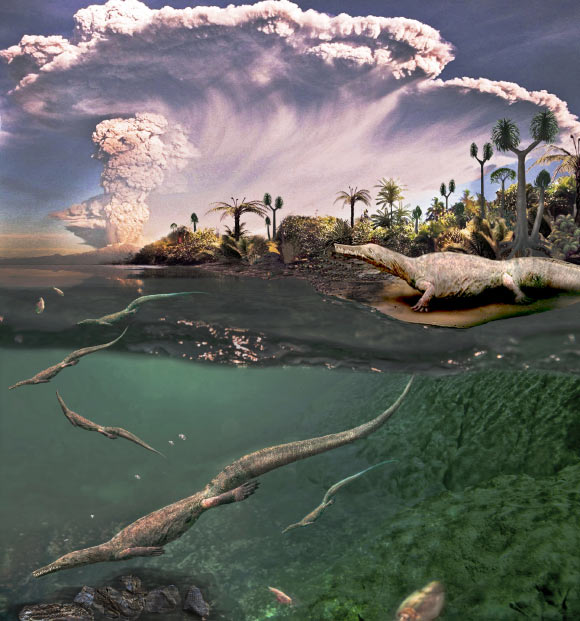
Mesosaur monster - Graphic image: Roman Yevseyev/Graciela Piñeiro
Dr. Graciela Piñeiro from the University of the Republic (Uruguay), the lead researcher, described the Mesosaur as a small to medium-sized aquatic reptile with a slender body and a tail longer than the rest of its body.
Their skulls are characterized by a long snout, very thin cranial bones, and many sharp, needle-like teeth.
This lineage of monsters existed on Earth approximately 299-270 million years ago, from the beginning to the middle of the Dichotomy.
Therefore, they are much older than dinosaurs, because the earliest dinosaurs only emerged in the later Triassic period (251-200 million years ago), before becoming the monsters that dominated the Earth in the subsequent Jurassic and Cretaceous periods.
Scientists have identified them as an "intermediate dinosaur," so studying them could provide invaluable clues about the amazing evolutionary process that created the world of dinosaurs.
The recently discovered Mesosaur fossils in South America also include individuals at different stages of development, from embryos to juveniles and adults, making this collection particularly important.
Previously found mesosaur specimens averaged 70 cm in length. This new species of crab, with a skull alone measuring 15-20 cm, has an estimated total body length of 1.5-2.5 m.
They may have been only the size of small modern-day crocodiles, but in the world of the ancient Dichotomy, that size was enough to make them enormous monsters.
Like other Mesosaurs, these giant Mesosaurs are believed to have disappeared during a turbulent period on the ancient supercontinent of Gondwana. Modern-day South America was once part of Gondwana.
It was a period of furious volcanic activity, devastating droughts, and widespread desertification... in the middle of the Dichotomy, according to a paper published in the journal Fossil Studies.
Source: https://nld.com.vn/phat-hien-quai-vat-mesosaur-lon-nhat-tung-duoc-biet-den-19625010710503312.htm





























![[Photo] Reception to welcome General Secretary and President To Lam and his wife on their State visit to the Philippines](https://vphoto.vietnam.vn/thumb/1200x675/vietnam/resource/IMAGE/2026/06/01/1780295488620_vna-potal-chieu-dai-chao-mung-tong-bi-thu-chu-tich-nuoc-to-lam-va-phu-nhan-tham-cap-nha-nuoc-toi-philippines-8798060-7855-jpg.webp)







































































Comment (0)