

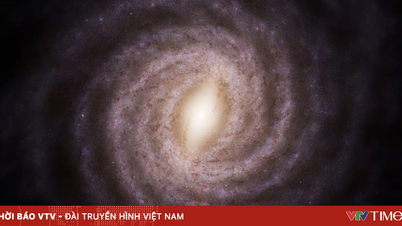
Astronomers have long believed that our galaxy has grown larger by absorbing and merging with smaller galaxies around it.
Now, a new study has revealed clear evidence of a “hidden galaxy” deep within the Milky Way, the remnant of a dwarf galaxy that was swallowed up in the early universe.
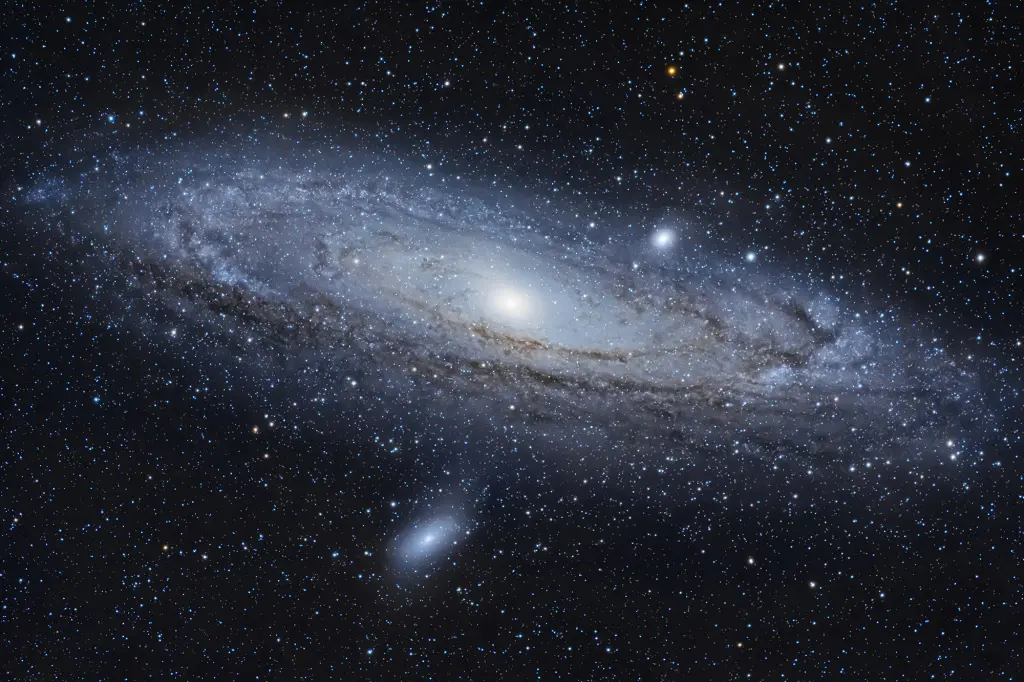
This discovery, published in the scientific journal Monthly Notices of the Royal Astronomical Society, sheds further light on the violent evolution of galaxies in the young universe.
Researchers call this ancient galaxy "Loki," after the trickster god in Norse mythology. The hypothesis is that Loki was once a separate dwarf galaxy with billions of individual stars before being completely absorbed by the Milky Way billions of years ago.
In other words, within our galaxy today, there may be remnants of another galaxy, like nested Russian nesting dolls on a cosmic scale.
The remnants left behind after the galactic "feast".
According to scientists, in the early stages of the universe, large galaxies like the Milky Way did not reach their current enormous size. They gradually grew through collisions and mergers with smaller galaxies.
Loki is believed to be a dwarf galaxy, a type of galaxy that is much smaller than mature galaxies. Despite possessing billions of stars, it is still only a "miniature version" compared to the Milky Way, which contains hundreds of billions of stars.
To detect traces of Loki, the research team analyzed 20 metal-poor stars located on the galactic plane, the disk-like region where most of the Milky Way's stars are concentrated.
Metal-poor stars are particularly important to modern astronomy because they formed in the very early stages of the universe.
Their chemical composition has been preserved almost intact for billions of years, much like the "chemical DNA" that preserves the environment in which they originated.
When analyzing the orbits and composition of these stars, researchers found they differed significantly from other metal-poor stars in the Milky Way. This suggests they may not have been born here.
Clues from ancient supernova explosions
What caught the research team's attention most was that these stars bore the marks of extreme cosmic events such as supernovae and neutron star collisions, explosions capable of creating heavy elements in the universe.
However, unusually, they show no evidence related to white dwarfs. These are the remnants left behind after stars similar in size to the Sun run out of fuel and lose their outer layers.
Typically, the formation of white dwarf stars takes billions of years. The lack of any trace of them has led scientists to speculate that Loki may have been a galaxy that existed for a very short time before being completely swallowed by the Milky Way.
In other words, Loki may have been "wiped out" very early in the universe's history, before older generations of stars had enough time to evolve into white dwarfs.
Researchers describe this process as the merging of the galaxy's "primordial building blocks" in the early stages of the universe, scattering stellar matter, gas, and dark matter into the developing young galaxy.
The history of violence in the Milky Way is revealed.
The discovery of Loki not only helps decipher the formation history of the Milky Way but also provides further evidence for modern models of galactic evolution.
According to this model, large galaxies don't appear all at once but are formed through countless mergers that take billions of years.
Astronomers have long known that the Milky Way has "devoured" many smaller galaxies in the past.
However, the discovery of chemical traces and Loki's specific trajectory strongly reinforces this theory.
It also revealed that the ancient universe was far more chaotic than previously imagined. Galaxies were constantly colliding, merging, and restructuring, creating the massive star systems that exist today.
However, scientists emphasize that the current evidence is still limited. The study sample consists of only 20 stars, a relatively small number to fully confirm the existence of Loki or to reconstruct the original structure of this galaxy.
In the future, next-generation telescopes and larger stellar databases may help astronomers accurately determine the size, shape, and history of Loki.
If confirmed, Loki would become one of the most significant “galactic fossils” ever discovered within the Milky Way, a reminder that the galaxy we live in is actually made up of countless collisions and mergers throughout the universe's history.
(According to NY Post, LiveScience)
Source: https://vietnamnet.vn/phat-hien-thien-ha-an-ben-trong-ngan-ha-2519208.html



![[Image] Close-up view of the interchange connecting the two expressways and Long Thanh Airport.](https://vphoto.vietnam.vn/thumb/1200x675/vietnam/resource/IMAGE/2026/05/25/1779703378210_ndo_br_z7863716673926-224453a31600126cce10622af6290afd-4549-jpg.webp)
![[Image] Hanoi's urban life under the challenge of a "scorching hot" environment](https://vphoto.vietnam.vn/thumb/1200x675/vietnam/resource/IMAGE/2026/05/25/1779706979265_nang-nong-t5-2026-minh-duy-7-4636-jpg.webp)





























































































Comment (0)