

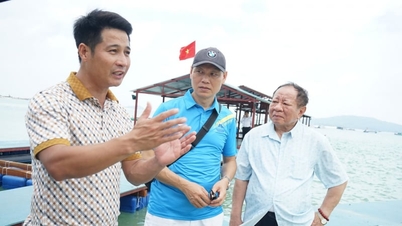
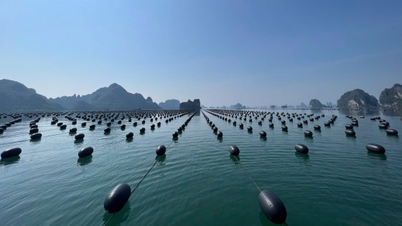
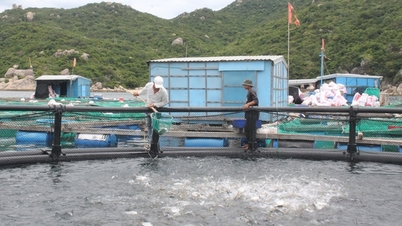
Established in 2024, Phuc Nam Aquaculture Cooperative (Cua Ong Ward) currently has 12 members specializing in aquaculture, with 6 members focusing on farming in the Ong Cu Island area. The cooperative has a system of cages for raising high -economic- value fish species such as peacock fish, pomfret, grouper, etc., covering an area of approximately 20,000 m².

According to Nguyen Van Tuan, Director of Phuc Nam Aquaculture Cooperative: "With the advantage of a large water surface area and a suitable farming environment, raising peacocks, pomfret, and grouper yields high efficiency and stable production. In 2025, the cooperative aims to achieve a production of approximately 150 tons of pomfret and peacocks; 300 tons of grouper, generating tens of billions of dong in revenue. Currently, the cooperative continues to maintain stable production, ensuring product output and creating jobs and income for its members."
Currently, the province has 368 aquaculture cooperatives (marine farming) with a total registered capital of over 4,000 billion VND. In recent years, Quang Ninh has promoted the transformation of aquaculture methods from small-scale and fragmented to industrial marine farming, applying high technology. Many coastal localities have formed concentrated farming areas with the active participation of aquaculture cooperatives. This is considered a suitable model to improve production efficiency, increase product competitiveness, and protect aquatic resources in the long term.

The establishment of cooperatives has created a significant shift in the production mindset of fishermen. Through cooperatives, farming households are linked in terms of capital, technology, breeding stock, feed, and product outlets; at the same time, they have access to state support policies on credit, science and technology, and vocational training. Many cooperatives have gradually applied digital technology in monitoring farming areas, managing production, and tracing product origins. Some models of marine fish, oyster, and clam farming according to the province's biosafety standards have initially yielded high economic efficiency, contributing to increasing the income of people in coastal and island areas.
Besides playing a role in linking production, marine aquaculture cooperatives also contribute to changing the economic landscape of coastal rural areas. Many local laborers have stable jobs with decent incomes; the lives of fishermen are gradually improving. The formation of concentrated aquaculture areas also creates conditions for localities to plan marine space rationally, reducing spontaneous aquaculture, overlapping shipping lanes, and limiting negative impacts on the ecological environment.
Currently, the province is determined to develop its fisheries sector in a green, clean, and sustainable direction, with cooperatives becoming a crucial force in achieving the goal of minimizing plastic waste in the sea. Marine farming models are gradually replacing traditional floating materials with environmentally friendly materials, contributing to the protection of marine ecosystems and enhancing long-term production value.

Despite the achievements, the operations of marine aquaculture cooperatives still face many difficulties. Production scale in many areas remains small; cooperative management capacity is uneven; and the application of science and technology is limited. Many cooperatives struggle to access large investment capital for offshore industrial farming systems. Furthermore, climate change, natural disasters, diseases, and market fluctuations also directly impact production efficiency.
To effectively promote the role of marine aquaculture cooperatives, the province needs to continue improving marine spatial planning, creating a stable water surface area so that people and cooperatives can confidently invest in the long term. At the same time, it is necessary to strengthen support through preferential credit, technology transfer, human resource training, and the development of product consumption linkages. Promoting digital transformation and applying high technology in marine aquaculture is also essential to improve the productivity, quality, and competitiveness of local aquatic products.
Marine aquaculture cooperatives need to play a role in disseminating information and mobilizing members to strictly comply with regulations on marine environmental protection, actively participate in preserving ecosystems and protecting aquatic resources, creating a foundation for the long-term and effective development of the marine aquaculture industry.
Source: https://baoquangninh.vn/phat-huy-vai-role-of-cooperative-fish-farming-3406798.html


![[Image] Close-up view of the interchange connecting the two expressways and Long Thanh Airport.](https://vphoto.vietnam.vn/thumb/1200x675/vietnam/resource/IMAGE/2026/05/25/1779703378210_ndo_br_z7863716673926-224453a31600126cce10622af6290afd-4549-jpg.webp)









































































Comment (0)