

In the context of climate change increasingly impacting agricultural production, upgrading key value chains is considered a crucial solution to enhance the competitiveness and sustainable development of the province's agricultural economy .
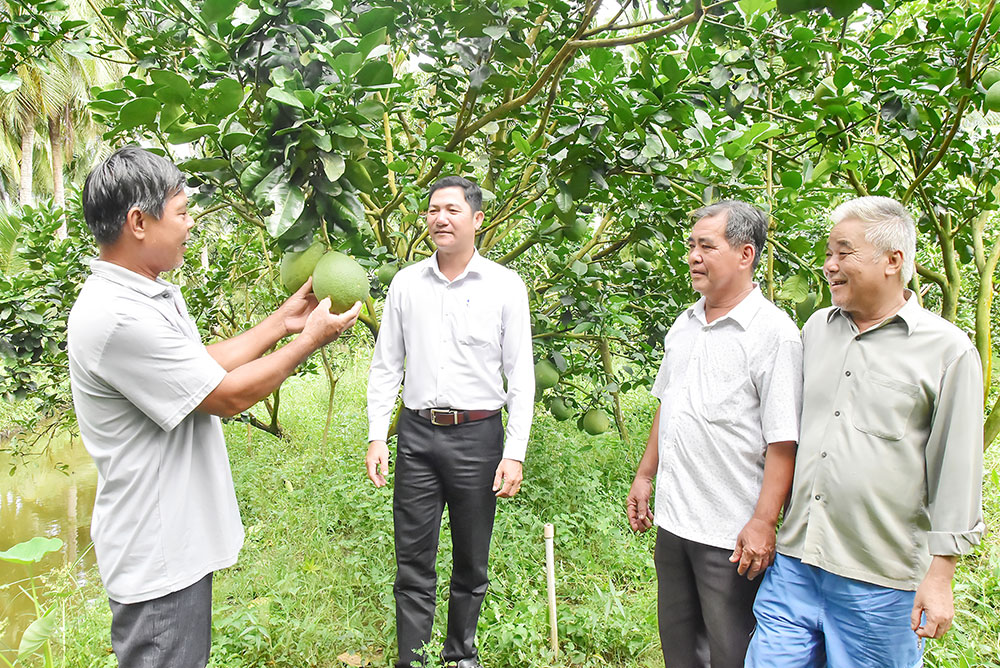 |
| Green-skinned pomelo is one of eight products included in the project's value chain upgrade plan. |
Strengthening connections
The Climate-Adaptive Smart Agriculture Value Chain Development Project in Tra Vinh (CSAT Tra Vinh), funded by the International Fund for Agriculture Development (IFAD), is being actively implemented by the CSAT Tra Vinh Project Management Board, while also preparing new ODA projects to promote sustainable agriculture and climate change adaptation.
The project, with an investment of $31.6 million, will be implemented from 2022 to 2026, aiming to develop smart agricultural value chains, increase income, and reduce risks for vulnerable groups, with priority given to women, rural youth, and ethnic minorities.
Mr. Lam Huu Dung, Deputy Director of the CSAT Tra Vinh Project, said: In the past period, the Project Management Board has reviewed and upgraded 8 key agricultural value chains; at the same time, organized training courses and workshops to improve the capacity of cooperatives, cooperative groups and enterprises; built and put into operation a public-private partnership (4P) platform to strengthen chain linkages and improve management efficiency.
Along with the CSAT Project, the province is preparing to implement the "Innovative Financing for Creating Resilient Livelihoods in Wetlands" (IFIA) Project in Tra Vinh and the Green Circular Economy Support Project funded by KOICA. These projects are expected to expand opportunities for adaptive livelihoods, promote the circular economy, strengthen agricultural value chain linkages in the Mekong Delta, and contribute to sustainable socio-economic development in the coming period.
Key solution groups
Eight key agricultural value chains in the province are being comprehensively upgraded to adapt to climate change, increase added value, and improve livelihoods for rural people. According to the plan, the upgrading of these value chains will be implemented synchronously through four key solution groups: product improvement and innovation, investment linked to job creation, and reduction of production costs, and improvement of distribution channels.
The focus is on developing raw material areas that meet GAP and organic standards; promoting deep processing and diversifying value-added products; and applying digital technology , automated irrigation, and climate change-adaptive production models.
Furthermore, strengthening horizontal and vertical linkages between farmers, cooperatives, and businesses is identified as a key solution to stabilize output and reduce market risks. Support for brand building, packaging, labeling, and product listing on e-commerce platforms should also be promoted.
When the eight value chains are upgraded effectively, it will increase people's income, promote sustainable rural economic development, and enhance the competitiveness of local agricultural products.
According to Mr. Lam Huu Dung, the key value chains identified include tiger shrimp, rice, drinking coconuts, oil-producing coconuts, peanuts, chili peppers, green pomelos, and mandarin oranges. These are key sectors in the agricultural economic structure, making significant contributions to growth, job creation, and livelihoods for rural people. The plan to upgrade these value chains aims to improve the efficiency of production linkages, increase the added value of agricultural products, enhance consumption, apply science and technology, adapt to climate change, and meet the increasingly high demands of the market in the context of integration.
The IFAD Fund has also officially launched the “Innovative Financing for Resilient Livelihoods in Wetlands” (IFIA) project, funded by the Adaptation Fund with approximately US$5 million, implemented in the Tra Vinh-Ben Tre (formerly) region. The implementation of the IFIA project through CSAT Tra Vinh is expected to provide additional resources for the locality.
The project focuses on providing technical support, enhancing the capacity of stakeholders, promoting innovation, and scaling up climate change-adaptive livelihood models. Through the project, the effectiveness of coordination among state management agencies, development support organizations, businesses, and people is strengthened, contributing to the dissemination of sustainable development models in wetland areas.
In the coming period, the Tra Vinh CSAT Project will closely coordinate with the Department of Agriculture and Environment and other relevant units to implement priority activities according to the roadmap for the 2026-2030 period, aiming at developing sustainable agriculture, adapting to changing conditions, and increasing income for the people.
Building a modern and sustainable agricultural sector.
According to Mr. Le Van Dong, Deputy Director of the Department of Agriculture and Environment: With the goal of building a modern, sustainable agriculture that adapts to climate change; forming stable, transparent linkages that ensure harmonious benefits between businesses, cooperatives, and farmers; creating high-value, traceable key products that are competitive in the domestic market and geared towards export.
The agricultural sector plays a crucial role in implementing planning tasks, providing support policies and incentive mechanisms for linkages; investing in essential infrastructure such as irrigation systems, rural transportation, and the digitalization of production management; supporting the transfer of science and technology, technical training, and market expansion.
Simultaneously, it acts as a "bridge" between businesses and producers, aiming to connect long-term, harmonious interests between all parties, contributing to the common goal of improving people's lives and developing a green, clean, and sustainable agriculture.
The agricultural sector is committed to providing maximum support and creating a favorable environment for cooperation; listening to the opinions of stakeholders to adjust policies to suit practical realities, in order to develop the province's key agricultural value chains in the coming time.
Text and photos: MẪN QUÂN
Source: https://baovinhlong.com.vn/kinh-te/nong-nghiep/202512/phat-trien-cac-chuoi-gia-tri-nong-nghiep-chu-luc-cua-tinh-7fe0431/
![[Photo] Prime Minister Pham Minh Chinh attends the Conference on the Implementation of Tasks for 2026 of the Industry and Trade Sector](/_next/image?url=https%3A%2F%2Fvphoto.vietnam.vn%2Fthumb%2F1200x675%2Fvietnam%2Fresource%2FIMAGE%2F2025%2F12%2F19%2F1766159500458_ndo_br_shared31-jpg.webp&w=3840&q=75)






























































Comment (0)