

According to statistics, Phu Tho province has over 443,000 hectares of forest, of which more than 207,000 hectares are natural forest, with a forest cover rate of over 43%. This is an important resource for the sustainable development of the forest economy . In particular, due to its topography, the natural forests in the province are mainly humid tropical forests, with a climate and soil suitable for the growth and development of many valuable medicinal plants.
Recognizing that developing medicinal plants under the forest canopy is a "one investment, four returns" solution—protecting forests, increasing forest cover, conserving biodiversity, and creating a stable income for forest growers—the province has implemented numerous mechanisms and policies in recent years to guide the sustainable development of the medicinal plant industry.
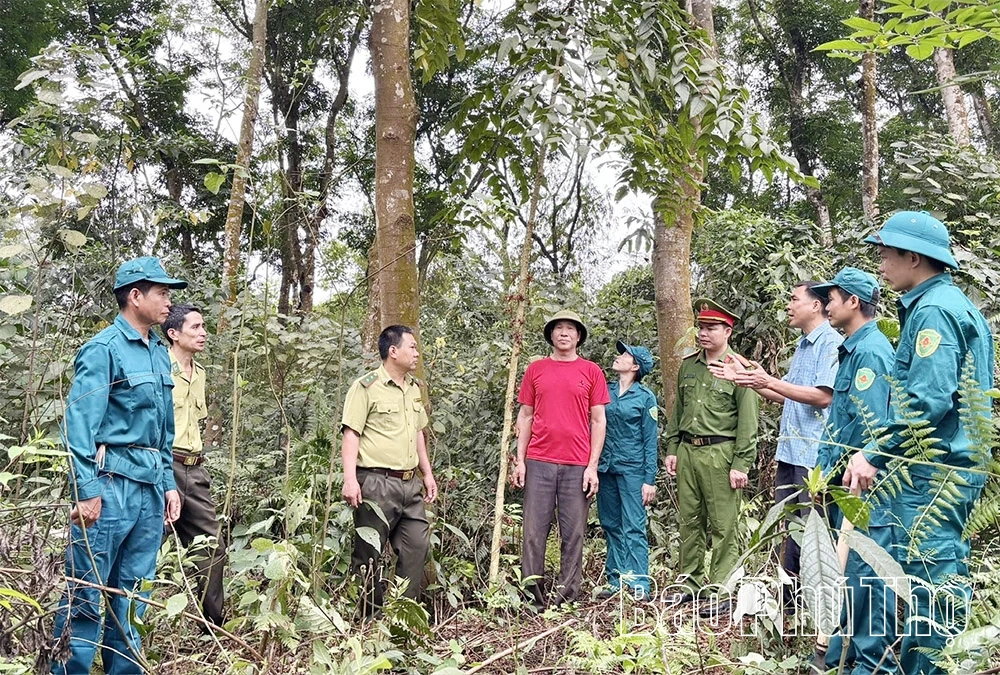
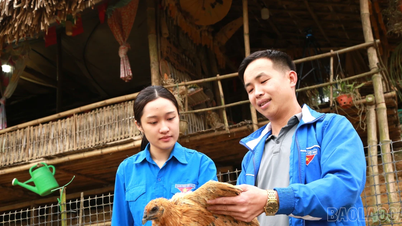
The Lac Son forest rangers, in coordination with the local government, are raising awareness and encouraging people in Dai Dong commune to protect the forest and develop medicinal plants under the forest canopy in order to increase their income.
In the former Phu Tho province, the Provincial People's Committee approved a list of priority medicinal plants for development, and simultaneously planned cultivation areas, conservation areas, and nurseries to propagate these valuable medicinal plants. This included several priority medicinal plants such as: *Tinospora cordifolia*, *Stephania tetrandra*, *Gynostemma pentaphyllum*, *Codonopsis pilosula*, *Amomum xanthioides*, *Moringa oleifera*, and *Ocimum basilicum*. Mountainous and midland areas such as Tan Son, Thanh Son, Yen Lap, and Lam Thao implemented the cultivation of medicinal plants under the forest canopy, combining planted and natural forests, thus protecting valuable genetic resources and enhancing the economic value of forest land. Medicinal plant products were produced in a closed-loop chain, from production, harvesting, processing to consumption.
In the former Hoa Binh province, the Provincial People's Committee also issued a project to plan the development of medicinal plants in Hoa Binh province until 2025, with a vision to 2030. The plan includes the designation of forest areas and areas with natural medicinal plants to conserve endemic, native, valuable, and highly endangered genetic resources for sustainable development in nature. It also includes the planning of four nurseries to supply medicinal plant seedlings for large-scale cultivation and development in the Tan Lac, Lac Thuy, Yen Thuy, and Lac Son areas. Furthermore, it aims to expand the area for commercial medicinal plant cultivation to 15,000 hectares, with an annual production of 80,000 to 120,000 tons.
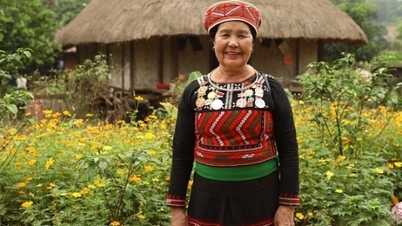
One of the clearest examples of the effectiveness of the medicinal plant cultivation model under the forest canopy is in Bao La commune. With a forest cover rate of over 66.7%, Bao La has favorable conditions for medicinal plants to grow naturally under the forest canopy. Recognizing the great potential of the local herbal resources, Ms. Ha Thi Le established the Huong Xuan Cooperative, pioneering the development of a medicinal plant cultivation area linked to processing. Based on her knowledge of traditional medicine and the advantage of abundant local raw materials, she has researched and restored many traditional herbal remedies. In particular, the cooperative has successfully produced Thanh Ngạnh herbal tea extract, which has the effect of clearing heat, detoxifying, and cooling the liver. In addition, the cooperative also develops many other types of herbs, contributing to the preservation of valuable medicinal plant genetic resources.
Besides Huong Xuan Cooperative, in Buoc hamlet, Bao La commune, Mai Chau forest rangers, in coordination with local people, have been conducting trial planting of Codonopsis pilosula under the forest canopy. After only one year, promising results were achieved: Codonopsis pilosula flowers, producing fruit for seed, and many plants began to form tubers. After three years, the plants entered a stable harvesting phase, yielding 12-20 tons of fresh tubers per hectare, with a selling price of 80-100 thousand VND per kilogram. Codonopsis pilosula is a valuable medicinal plant; almost all parts of its stem and leaves can be harvested and used in medicine. Introducing Codonopsis pilosula cultivation not only opens up a new direction for the forest-based economy but also increases income and contributes to local economic development.
Comrade Hoang Dinh Trang - Deputy Director of the Department of Agriculture and Environment, said: Developing forestry trees, non-timber forest products, and medicinal plants grown under the forest canopy is an important direction to enhance the value of forest land use, while promoting the indigenous knowledge of the community and local people.
To effectively exploit forest resources and maximize the economic efficiency of medicinal plant cultivation models under the forest canopy, according to the Deputy Director of the Department of Agriculture and Environment: In the coming time, the department will advise the province to focus on developing effective and sustainable integrated agricultural and forestry production models based on exploiting the potential and advantages of each region and locality, combined with effectively utilizing indigenous knowledge to increase added value from forests, create more products and services, and contribute to increasing economic value per unit of cultivated area. Priority will be given to allocating resources to support households, cooperatives, and businesses investing in planting high-economic-value medicinal plants under the forest canopy. Focus will be placed on supporting seeds, materials, techniques, and cultivation processes according to good agricultural and harvesting practices, ensuring the quality of investments for both domestic and export markets. In particular, the province will invest resources in building concentrated medicinal plant raw material areas linked to factories and deep processing facilities with the goal of increasing the proportion of refined processing, from raw products to high value-added products such as functional foods and pharmaceuticals, stabilizing output and creating a brand for Phu Tho medicinal herbs.
Dinh Hoa
Source: https://baophutho.vn/phat-develop-medicinal-materials-under-forest-243008.htm


![[Photo] General Secretary and President To Lam meets with National Assembly delegates from ethnic minorities.](https://vphoto.vietnam.vn/thumb/1200x675/vietnam/resource/IMAGE/2026/04/20/1776696701056_a1-bnd-8331-3342-jpg.webp)
![[Image] National Assembly discusses the implementation of the socio-economic development plan.](https://vphoto.vietnam.vn/thumb/1200x675/vietnam/resource/IMAGE/2026/04/20/1776696707422_ndo_br_img-20260420-185419-jpg.webp)














































































Comment (0)