

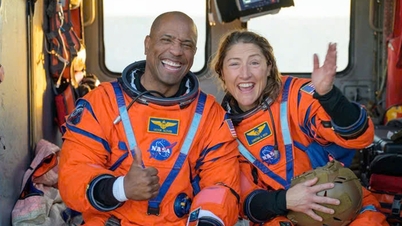
In the Artemis II mission, NASA is deploying cutting-edge technologies to protect the crew from solar storms and space radiation.
The dangers of radiation in outer space.
Extreme weather in space can be deadly. For example, in October 1989, a massive solar flare released a high-energy stream of protons that lasted for days. From the shelter area on the space shuttle Atlantis, astronauts witnessed blinding flashes of light so bright they couldn't open their eyes. Researchers later estimated that if a crew were outside the protective zone of Earth's magnetic field, they could face fatal risks.
This event alerted the space science industry to the dangers of space weather, such as solar storms, radiation, and streams of high-energy particles.
With the Artemis II mission, for the first time in decades, humanity will venture beyond the protective shield of Earth's magnetic field, where these risks are more serious than ever. However, after years of research, scientists have developed solutions to mitigate these threats.
During its journey from Earth to the Moon, the Orion spacecraft faced three main sources of radiation, each capable of causing serious harm to the human body.
First, there are the particles trapped in the Van Allen Belts, two donut-shaped radiation zones surrounding Earth, filled with high-energy protons and electrons. Despite the danger, the Artemis II crew only passed through this area for a short time, limiting the level of exposure.
The second threat comes from galactic cosmic rays. These are extremely energetic particles that travel near the speed of light and originate from distant stellar explosions. The worrying aspect is that when these particles strike the spacecraft, they trigger secondary reactions, releasing even smaller particles. These particles are invisible to the naked eye and can easily penetrate astronaut suits.
The third source of danger is high-energy particle events from the Sun, such as solar storms and coronal mass ejections. These phenomena occur more frequently during periods of intense solar activity.
Like extreme weather events on Earth, storms occur randomly. Scientists can predict when energy accumulates in active regions of the Sun based on sunspots and other data. However, it is impossible to predict precisely when a storm will make landfall.
The only way to minimize harm is to travel during periods of strong solar activity because the stream of charged particles ejected from the star creates a protective layer, similar to Earth's magnetic field, shielding the crew from the threat.
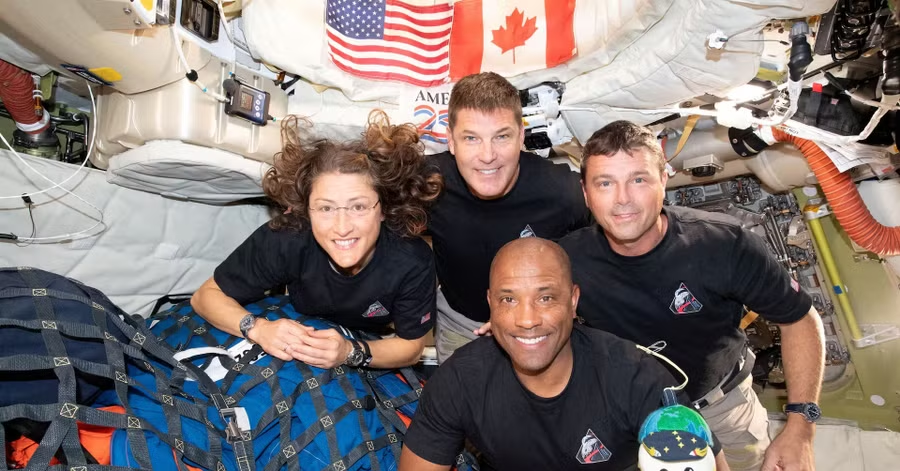
Technology and strategies for protecting astronauts
To counter these threats, NASA designed the Orion spacecraft as a "mobile shield" for the Artemis II crew. In the earlier Artemis I mission, the spacecraft carried radiation sensors, providing crucial data that helped improve the design and protection strategy.
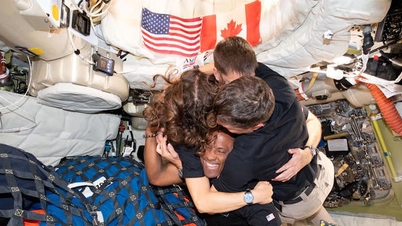
One notable improvement is the dedicated storm shelter. This area, located deep within the spacecraft, is specially reinforced to minimize the impact of radiation in the event of a hazardous event. Upon receiving a warning from monitoring systems, astronauts will quickly move into this area, using additional available materials such as bags to enhance their shielding.
In addition, space weather monitoring systems play a crucial role. NASA and the U.S. National Oceanic and Atmospheric Administration (NOAA) operate numerous satellites such as DSCOVR, located approximately 1.6 million kilometers from the Sun, capable of providing advance warnings 15 to 60 minutes before storms impact near Earth. More recently, newer satellites such as IMAP, Carruthers, and SOLAR-1 have been deployed, allowing for continuous monitoring of solar activity and improving forecast accuracy.
Thanks to an advanced warning system, the control center has a short window of time to determine the severity of the storm. If the forecast indicates that the astronauts may be in danger, they will be ordered to move to the storm shelter on the Orion spacecraft.
However, since a solar storm can last for days, the walls and hull of the spacecraft are made of aluminum and polyethylene to absorb some of the radiation.
However, accurately predicting the timing of solar storms remains a major challenge. Scientists can only identify potentially high-risk activity zones based on data such as sunspots and magnetic field patterns. Eruptions are still random, requiring rapid warning and response systems to be constantly ready.
In an emergency, astronauts must not only rely on existing designs but also be adaptable. They can create "temporary fortresses" by utilizing whatever materials are available on board to enhance protection.
Source: https://giaoducthoidai.vn/phi-hanh-doan-artemis-chong-choi-voi-bao-mat-troi-the-nao-post778020.html















































































Comment (0)