

 |
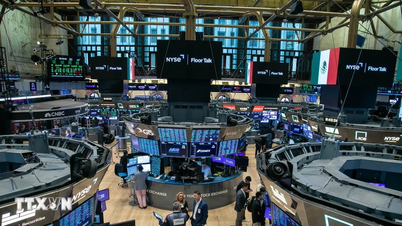
| US stocks rose across the board on March 16 as oil prices cooled and money flowed back into technology stocks. |
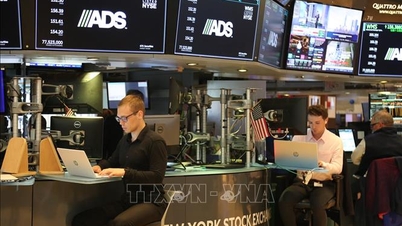
US stocks closed higher on March 16 (early morning of March 16 in Vietnam time) as oil prices cooled and money flowed back into technology stocks. However, investors remained cautious amid geopolitical risks and the outlook for monetary policy from the Federal Reserve (Fed).
The first trading session of the week on Wall Street saw a remarkable recovery as all three major indices rose, marking the strongest rebound since tensions in the Middle East recently escalated. According to aggregated data from international news agencies, the S&P 500 index rose 67.19 points, or 1%, to 6,699.38 points.
Meanwhile, the Dow Jones Industrial Average rose 387.94 points, or 0.8%, to 46,946.41 points. The Nasdaq Composite technology index saw the strongest gains, rising 1.2% to 22,374.18 points.
Small-cap stocks also saw positive performance, with the Russell 2000 rising 23.24 points, or 0.9%, to 2,503.29. This was considered the strongest gain for the US stock market in about five weeks, reflecting a temporary improvement in investor sentiment after a period of significant volatility.
One of the key factors driving the market's upward momentum was the correction in crude oil prices. On March 16th, the benchmark US oil price fell sharply from over $102 per barrel to around $93-$94 per barrel.
Previously, oil prices had surged due to concerns that conflict in the Middle East could disrupt global energy supplies. However, positive signals regarding the potential restoration of shipping activity through the Strait of Hormuz, a route for approximately 20% of the world 's oil, have helped to ease tensions in the energy market.
Lower oil prices not only ease fuel cost pressures on businesses but also push down US Treasury yields. This development creates favorable conditions for the stock market as capital costs tend to decrease and inflation expectations improve.
Energy-intensive sectors such as transportation, aviation, and logistics therefore saw significant buying interest during the session. Investors also appeared more optimistic as risks from the energy market temporarily eased.
Besides energy, technology stocks continued to play a leading role in driving the market upward. Many stocks related to artificial intelligence (AI) and semiconductors recorded significant gains as money flowed back into growth stocks.
According to international financial news agencies, many major technology companies have recently introduced new AI products and solutions at technology conferences, thereby reinforcing expectations for long-term demand for AI computing and infrastructure.
In particular, chip manufacturers, considered central to the global AI race, continue to attract capital from major investment funds. Expectations of a boom in artificial intelligence technology are becoming one of the most important growth stories on Wall Street today.
Thanks to the pull from this group of stocks, the Nasdaq index, which houses many technology companies, recorded the strongest gains among the three main market indices.
Despite the market's impressive recovery, analysts believe the short-term outlook for US stocks remains highly volatile.
Geopolitical tensions in the Middle East remain an unpredictable factor. If conflict escalates or global oil supplies are disrupted, financial markets could face a new shock from energy prices.
Several major financial institutions warn that, in a negative scenario, soaring oil prices could put significant pressure on inflation and undermine global economic growth prospects. This could trigger a stock market correction after a short-term rebound.
In addition, investors are closely monitoring the upcoming monetary policy meeting of the US Federal Reserve. The decision on interest rates and related signals regarding the Fed's policy direction are expected to strongly influence capital flows in global financial markets.
According to many experts, the market is currently "sensitive" to macroeconomic information, especially inflation data, the labor market, and developments in US Treasury bond yields.
Despite a notable recovery, the major US stock indices have not yet fully escaped the volatile trend they have been in since the beginning of 2026.
Year-to-date, the S&P 500 is still down about 2.1%, while the Dow Jones is down 2.3% and the Nasdaq is down about 3.7%. The Russell 2000, representing small-cap stocks, is the only exception, up about 0.9%.
This development shows that the market is still in a correction phase and searching for new momentum as investors must weigh the growth prospects of businesses against the risks from the global economic environment.
In this context, many investors are opting for a cautious strategy, closely monitoring geopolitical developments and monetary policy decisions before increasing their investment holdings.
Nevertheless, expectations of corporate profit growth, along with the wave of AI technology development, are still considered important factors helping the US stock market maintain its attractiveness in the medium and long term.
Source: https://thoibaonganhang.vn/pho-wall-bat-tang-manh-khi-gia-dau-ha-nhiet-178963.html


![[Photo] General Secretary and President To Lam presides over a meeting on preparations for the review of one year of operation of the three-tiered government system.](https://vphoto.vietnam.vn/thumb/1200x675/vietnam/resource/IMAGE/2026/06/02/1780391821195_a1-bnd-4595-9717-jpg.webp)





























































































Comment (0)