

 |
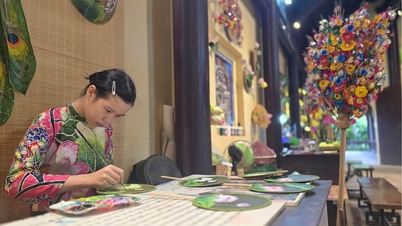
| The craft of weaving sedge mats has helped many families in Phong Dinh escape poverty. |
Giving someone a "fishing rod" to create suitable livelihoods.
Prior to 2020, support for poor and near-poor households in the area was primarily limited to temporary subsidies and emergency relief. This approach only addressed the symptoms and failed to create the motivation for people to proactively improve their lives. Recognizing this limitation, Phong Dinh ward has recently shifted strongly towards a "livelihood-building" approach, providing conditional support and linking responsibility to the effective use of funds.
Through policy credit sources, the Fund for the Poor, production support programs, and vocational training, many poor households have had the opportunity to access resources to invest in livestock farming, crop cultivation, and small-scale trading, gradually stabilizing their lives. Importantly, this model not only helps people improve their material well-being but also changes their mindset, shifting from dependence and reliance to self-reliance and proactively seeking development directions suitable to each family's conditions.
 |
| The goat farming model provides the main source of income for Ms. Huong's family. |
The family of Ms. Nguyen Thi Thu Huong, residing in Tay Phu residential area, Pho Trach commune, is a prime example. Previously, Ms. Huong's family was classified as a poor household. Thanks to local organizations providing capital for house repairs, support with 7 breeding goats, and policy credit loans for small-scale trading since 2023, the initial goat herd, with proper care and techniques, has developed steadily, providing a stable income for the family. To date, Ms. Huong's family has escaped poverty, their lives have gradually improved, and she is even happier to have the means to care for her two grandchildren, who are of school age and suffer from thalassemia (a congenital blood disorder).
Similarly, the family of Mr. Doan Van Tho, residing in Dong Thuong Hamlet, also received support in the form of breeding cows, chicken breeds, and access to preferential loans to develop livestock farming and rice cultivation. Thanks to this model, Mr. Tho's family not only improved their income but also built a stable livelihood and enhanced their quality of life.
 |
| Mr. Tho's cattle farming model provides income for his family. |
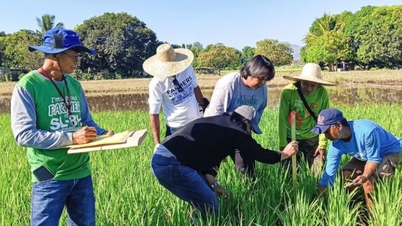
Visiting Phong Dinh today, one can clearly feel the changes in this purely agricultural area. Village roads, alleys, and houses are clean and well-maintained. The people of Phong Dinh are not only focused on traditional farming and livestock raising but are also encouraged to diversify their livelihoods, taking advantage of the local resources. Many households have boldly invested in plows, tillage machines, and rice milling machines, serving both their family's production needs and providing food services and mechanical repairs for people in the surrounding area, creating a significant additional source of income. In particular, many young workers have been supported in learning traditional crafts such as weaving bamboo mats and nets, and have been introduced to jobs, contributing to a reduction in the poverty and unemployment rates that were previously high.
Following ward officials from the central areas of residential clusters such as Dong Phu, Tay Phu, Van Trinh, and the inland sandy areas of Phong Chuong commune (formerly), one can easily find models of cattle and goat farming, duck farming, vegetable cultivation, rice milling services, electrical and mechanical services, etc. Each model here, though small, collectively creates a diverse livelihood picture, suitable to the characteristics of a ward undergoing urbanization.
 |
| Concrete block casting services provide employment for unemployed people and stable income in Phong Dinh. |
According to information from the leaders of Phong Dinh ward, to ensure that poverty reduction efforts are truly effective in the locality, the Party committee, government, and mass organizations have made many efforts. The approach in this locality is to conduct a review and classification of poor and near-poor households at the end of each year according to specific causes, thereby developing practical solutions and support plans for the following year, avoiding situations where support is given to the wrong people or to the wrong addresses.
Organizations such as women's associations, farmers' associations, youth unions, and veterans' associations have played a crucial "bridging" role. They act as guarantors for loans, provide technical guidance, monitor the use of funds, and promptly resolve difficulties for members and the poor. As a result, capital reaches the people without being diverted, ensuring it reaches the right people, improving investment efficiency, and preventing bad debts and overdue loans.
 |
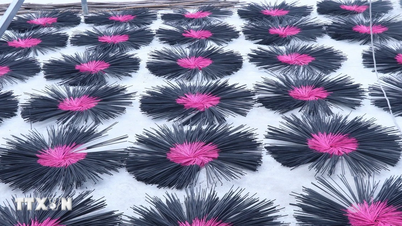
| The craft of net weaving creates jobs and provides additional income for poor families in the local area. |
According to Mr. Doan Van Quoc, Chairman of the Vietnam Fatherland Front Committee of Phong Dinh Ward, the effectiveness of poverty reduction at the grassroots level is also due to the strengthening of propaganda and mobilization efforts. People are clearly explained the goals of sustainable poverty reduction; at the same time, everyone understands that to escape poverty, they need to rise up through their own labor, instead of relying on state support. As a result, people's awareness has changed, and they agree on how to integrate with local socio -economic development programs. Thanks to this synchronized approach, the number of poor and near-poor households in Phong Dinh has decreased year by year, and the material and spiritual lives of the people are increasingly improving. Currently, the entire ward has 6,827 households with 28,273 people, but only 104 poor households with 209 people remain, accounting for 1.52%, a decrease of 36 households compared to 2024.
Phong Dinh Ward continues to identify poverty reduction as the foundation for sustainable development at the grassroots level, therefore it continues to integrate programs and projects, prioritizing livelihood support linked to vocational training, job creation, and income improvement for the people. Alongside these activities and movements, local authorities and associations at all levels strengthen inspection and supervision, replicate effective models, and limit the recurrence of poverty.
 |
| The chicken farming model in Nhat Phong residential area contributes to poverty reduction in the locality. |
According to Mr. Tran Van Huy, Vice Chairman of the People's Committee of Phong Dinh Ward, in the context of the locality being newly established from the merger of three wards/communes, Phong Hoa, Phong Binh, and Phong Chuong, it is necessary to adjust the poverty reduction strategy and implement comprehensive, practical solutions that are appropriate to the new characteristics. Based on the achievements already made, Phong Dinh will continue to implement these solutions in depth, contributing to creating a solid foundation for people to work, produce, and build increasingly prosperous and happy lives.
Source: https://huengaynay.vn/chinh-polit-xa-hoi/phong-dinh-chu-trong-phat-trien-ben-vung-tu-co-so-161269.html


![[Image] Hanoi's urban life under the challenge of a "scorching hot" environment](https://vphoto.vietnam.vn/thumb/1200x675/vietnam/resource/IMAGE/2026/05/25/1779706979265_nang-nong-t5-2026-minh-duy-7-4636-jpg.webp)





































































Comment (0)