

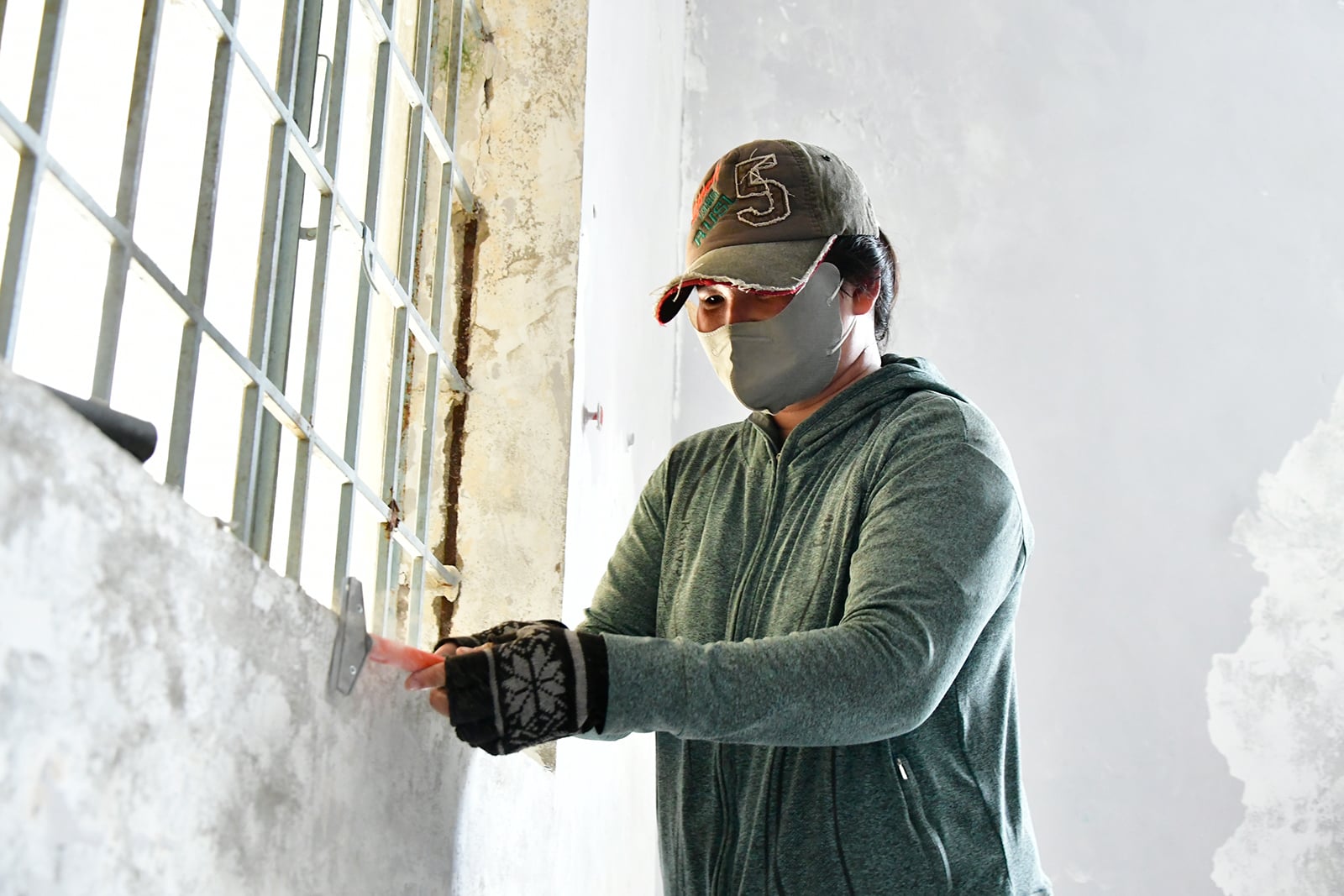
Ms. Thi My Dung scrapes off the old paint at the construction site. Photo: BAO TRAN
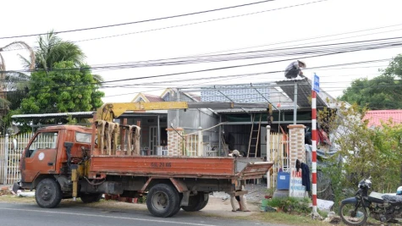
At 7 a.m., the sound of shovels shoveling sand echoed in front of a half-finished construction site in Tay Yen commune. Amidst a group of male workers, Mrs. Vo Hoang Kim (43 years old), a resident of An Bien commune, bent down to pull a bag of cement and mix it with sand and water. Wiping the sweat from her forehead, revealing prominent dark spots on her cheeks, she recounted that she and her husband have two children; the older one is in her third year of university, and the younger one is 12 years old. Every month, they have to go to the hospital for blood transfusions. Once, while waiting for donated blood, the two of them stayed in the hospital for 4-5 days before being allowed to go home. “Before, I worked as a kitchen helper and dishwasher at the market. But every time my child was hospitalized, I had to ask for time off. I missed several days every month, so I felt bad for my employer. After that, I followed my husband to work as a construction helper, doing day jobs, and accepting whatever days I missed,” Mrs. Kim said, her eyes reddening.
In the early days of her career, this woman, accustomed to cooking and housework, often felt disheartened because she couldn't keep up with the men's strength. Some concrete buckets were so heavy that male workers had to help lift them onto her shoulders. She was afraid of heights, but still had to climb scaffolding on high-rise construction sites. For the past 12 years, whenever a project was nearing completion, she would inquire about new jobs beforehand, because even a few days off would leave her short of money for her children's medicine and school fees. "Sometimes, I was exposed to so much cement that my skin itched and my face became more discolored, but I didn't dare complain, afraid my children would hear and want to quit school. I tried to work until my children graduated and found stable jobs, then I'd figure things out," Mrs. Kim shared.
Every day at 5 a.m., Mrs. Kim wakes up to cook rice. She sets some aside for her children at home and takes the rest to the construction site. Her work as a construction laborer is from 7 a.m. to 11 a.m., and then continues from 1 p.m. to 5 p.m. Female laborers are paid 270,000 dong per day, a few tens of thousands less than male workers. Besides the lower wages, female laborers face many inconveniences that men rarely think about. Many construction sites lack restrooms, forcing women to find discreet places to hide. They also have to wear two or three layers of clothing, so that if something tears, it's less embarrassing. Danger is always lurking. Mrs. Kim recalls an incident where she was passing a bucket of mortar up to a worker above; the person receiving it missed, and the bucket fell directly onto her face, causing a minor injury.
After saying goodbye to Mrs. Kim, I sought out Ms. Thi My Dung, a resident of Dong Thai commune, who many workers in the profession describe as quick-witted and courageous, no less so than men. Having worked as a construction laborer for over 8 years, she is accustomed to pulling iron, mixing mortar, carrying cement, and transporting bricks. Unlike many women who are still hesitant about heights, Ms. Dung can nimbly climb scaffolding 5-6 stories high to assist with work. Therefore, her wages are paid the same as men's, around 300,000 VND per day.
At 11 o'clock, Ms. Dung quickly ate the rice she had brought with her and then hung her hammock on the scaffolding to rest. The hammock swayed on the jumbled iron bars as she leisurely recounted her life story. Before becoming a construction worker, she and her husband used to work as hired rice harvesters. But when harvesting machines became more common, and laborers became scarce, she switched to working as a construction laborer.
Because they live near her husband's parents, the couple sends their children to school so they can take on construction projects in Ho Chi Minh City or Phu Quoc to earn extra income. Ms. Dung said that this summer, she and her husband went to Phu Quoc to work again. There, they sometimes work overtime until 8 or 9 PM, earning 600,000 to 800,000 VND per day, plus they receive a meal allowance.
Despite being strong and used to the work, Dung's body still aches on days when she carries many bags of cement or stands in the sun for a long time. Some nights, she and her husband have to take turns massaging her body and giving her painkillers before she can get any sleep. Yet, this woman has never thought about giving up the job. "As long as I have the strength, I'll keep working. I can endure a little more hardship, as long as my children can get a proper education," Dung said, glancing at her phone screen which showed it was almost 1 PM. She took down the hammock hanging on the scaffolding, neatly folded it into her bag, adjusted her mask, and returned to the unfinished section of the wall.
The afternoon sun still blazed down, yet these women continued diligently performing work traditionally reserved for men. They not only contributed to building homes for others but also devoted themselves to securing a better future for their children.
Source: https://baoangiang.com.vn/phu-nu-tren-gian-giao-a486088.html



![[Image] Close-up view of the interchange connecting the two expressways and Long Thanh Airport.](https://vphoto.vietnam.vn/thumb/1200x675/vietnam/resource/IMAGE/2026/05/25/1779703378210_ndo_br_z7863716673926-224453a31600126cce10622af6290afd-4549-jpg.webp)


























































































Comment (0)