

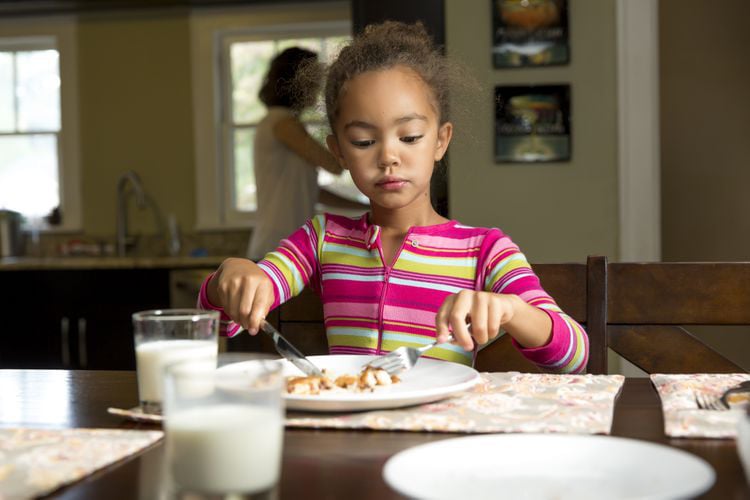
Every child can learn a skill if parents educate them properly - Photo: Parents
Social skills need to be continuously honed as children grow. These skills will continue to develop with age and can be learned and strengthened through effort and practice.
Every child can learn a skill if their parents educate them properly.
Children need to learn how to share.
Being willing to share snacks or toys can be very helpful in helping children make and maintain friends.
According to a study published in the journal Psychological Science , children as young as two years old can express a desire to share with others, but usually only when they have an excess.
You shouldn't force your child to share, but you can frequently point out beautiful things that happen through sharing. When your child shares, praise them and explain how their actions help others, for example, "You shared with your friend. I believe your friend will be very happy. This is a good thing you should do."
Cooperate
Cooperation means working together to achieve a common goal. Children who know how to cooperate respect the requests of others, and are willing to contribute, participate, and help. Good cooperation skills are essential for successful integration into the community.
Cooperation also teaches children a positive attitude toward undesirable situations, that rejoicing in the success of others does not diminish their own self-worth.
Parents should talk to children about the importance of teamwork and cooperation, and how work is better when everyone participates. Create opportunities for the whole family to work together, such as preparing meals or doing household chores, helping children practice in the most familiar environment.
Listen
Listening is not just about staying silent, but about truly absorbing what others are saying. This is a crucial element in healthy communication and building empathy. A child who doesn't know how to listen and understand what others are saying will find it difficult to show compassion or a desire to help.
Parents can develop listening skills in children by reading to them, occasionally pausing and asking them to retell what the reader has just read. Help them fill in any missing details and encourage them to continue listening.
Don't let children interrupt when others are speaking, or hold electronic devices while people are talking.
Follow the instructions.
Children who lack the ability to follow instructions can run into a lot of trouble, from having to redo homework to getting into trouble for misbehavior. To help children develop this skill, parents need to be good at giving appropriate instructions.
At any given time, only give one instruction, allowing the child to complete it before giving another. Remember that it's normal for children to make mistakes, get distracted, act impulsively, and forget instructions. View this as an opportunity to help them develop skills, and praise them when they do well.
Respect personal space.
Teach children to respect other people's personal space, establishing family rules such as knocking on closed doors and not touching strangers. If children snatch things from others or push impatiently, impose punishments to stop these behaviors.
You can create various scenarios to help children practice respecting different personal spaces. As children grow older, parents can explain the concept of boundaries to them, including setting boundaries for themselves and respecting the boundaries of others.
Eye contact
Some children have difficulty making eye contact when talking to someone. Eye contact is an important skill they need to learn. For shy children, gently prompt them instead of scolding, and praise them when they practice well.
Appropriate behavior
Teaching children to say "please," "thank you," and to behave well is very helpful. Everyone respects a well-behaved child.
Teaching good manners can be challenging for young children. Sometimes they are unaware of how they should behave. However, parents need to teach their children politeness and respect, especially in other people's homes and in public places.
Parents should be good role models in terms of behavior, so that children learn from a practical example. Remind children when they forget how to behave and praise them when you see them behaving appropriately.
Good behaviors that young children need to learn.
Knowing how to say "please," "thank you," and "sorry."
Waiting in line for your turn.
Know how to ask for permission
Don't comment on other people's appearance.
Responding to greetings
Expressing gratitude
Knock on the door.
Introduce yourself
Do not use vulgar language.
Do not use nicknames or tease others.
Maintain good personal hygiene.
Hold the door for others.
Offer to help others
Use napkins and eating utensils properly.
Follow instructions without complaining.
Appropriate table manners
Source
![[Photo] First session of the 14th Congress of the Vietnam Trade Union](https://vphoto.vietnam.vn/thumb/1200x675/vietnam/resource/IMAGE/2026/06/03/1780465947883_ndo_br_img-3852-jpg.webp)
![[Photo] General Secretary and President To Lam presides over a meeting with the Central Organizing Committee.](https://vphoto.vietnam.vn/thumb/1200x675/vietnam/resource/IMAGE/2026/06/03/1780482764658_a1-bnd-4741-3342-jpg.webp)

![[Photo] Secretary of the National Assembly Party Committee, Chairman of the National Assembly presides over the meeting of the Standing Committee and Executive Committee of the National Assembly Party Committee.](https://vphoto.vietnam.vn/thumb/1200x675/vietnam/resource/IMAGE/2026/06/03/1780480353201_ndo_br_bnd-2585-jpg.webp)













































![[Video] Sunset at Lap An Lagoon – Where the sun sets over the fishing nets](https://vphoto.vietnam.vn/thumb/1200x675/vietnam/resource/IMAGE/2026/05/31/1780192137701_beach-landscape-sea-water-nature-grass-745871-pxhere-com.jpeg)
































Comment (0)