

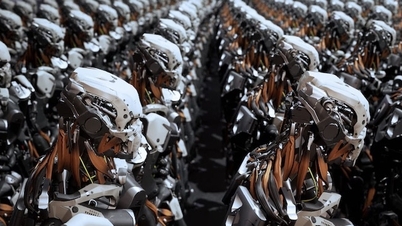
From factories and hospitals to community cultural events, the increasing presence of robots shows that the global technology race has entered a new phase, where artificial intelligence no longer exists on computer screens but manifests itself in "bodies" that can move, interact, and work alongside humans.

Earlier this year, a series of humanoid robots appearing at China's Lunar New Year Gala drew worldwide attention. Behind this technological display lies Beijing's long-term development strategy for the humanoid robotics industry – a field seen as key to future labor productivity and industrial competitiveness.
In recent years, China has consistently promoted the training of robots for practical work rather than just testing them in laboratories. Robots are expected to help address the labor shortage problem and create more room for growth in the large-scale manufacturing economy . Chinese policymakers have also identified humanoid robots as a priority sector by 2030 to maintain a competitive advantage in global supply chains and technology.
Recently, Beijing announced its first national standards for humanoid robots and AI. These standards provide detailed regulations on data systems, AI model training processes, operation, safety, and ethical requirements. This move is seen as a necessary standardization step given the rapid development of the robotics industry.
Not to be left behind, South Korea is also accelerating investment in humanoid robots amid an aging population and increasingly evident labor shortages. The government plans to invest more than 50 billion won in its robot development strategy by 2030. Many technology companies are collaborating with AI companies to build the "brains" for robots – considered the most complex part, as it determines the machines' ability to learn, react, and interact.
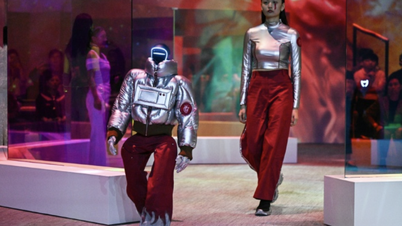
The appearance of four "robot monks" at the Lotus Lantern Festival celebrating Buddha's Birthday in Seoul last May also sparked interesting debate. Images of these robots participating in the traditional parade show that technology is increasingly penetrating cultural life and opening up new approaches to bringing community activities closer to young people.
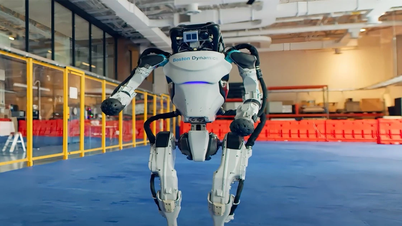
Meanwhile, the US remains one of the leading countries in robotics technology, with many big names such as Tesla, Figure AI, and Boston Dynamics. Recently, the US announced the operation of its first humanoid robot "megafactory" in California, aiming to produce approximately 100,000 household robots by 2027. If this plan comes to fruition, humanoid robots could become commonplace in households much sooner than previously predicted.
Another notable milestone is Figure AI's successful testing of a robot capable of working continuously for over 24 hours. This robot can automatically sort goods, rotate them correctly, and place them on a conveyor belt with virtually no human supervision. This is considered a significant step forward for the logistics and manufacturing automation industries.
In fact, robots have come a very long way in their development. Previously, industrial robots were primarily used for lifting heavy objects or working in hazardous environments. As the demand for automation increased, robots gradually took on jobs requiring high precision in manufacturing, electronic assembly, or engineering operations.
The explosion of artificial intelligence in recent years is creating the biggest turning point. AI helps robots perform repetitive tasks while also enabling them to learn, recognize their environment, and coordinate more flexibly with humans. The human-robot collaboration model – also known as Cobot – is becoming increasingly common in modern factories.
Robots are now also involved in many highly specialized fields such as healthcare, personal assistance, services, and industrial production. In the near future, along with the strong development of AI and machine learning, humanoid robots are predicted to continue expanding their presence in daily life, contributing to changing the way people work, live, and interact with technology.
Source: https://baovanhoa.vn/nhip-song-so/robot-va-nhung-buoc-tien-khong-ngung-nghi-231318.html
![[Photo] Admire the coral "masterpiece" amidst the million-year-old heritage of Dak Lak province.](https://vphoto.vietnam.vn/thumb/1200x675/vietnam/resource/IMAGE/2026/05/31/1780221235105_anh-man-hinh-2026-05-31-luc-16-53-27.png)
![[Image] Hanoi Police officially crowned champions of V-League 2025/2026](https://vphoto.vietnam.vn/thumb/1200x675/vietnam/resource/IMAGE/2026/05/31/1780244769054_ndo_br_039d561b692be875b13a-jpg.webp)

![[Photo] The General Secretary, President and his wife begin their state visit to the Philippines.](https://vphoto.vietnam.vn/thumb/1200x675/vietnam/resource/IMAGE/2026/05/31/1780230559452_anh-man-hinh-2026-05-31-luc-19-28-11.png)

![[Photo] Solemn bathing ceremony and Buddha procession in Hue](https://vphoto.vietnam.vn/thumb/1200x675/vietnam/resource/IMAGE/2026/05/31/1780228263543_1-jpg.webp)
















![[Video] Sunset at Lap An Lagoon – Where the sun sets over the fishing nets](https://vphoto.vietnam.vn/thumb/340x192/vietnam/resource/IMAGE/2026/05/31/1780192137701_beach-landscape-sea-water-nature-grass-745871-pxhere-com.jpeg)







































![[Photo] Admire the coral "masterpiece" amidst the million-year-old heritage of Dak Lak province.](https://vphoto.vietnam.vn/thumb/402x226/vietnam/resource/IMAGE/2026/05/31/1780221235105_anh-man-hinh-2026-05-31-luc-16-53-27.png)


































Comment (0)