

According to Dr. Do Thi Lan, from the Traditional Medicine and Rehabilitation Department of Hai Phong Children's Hospital, the unit recently received a 4-year-old patient who presented with torticollis (wry neck). Clinical and paraclinical examinations ruled out the possibility of congenital diseases or muscle fibrosis.
According to the patient's family, the family trained the child to roll over early from more than 2 months old. The baby lay in a prone position with his head stretched out for a long time, and when tired, he would lower himself down.
At around 4 months, the child showed signs of torticollis but the parents waited for it to go away on its own. After two weeks of waiting, there was no improvement so the parents took the child to see a doctor.
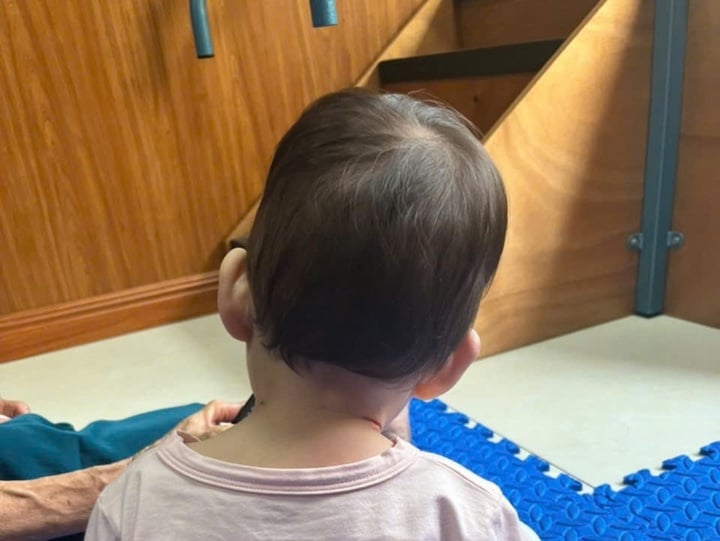
The child has torticollis. (Photo: BSCC)
Torticollis in children has many causes, including: Posture (breech presentation in the womb, after birth due to incorrect positioning during carrying, inappropriate physical activity for their age); Fibrosis of the sternoclavicular muscle; Congenital conditions such as cerebral palsy, developmental delay, and congenital deformities of the cervical spine.
"The cause of the torticollis in the 4-month-old patient is that the family started to encourage the child to crawl too early. At that time, the neck muscles were still weak, making it difficult for the child to crawl independently. Parents supporting the head and neck meant that the neck was held in an extended position for too long, causing the neck muscles to weaken, become fatigued, and gradually turn to one side ," Dr. Lan explained.
Torticollis caused by incorrect posture is common in children aged 4-6 months. However, it can appear later, even after 1 year of age, when parents encourage early crawling, carry or position the child incorrectly, feed them in the wrong posture, or allow them to watch too much television.
If a child's torticollis is detected early due to posture and the curvature is not significant, and the child has good neck movement, the doctor will provide guidance on home care and exercises. In some cases, the child may require therapeutic intervention.
According to Dr. Lan, treatment for torticollis involves a multi-modal approach combining traditional medicine and rehabilitation, including: acupuncture, massage and acupressure, electrostimulation, electrolysis, neck stretching, infrared therapy, ultrasound therapy, and neck splinting. This helps to soften stiff muscle groups, strengthen weak muscle groups, and practice head and neck control to maintain the child's head and neck in the correct physiological position.
To avoid children having a crooked neck, parents should note:
- Let children exercise at the right developmental milestones.
- Do not force your baby to crawl too early. When your baby crawls, do not let him lie on his stomach with his head out for too long.
- Young children have weak neck muscles and should not be carried early. If the child needs to be carried, support the child's head.
- Babies should be breastfed equally from both breasts.
- Avoid lying on your side or turning your head and neck to one side for too long.
- Limit prolonged tilted (rotated) head and neck posture.
- When children are young, limit their TV viewing to avoid prolonged immobility, which can easily cause their necks to become tired and tilt.
Note, when children have abnormalities in the cervical spine, they need to be taken to the doctor early.
Source: https://vtcnews.vn/sai-lam-khien-tre-bi-veo-co-cha-me-can-tranh-ar912374.html

![[Photo] The captivating scenery of the fragrant maple forest in Quang Tri](/_next/image?url=https%3A%2F%2Fvphoto.vietnam.vn%2Fthumb%2F1200x675%2Fvietnam%2Fresource%2FIMAGE%2F2025%2F12%2F10%2F1765353233198_lan09046-jpg.webp&w=3840&q=75)


![[Photo] Explore the US Navy's USS Robert Smalls warship](/_next/image?url=https%3A%2F%2Fvphoto.vietnam.vn%2Fthumb%2F1200x675%2Fvietnam%2Fresource%2FIMAGE%2F2025%2F12%2F10%2F1765341533272_11212121-8303-jpg.webp&w=3840&q=75)





















![[Video] The craft of making Dong Ho folk paintings has been inscribed by UNESCO on the List of Crafts in Need of Urgent Safeguarding.](https://vphoto.vietnam.vn/thumb/402x226/vietnam/resource/IMAGE/2025/12/10/1765350246533_tranh-dong-ho-734-jpg.webp)





















































Comment (0)