

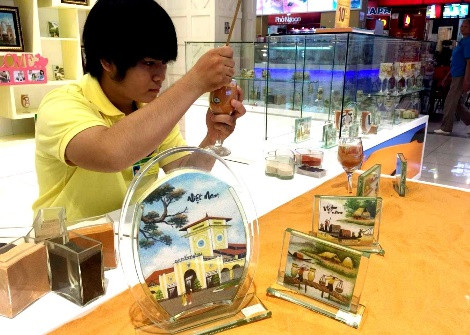
Sand painting
Along the more than 192-kilometer coastline of Binh Thuan province, there are countless natural sand dunes. Besides the Mui Ne sand dunes, there are also the Trinh Nu, Hoa Phu, Chi Cong, and Binh Thanh sand dunes… each one beautiful, with fine, hot, and constantly shifting sand. However, the sand grains of Mui Ne are different; the surface of the dunes has a relatively high proportion of light pink. Therefore, the locals call it the "Pink Dune"; beneath that pink sand layer, there are many other colors. Taking advantage of this region's diverse sand resources, Phi Long Sand Painting Company has extracted sand from the Mui Ne pink dunes and filtered it into 7 types of natural colored sand to create unique sand paintings. I once visited the Phi Long sand painting workshop on Thu Khoa Huan Street (Phan Thiet). At the sand painting workshop, more than 30 artisans, mostly disabled teenagers, are diligently working on pre-ordered works such as sand paintings of seascapes, rural landscapes, portraits, the Phan Thiet water tower, and the Truong Duc Thanh historical site. Particularly noteworthy is the sand painting "President Ho Chi Minh sitting reading a newspaper on a rattan chair," measuring 60cm wide and 120cm long, created by artist Phi Long over several months. Although it's called painting, the tools used aren't pencils or brushes, but rather small tongs and teaspoons used to scoop up glistening grains of sand and pour them into a transparent glass block. Alongside this, there are many portraits of President Ho Chi Minh created by other artists that are indistinguishable from the original photographs. Realistic, unique, artistic, with colors that don't fade and last over time… these are the characteristics of sand paintings, and anyone who has used them is satisfied. Sand paintings have naturally become a valuable cultural and handicraft gift. The artisan has contributed to promoting the image of Vietnam, and his hometown of Binh Thuan, to domestic and international tourists with grains of sand from the pink sand dunes of Mui Ne.
It's not just about painting with grains of sand; the pink sand dunes of Mui Ne are also an inexhaustible source of material for artists to build a "sand sculpture park" showcasing dozens of sculptures on Nguyen Thong Street in Phan Thiet city. With the theme "fairy tale world ," each sand sculpture is created based on fairy tales or cultural symbols. Blocks of sand taken from the pink sand dunes are compressed using hydraulic pressure between sand and water to create a certain hardness, allowing artists to sculpt and shape them into works of art, leaving viewers amazed. I remember a few years ago when the "sand sculpture park" opened, sculptors from 15 countries around the world gathered in Phan Thiet and created nearly 30 magnificent works from over 300 tons of Mui Ne pink sand. The "sand sculpture park" is a meticulously invested art space where young people can connect with nature and deeply appreciate the art of sand sculpture.
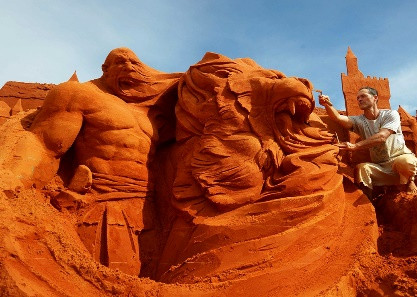
Sculpting statues from the sand of Hong Hill.
If natural colored sand is a distinctive material for artistic creation, then the beautiful shape of the Mui Ne Red Sand Dunes is an endless source of inspiration for photographers. Photographer Le Hong Linh shared: “I have taken hundreds of photos of the sand dunes and have won 20 gold and silver medals domestically and internationally for my photos of the Mui Ne sand dunes. But every time I go back to Phan Thiet to visit my wife's hometown, I always bring my camera to the sand dunes to capture beautiful images. Because the sand dunes are always in motion, they inspire photographers. The newly formed sand dunes, shaped by strong winds, create sharp, curved lines like a young woman's breasts; the ever-changing shape of the sand dunes captivates the creativity of artists. The Mui Ne Red Sand Dunes alone have produced thousands of award-winning artistic photographs domestically and internationally.”
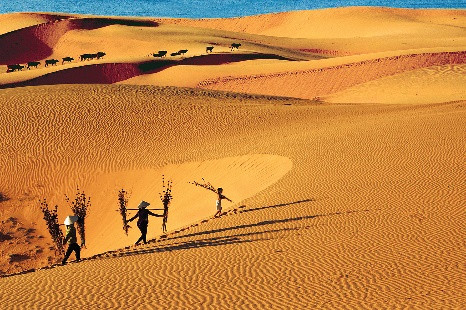
Artistic photo of "Pink Hill in Mui Ne" - University photo
The Mui Ne pink sand dunes were formed a very long time ago, stretching across a vast area of over 50 hectares. The sand surface displays 18 diverse colors, but mainly yellow, ivory white, dark red, light red, and black mixed together, creating a beautiful sight. The most unique aspect of the sand dunes is that after a strong wind or after a day and night, the dunes return to their original appearance. Local people explain this phenomenon as being influenced by natural factors such as monsoon winds, climate, and weather. The wind itself creates the unique and novel landscapes and shapes of the sand dunes, sparking interest and curiosity in many visitors. Here, tourists can compete in climbing small sand dunes or enjoy the exciting activity of sandboarding.
The pink sand dunes of Mui Ne are a priceless gift that nature has bestowed upon this land of sunshine and wind. Despite the harsh climate, the Mui Ne sand dunes have become a source of artistic inspiration. The natural colors in each grain of sand on the pink dunes are unlike any other. This uniqueness serves as inspiration for artisans and artists to create unique tourism products in Binh Thuan.
Source







































































Comment (0)