

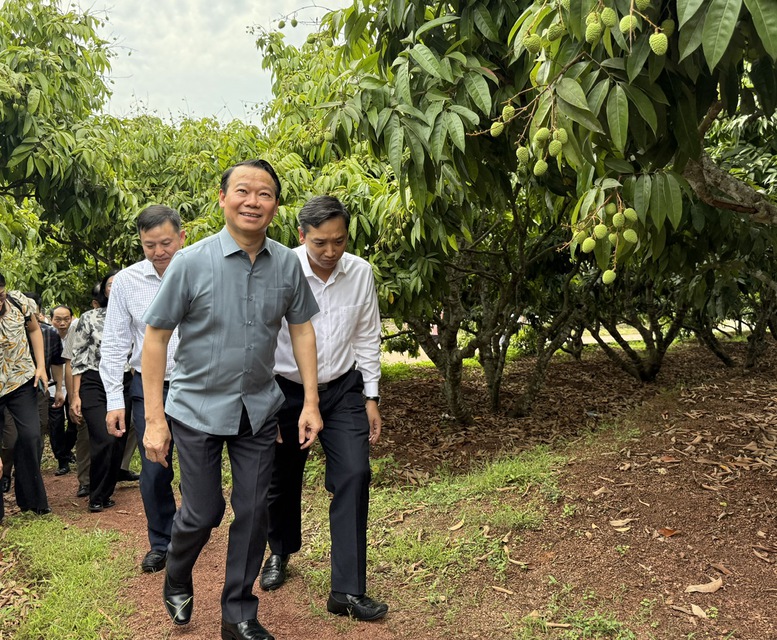
Minister Do Duc Duy acknowledges that the potential for lychee production and value enhancement in Bac Giang province is still very large - Photo: VGP/Do Huong
According to the Department of Crop Production and Plant Protection, Ministry of Agriculture and Environment , the 2025 lychee crop is expected to be bountiful with a projected yield of 303,000 tons, a 30% increase compared to 2024, thanks to favorable weather and effective pest and disease control.
In Bac Giang province alone, the Department of Agriculture and Environment reported that the total lychee growing area is 29,700 hectares, with a production of 165,000 tons, of which: early-season lychee accounts for 8,000 hectares, or 27%, with a production of 60,650 tons; and main-season lychee accounts for 21,700 hectares, or 73%, with a production of 104,350 tons.
The area for producing lychees according to VietGAP standards is 16,000 hectares, with a yield of 116,000 tons; the area for lychee production according to GlobalGAP standards maintains 153 hectares that have already been certified. At the same time, 20 hectares have been newly certified, bringing the total to 173 hectares, with a yield of 1,400 tons; organic lychee production covers 10 hectares in Luc Ngan district.
The province effectively manages and directs production in 238 registered growing areas, covering over 17,400 hectares, serving export markets such as China (127 registered areas, nearly 16,200 hectares, and a production of 110,000 tons).
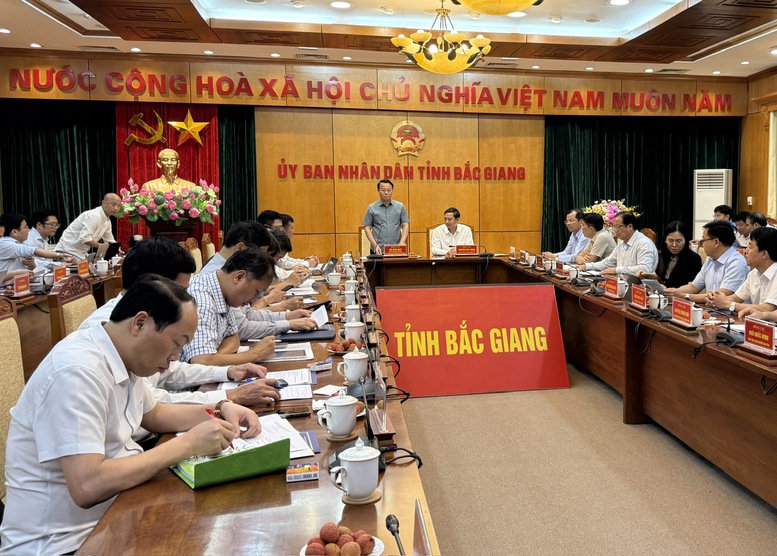
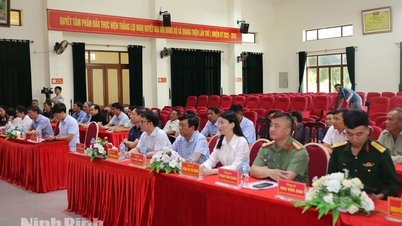
The working group from the Ministry of Agriculture and Environment met with the People's Committee of Bac Giang province and businesses involved in lychee consumption - Photo: VGP/Do Huong
For demanding markets such as the United States, Bac Giang province has 18 registered growing areas, covering nearly 216 hectares and producing 2,500 tons; for the Australian market, 29 registered growing areas, covering over 386 hectares and producing 3,000 tons; for the Thai market, 25 registered growing areas, covering over 290 hectares and producing 2,000 tons; and for the Japanese market, 39 registered growing areas, covering nearly 327 hectares and producing 3,500 tons.
Regarding packaging facilities, the province has 37 facilities that meet the requirements for exporting to the Chinese market, located in districts such as Luc Ngan (33 facilities), Luc Nam (1 facility), Tan Yen (1 facility), Yen The (1 facility), and Bac Giang city (1 facility). One fumigation, sterilization, and packaging facility is maintained in Bac Giang province, and is linked with three fumigation and sterilization facilities outside the province to meet the export needs of the Japanese market; support is also provided to businesses in irradiation procedures for export to the Australian and US markets.
In 2025, favorable weather forecasts ensure the flowering of lychee trees. Early-season lychee varieties are entering the flowering stage, with an expected flowering rate of over 90%; main-season lychee varieties are in the flower bud development stage, with an expected flowering rate of over 85%.
Taking note of the opinions of localities and businesses at the working session, Minister of Agriculture and Environment Do Duc Duy said that the Ministry has implemented many solutions simultaneously. First, controlling production planning, adjusting crop structure, and combining this with enhanced forecasting to adjust production according to market demand.
Secondly, diversify products, prioritizing improved quality and added value, focusing on national key products, regional specialties, and highly competitive products.
Thirdly, investing in deep processing and storage capacity helps address seasonal surpluses when domestic and international markets are unbalanced.
Fourth, we will continue negotiations to expand markets, especially potential markets such as South America, Africa, and the Middle East, leveraging free trade agreements to promote brands and reduce dependence on certain markets like the United States. "Finally, we advise the Government to negotiate trade agreements, remove tariff and technical barriers, and create favorable conditions for Vietnamese agricultural products to access demanding markets," the Minister emphasized.
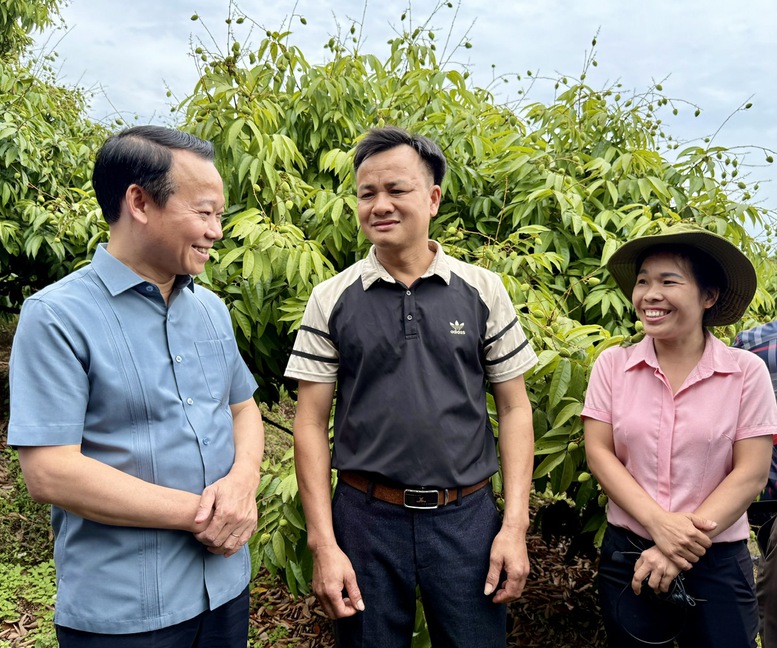
Lychee farmers in Bac Giang share their new expectations for expanding the area of high-quality lychee cultivation with Minister Do Duc Duy - Photo: VGP/Do Huong
The Department of Crop Production and Plant Protection stated that from now until the end of the season, it is necessary to monitor fruit stem borers and respond to heatwaves to protect yields. The Northern Center for Crop Production and Plant Protection has sent staff to support growing areas, ensuring a successful harvest.
The lychee harvest season is short, from May 20th to July 25th, divided into two phases: early lychees (May 20th - June 10th) and main harvest (June 10th - July 25th). Preparations for harvesting, processing, and consumption are implemented early. Regarding quality, localities have monitored the use of pesticides and checked for residues and heavy metals in the lychees.
Regarding processing, lychees are mainly consumed fresh, with only 3% of production processed industrially (juice, frozen, canned), and the majority dried. Processing facilities are ready to operate. From April 2025, the Department of Crop Production and Plant Protection, in coordination with quarantine agencies of various countries, approved 6 facilities for processing fresh lychees (3 irradiated, 3 fumigated) for export to demanding markets. Notably, Japan authorized Vietnam to supervise the processing of export shipments, saving costs and time.
The consumption plan for the 2025 crop year anticipates 60% of the production (181,800 tons) to be consumed domestically through wholesale markets and supermarkets, and 40% (121,200 tons) to be exported, mainly to China (accounting for 90%). Bac Giang and Hai Duong provinces have organized trade promotion conferences and signed agreements with businesses, cooperatives, and transportation and e-commerce companies.
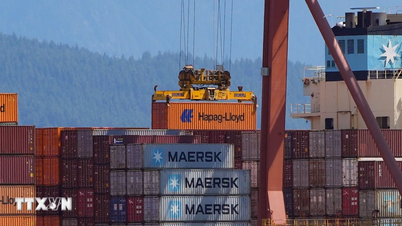
However, the short harvesting period puts pressure on preservation and transportation, while high logistics costs, limited advanced processing technology, and quarantine barriers from major markets such as the United States and Japan remain challenges. Bac Giang has organized a conference to connect consumers and promote cooperation to ensure stable outlets for lychees.
Do Huong
Source: https://baochinhphu.vn/san-sang-cho-vu-vai-thieu-2025-102250511180010874.htm



![[Image] Nearly 125,000 Hanoi students completed the Literature exam for the 10th grade entrance exam.](https://vphoto.vietnam.vn/thumb/1200x675/vietnam/resource/IMAGE/2026/05/30/1780117233041_ndo_br_thiet-ke-chua-co-ten-2-png.webp)













![[Photo] Admire the coral "masterpiece" amidst the million-year-old heritage of Dak Lak province.](https://vphoto.vietnam.vn/thumb/1200x675/vietnam/resource/IMAGE/2026/05/30/1780107638639_y25-jpg.webp)

























































Comment (0)