

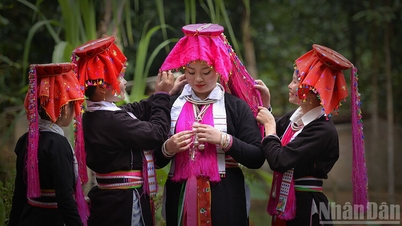
In the classroom, Mrs. Phan Thi Danh, dressed in traditional attire, enthusiastically teaches folk songs to the women and children in the village. According to Mrs. Phan Thi Danh, the Dao Tuyen people have a rich repertoire of folk songs, including lullabies, call-and-response love songs during Tet (Lunar New Year), and songs sung at weddings and funerals. The Dao Tuyen people don't place too much emphasis on musical instruments, so they can sing in any appropriate context, enriching their spiritual lives.
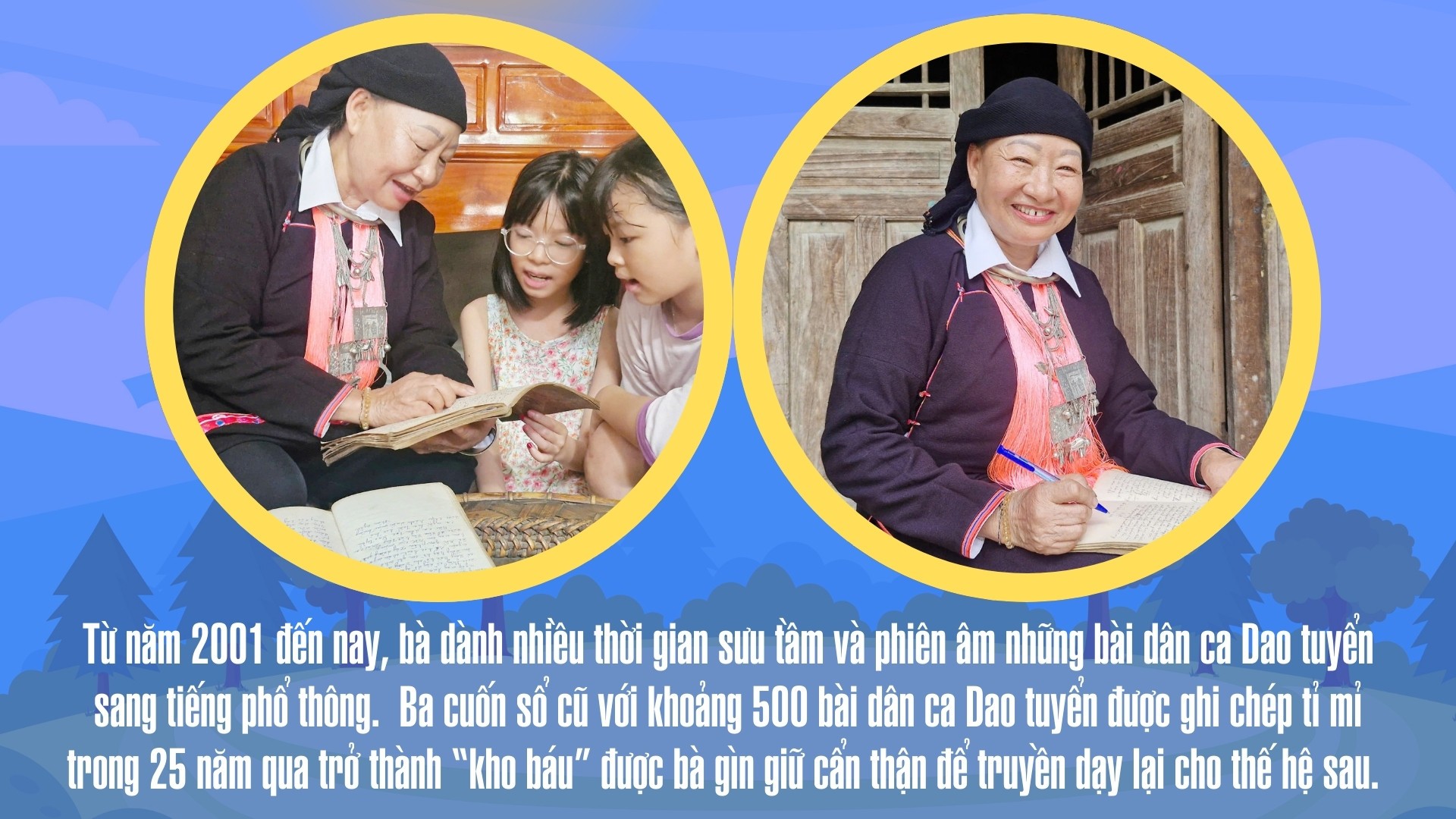
As a daughter of the Dao ethnic group, from a young age, Ms. Danh lived in a cultural environment rich in ethnic identity. In particular, folk songs were like mother's milk, nurturing her soul, and she grew to love and be passionate about her people's songs.
In the past, only Dao men were allowed to learn the Nôm script and learn songs and rituals recorded in ancient books. Women, on the other hand, mainly learned and sang folk songs, lullabies, and love songs through oral tradition passed down from generation to generation, from one person to another.
Mrs. Danh recalled: "When I was little, listening to the women sing, I would hum along and remember the lyrics of a few nursery rhymes. When I was 7 years old, my mother started teaching me to sing short folk songs such as: the fairy tale song 'Tam Cam,' lullabies, songs about mothers going to the fields, songs about palm trees..."
Passionate about learning to sing, by the age of 13, Phan Thi Danh had memorized many folk songs and was taught additional call-and-response love songs by her mother so she could accompany her older siblings to other villages to sing in call-and-response style.
When asked about her youthful years of passion for singing, Mrs. Danh's eyes lit up with joy, just like when she happily participated in the "Village Festival" in the spring. Mrs. Danh said, "In 1993-1994, I was encouraged and guided by Mrs. Lo Thi May, a skilled folk singer in the village. She was my second teacher; she taught me lullabies, how to sing them expressively, how to breathe properly, and how to use vocal embellishments. Especially, she taught me how to train my voice to be clear and high without running out of breath, and how to perform confidently on stage. At the end of 1994, I was invited to participate in a lullaby singing competition organized by Lao Cai province and won second prize."
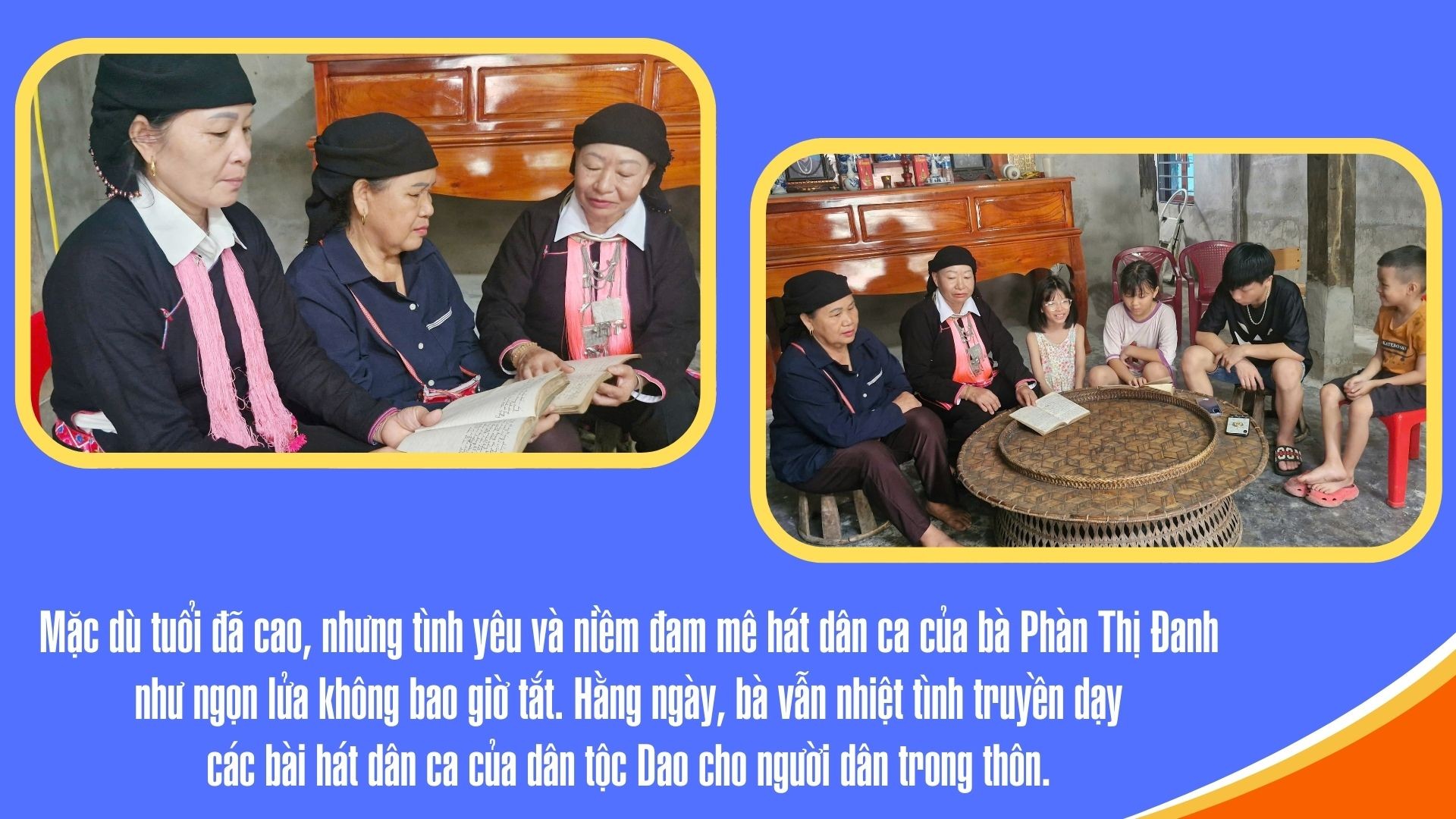
After three years of studying folk songs with Mrs. Lo Thi May, Phan Thi Danh mastered over 250 folk songs, both long and short, belonging to various genres such as wedding songs, funeral songs, songs for spring festivals and celebrations, lullabies, and love songs, becoming the best folk singer in the village.
With her rich repertoire of folk songs and a voice as smooth and sweet as a mountain stream, Phan Thi Danh became a key figure in the local arts scene. She not only sang within her village but also traveled to other villages to engage in call-and-response singing with other folk singers. The voice of this Dao ethnic girl from Bau Bang village spread far and wide, becoming known throughout the region. Every year, participating in the "Singing Festival Across Villages"—a traditional festival of the Dao ethnic group, a singing competition between Bau Bang and Na Nung villages—Phan Thi Danh always emerged victorious.
Meeting Ms. Phan Thi Danh, we were quite surprised to learn that she only completed the third grade, yet her handwriting is remarkably neat and beautiful. Since 2001, she has dedicated much of her time to collecting and transcribing selected Dao folk songs into standard Vietnamese. Three old notebooks containing approximately 500 meticulously recorded Dao folk songs from the past 25 years have become a "treasure trove" that she carefully preserves to pass on to future generations. These include many songs in various genres such as lullabies (5 songs); wedding songs (about 50 songs); courtship songs (over 200 songs); call-and-response songs (about 100 songs); storytelling songs (50 songs); and songs used in rituals (about 50 songs). With her passion for singing and innate talent, based on the folk melodies of her ethnic group, Ms. Danh also composes new songs with new themes, praising the beauty of her homeland, community spirit, and the changes in her locality…
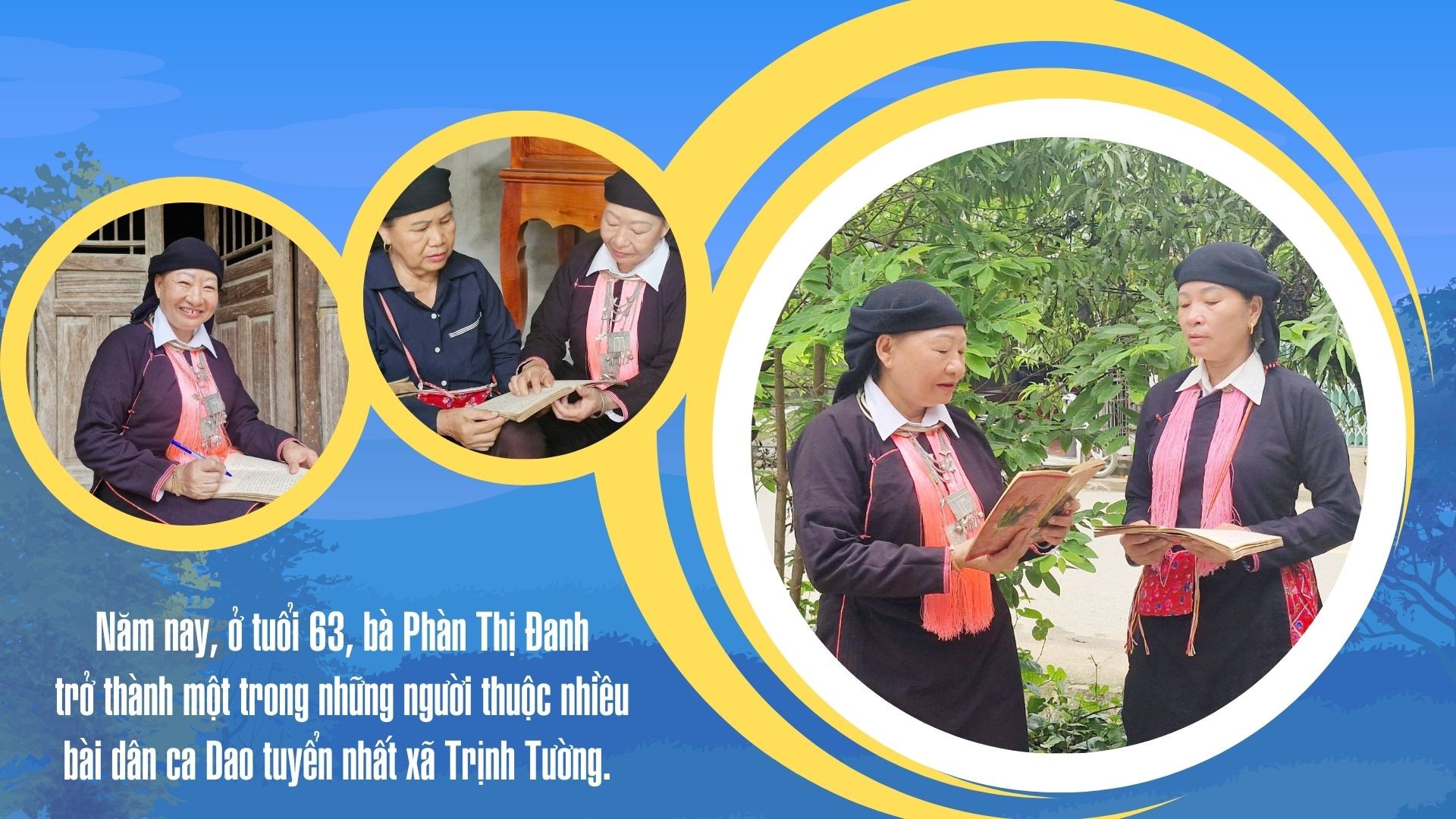
This year, at the age of 63, Ms. Phan Thi Danh has become one of the people who knows the most Dao folk songs in Trinh Tuong commune. Not keeping them to herself, she actively promotes and encourages women in the village to practice singing folk songs to preserve their ethnic identity. Through Ms. Danh's enthusiastic teaching, Dao women in Trinh Tuong commune have learned many folk songs and can perform them at festivals and celebrations, notably Ms. Tan Thi Phuong, Ms. Ly Thi Nga, Ms. Ly Thi Lan, Ms. Ly Thi Sang (Na Lung village), Ms. Phan Thi Hong, and Ms. Tan Thi Lien (Nam Chon village).
As a student of Mrs. Danh, and also a lover of folk songs who actively learned to sing them from Mrs. Phan Thi Danh, Ms. Tan Thi Phuong and her husband, Phan A Gan, have become the "core" of the village's performing arts group.
Ms. Tan Thi Phuong said: "Ms. Phan Thi Danh is not only a talented singer who knows many folk songs, but she also cares about teaching the next generation. She has instilled in us a love for folk songs and a deeper understanding of the beauty of the folk melodies of the Dao ethnic group."
Despite her advanced age, Mrs. Phan Thi Danh's love and passion for folk singing remains undiminished. Every day, she enthusiastically teaches folk songs to the younger generation in the village without expecting anything in return.
In recognition of Ms. Phan Thi Danh's contributions and to encourage her to continue preserving the cultural identity of the ethnic group, the Provincial Folk Arts Association recently organized a workshop to prepare a dossier proposing that the Vietnam Folk Arts Association recognize Ms. Phan Thi Danh as a folk artisan.
"What makes me happiest is that I have passed on my love for folk songs to the younger generation, so that the beautiful cultural identity of the Dao ethnic group can be preserved and endure through time," Ms. Danh shared.
Source: https://baolaocai.vn/sang-mai-ngon-lua-dan-ca-dao-post882148.html
![[Photo] First session of the 14th Congress of the Vietnam Trade Union](https://vphoto.vietnam.vn/thumb/1200x675/vietnam/resource/IMAGE/2026/06/03/1780465947883_ndo_br_img-3852-jpg.webp)
![[Photo] General Secretary and President To Lam presides over a meeting with the Central Organizing Committee.](https://vphoto.vietnam.vn/thumb/1200x675/vietnam/resource/IMAGE/2026/06/03/1780482764658_a1-bnd-4741-3342-jpg.webp)

![[Photo] Secretary of the National Assembly Party Committee, Chairman of the National Assembly presides over the meeting of the Standing Committee and Executive Committee of the National Assembly Party Committee.](https://vphoto.vietnam.vn/thumb/1200x675/vietnam/resource/IMAGE/2026/06/03/1780480353201_ndo_br_bnd-2585-jpg.webp)











































![[Video] Sunset at Lap An Lagoon – Where the sun sets over the fishing nets](https://vphoto.vietnam.vn/thumb/1200x675/vietnam/resource/IMAGE/2026/05/31/1780192137701_beach-landscape-sea-water-nature-grass-745871-pxhere-com.jpeg)






























Comment (0)