

More than just a foreign language, Vietnamese is also considered a key to helping learners access different cultures, expand career opportunities, and increase their competitive advantage in the Southeast Asian labor market.
The circumstances that led me to learn Vietnamese.
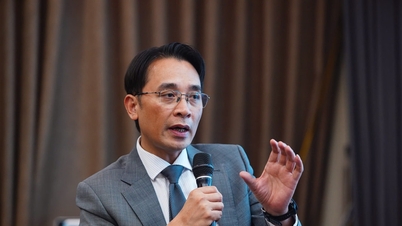
According to Associate Professor Dr. Nguyen Thi Phuong Thuy, lecturer in the Department of Linguistics, Vietnamese Language and Vietnamese Studies, Faculty of Social Sciences and Humanities (Vietnam National University, Hanoi), the program for teaching Vietnamese to foreigners, especially Chinese students, was established quite early.
 |
| Associate Professor Dr. Nguyen Thi Phuong Thuy, lecturer in the Department of Linguistics, Vietnamese Language and Vietnamese Studies, University of Social Sciences and Humanities. (Photo: Thanh Huyen) |
Since 2002, the Department of Linguistics has laid the foundation for cooperation with many universities in China to train and exchange students studying Vietnamese.
She stated that the motivations for learning Vietnamese among Chinese students today are quite diverse. Many students choose Vietnamese with the aim of working in diplomatic agencies, immigration, radio and television stations, or commercial enterprises between the two countries. Others continue their studies at the graduate or doctoral level to become Vietnamese language lecturers at universities in China.
Notably, many students come to study Vietnamese through unexpected circumstances. Associate Professor Dr. Nguyen Thi Phuong Thuy recounted the case of a student who had initially wanted to study another foreign language but switched to Vietnamese due to the high competition scores.
However, after graduation, it was the advantage of Vietnamese being "less competitive but highly specialized" that helped this student get hired by Beijing Television.
"She said that there's a silver lining in every cloud. Thanks to learning Vietnamese, her competitiveness is lower compared to students majoring in English, which opens up more job opportunities," she shared.
For practical reasons, the journey of learning Vietnamese for many Chinese students gradually transforms into a cultural and personal connection.
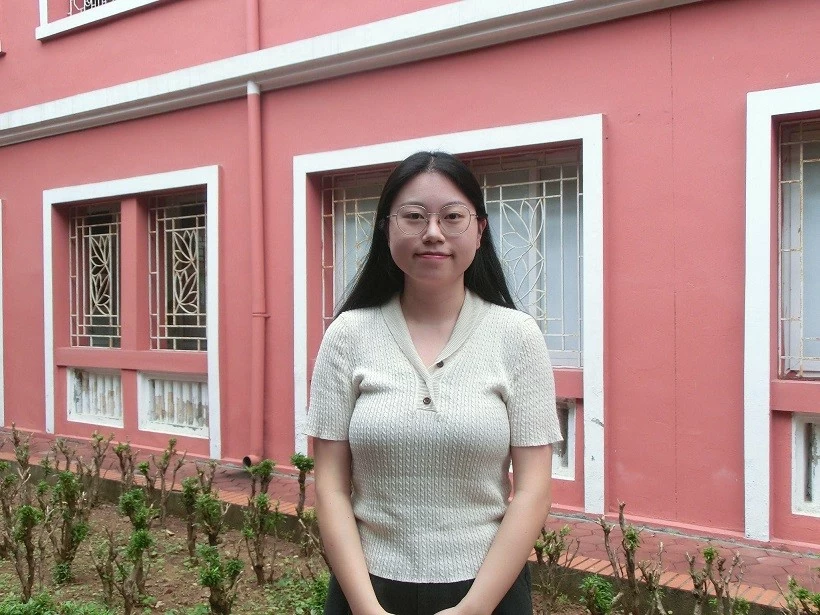
Hung Mai, a third-year student at Yunnan Nationalities University, currently on an exchange program at the University of Social Sciences and Humanities, said she chose Vietnamese because she found it easier to learn than some other Southeast Asian languages, and also because Vietnam has better development prospects and broader job opportunities.
Initially, Hung Mai's impression of Vietnam was mainly based on "viral" songs on TikTok or the reputation of Vietnamese coffee. However, during her studies and life in Vietnam, she gradually understood that language is not only a means of communication but also a "bridge to culture."
According to her, only when learners reach a certain level of Vietnamese proficiency can they truly understand the life, way of thinking, and cultural values of the Vietnamese people.
 |
| Hung Mai, a third-year student at Yunnan Nationalities University, China. (Photo: Hai Phuong) |
Learning Vietnamese also presented many challenges. For Hung Mai, the biggest difficulty was pronunciation because Vietnamese has a rather complex tonal system. To overcome this, she regularly watched Vietnamese television dramas, practiced speaking by imitating the characters, and read Vietnamese novels to build her vocabulary.
Meanwhile, Vuong Tuan Tinh, an exchange student at Hanoi University, believes her biggest obstacle is her shyness about communicating. However, she gradually realized that language learning cannot be separated from the process of conversing and connecting with native speakers.
Changing perspectives on Vietnam
Beyond overcoming language barriers, many Chinese students also gain practical experiences that change their perspectives on Vietnam.
Hung Mai recalled that when she first arrived in Vietnam, her limited communication skills often caused difficulties in her daily life.
However, the enthusiasm of the delivery people, the dedication of the lecturers, and the help in buying a SIM card or getting a bank card made her clearly feel the friendliness of the Vietnamese people. "I think Vietnam is a very enthusiastic and patient country," she shared.
For Vuong Tuan Tinh, the most profound impression was the care and attention she received from her lecturers when she first arrived in Vietnam. This support not only helped her quickly adapt to the new environment but also created a sense of closeness during her studies and daily life.
 |
| Ms. Vuong Tuan Tinh giving a presentation at Hanoi University. (Photo: Thanh Huyen) |
From a career perspective, the Vietnamese language is gradually opening up many new opportunities for Chinese students. Besides interpreting and translating in Vietnam-China exchange programs, many students also participate in research programs, academic conferences, or work in import-export businesses between the two countries.
Some students hope to be able to teach Chinese in Vietnam or work long-term in a bilateral cooperation environment.
In addition, the increasing presence of Chinese businesses in Vietnam and Vietnamese businesses collaborating with the Chinese market has also increased the demand for Chinese personnel fluent in Vietnamese.
Many companies in the import-export, logistics, e-commerce, tourism, and manufacturing sectors prioritize hiring employees who are bilingual in Vietnamese and Chinese to support partner networking, customer service, and business operations.
This makes Vietnamese a practical career advantage for Chinese students who want to work long-term in Vietnam or in a bilateral economic cooperation environment.
According to experts, this trend reflects the increasingly prominent role of language in connecting regional human resources. As economic cooperation and educational exchanges between Vietnam and China expand, the demand for personnel proficient in Vietnamese and knowledgeable about Vietnamese culture is also increasing significantly. Therefore, Vietnamese is not only a language skill but also a competitive advantage in the international labor market.
In this context, many opinions suggest that it is necessary to continue expanding student exchange programs between the two countries, while strengthening Vietnamese language training for foreigners in a practical way and linked to actual career needs.
Furthermore, promoting linkages between schools and businesses is also crucial in creating sustainable career opportunities for students, giving them the chance to access internships, research, and employment while still in school.
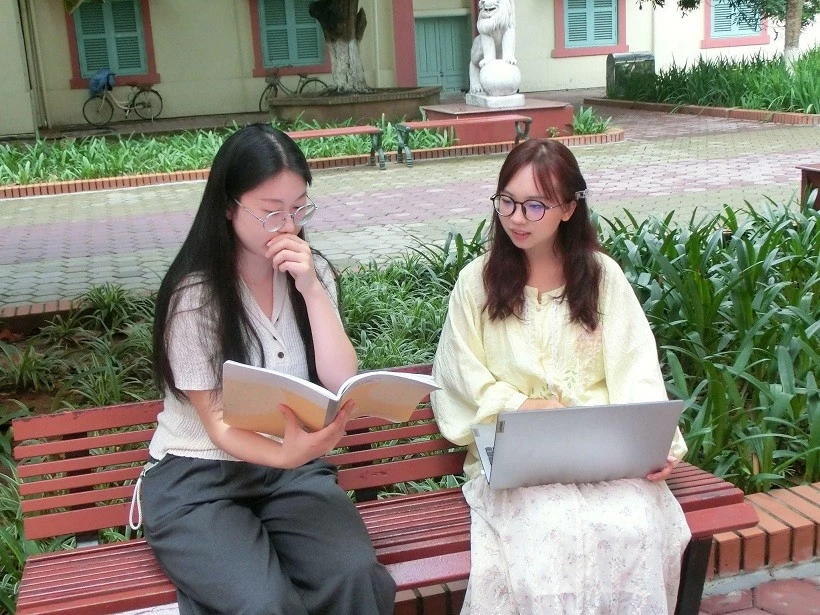 |
| Chinese students discuss their studies after class. (Photo: Thanh Huyen) |
From Vietnamese language classes for international students to personal stories about overcoming language and cultural barriers, it's clear that the Vietnamese language is gradually becoming an important bridge in Vietnam-China relations.
Language not only opens up opportunities for learning and career advancement, but also contributes to fostering understanding between people, a sustainable foundation for future regional cooperation.
Source: https://baoquocte.vn/sinh-vien-trung-quoc-tim-kiem-co-hoi-tu-tieng-viet-395689.html
![[Image] Hanoi's urban life under the challenge of a "scorching hot" environment](https://vphoto.vietnam.vn/thumb/1200x675/vietnam/resource/IMAGE/2026/05/25/1779706979265_nang-nong-t5-2026-minh-duy-7-4636-jpg.webp)

![[Image] Close-up view of the interchange connecting the two expressways and Long Thanh Airport.](https://vphoto.vietnam.vn/thumb/1200x675/vietnam/resource/IMAGE/2026/05/25/1779703378210_ndo_br_z7863716673926-224453a31600126cce10622af6290afd-4549-jpg.webp)



















































































Comment (0)