

This afternoon (December 18th), at the Ho Chi Minh City Press Center, the Ho Chi Minh City Department of Education and Training held a press briefing on various educational issues of interest, including the collaboration in organizing educational activities at general education institutions in the city; and the "collaborative" subjects in public schools.
What is the legal basis for implementing collaborative educational activities within public schools?
Mr. Ho Tan Minh, Chief of the Office of the Department of Education and Training of Ho Chi Minh City, said: "There are no voluntary subjects here," "no joint subjects," and hoped that the press would use the correct names for the subjects in the 2018 General Education Program.
According to Mr. Ho Tan Minh, the subjects and educational activities in the 2018 General Education Program help to develop competencies and qualities in students, specifically 10 competencies and 5 qualities, and these qualities are not only manifested in subjects but also in other educational activities.
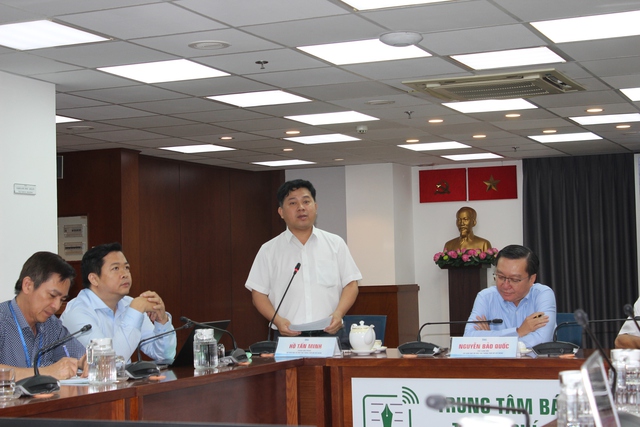
Mr. Ho Tan Minh, Chief of the Office of the Ho Chi Minh City Department of Education and Training, answered questions from the press on the afternoon of December 18th. Next to him on the right is Mr. Nguyen Bao Quoc, Deputy Director of the Ho Chi Minh City Department of Education and Training.
PHOTO: THUY HANG
In addition to conducting lessons according to the 2018 General Education Program's curriculum, schools will use the remaining lessons to implement supplementary educational activities, consolidate and develop students' abilities; organize other educational activities from socialized sources to enhance students' capabilities and meet the practical requirements of the city, including scientific and technical research activities, career guidance education, experiential activities, STEM/STEAM education, reading culture education, etc., to meet the needs, interests, and talents of students…
According to Mr. Ho Tan Minh, depending on the situation, the school can assign teachers who have not yet met the teaching load to organize these activities in the form of free clubs. Once the teaching load of existing teachers has been met, the school is responsible for surveying and compiling the needs of students and parents on a voluntary basis to organize educational activities according to the needs and interests of the students. The principal will organize the development of a time plan for implementation that is consistent with the time plan of the curriculum for each subject, educational activities, and the specific conditions of the school.
Speaking at this afternoon's press briefing, Mr. Ho Tan Minh stated that when principals develop the main curriculum and school program, Decree 24 ( Government Decree No. 24/2021/ND-CP) "allows principals to collaborate" in organizing these activities.
"During the implementation of the school program, the first thing the Department requires schools to do is to develop a plan. This plan must first ensure fairness in education, ensure transparency in development, guarantee quality in education, and be organized in the spirit of prioritizing students. Secondly, schools must utilize all available resources, including resources from teachers who do not have enough teaching hours, to develop activities within the school. When school resources are exhausted, then these activities should be socialized," said Mr. Ho Tan Minh.
Some establishments are not operating correctly and must be dealt with decisively.
Mr. Minh also affirmed that the Department of Education and Training had provided detailed guidance to schools during the implementation process, stating, "The process of implementing collaborative education activities in Ho Chi Minh City has been thoroughly understood and carried out systematically and in detail."
In particular, he emphasized that while schools can engage in collaborative programs, principals must obtain approval from the school board and parents during the curriculum development process. Parents should have the option to choose what they want to participate in to develop their children's qualities and abilities.
"According to document 1619 from the Department of Education and Training regarding school programs, we require that the program must have at least two options for parents to choose from, ensuring that parents' needs are met in accordance with their children's developmental needs. Based on parents' registrations, the school will assign classes accordingly, implement a suitable timetable, and organize activities flexibly, without forcing students to study," Mr. Minh said.
"However, given the large number of schools, some institutions are not implementing the program correctly, and the Department will decisively address these issues. It's impossible to equate the entire program with benefiting students, developing their qualities and competencies, and benefiting parents," Mr. Minh stated.
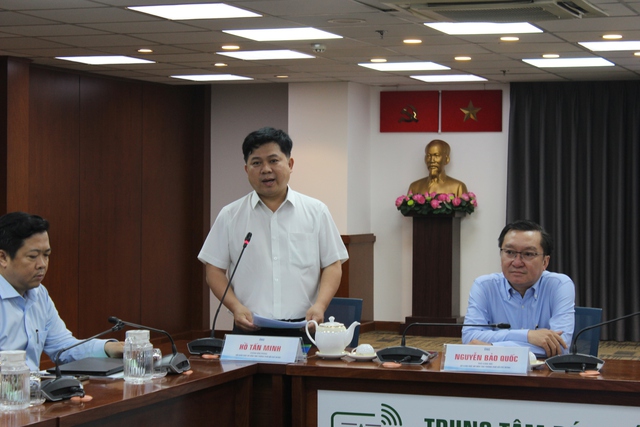
Mr. Minh stated that some institutions are not following the school curriculum correctly and must be dealt with decisively.
PHOTO: THUY HANG
The Chief of Staff of the Ho Chi Minh City Department of Education and Training affirmed, "We are ready to receive information from any school and will handle any issues decisively. The education sector will identify what is wrong and address it accordingly, to ensure that the education sector always provides transparent information to the public, guarantees educational fairness, program quality, and content."
At the same time, according to Mr. Minh, when controversies arise regarding school curriculum subjects, it is due to insufficient supervision within the education sector. He hopes for continued support, sharing, feedback, and suggestions from the press to receive information, thoroughly address issues, and bring positive results for 2.6 million students and more than 3,500 schools.
As Thanh Nien newspaper reported recently, following the 10th session of the 15th National Assembly, on the morning of December 15th, at the headquarters of Bach Mai ward (Hanoi), General Secretary To Lam and National Assembly delegates met with voters from the following wards: Dong Da, Kim Lien, Van Mieu - Quoc Tu Giam, Lang, O Cho Dua, Ba Dinh, Ngoc Ha, Giang Vo, Hai Ba Trung, Vinh Tuy, Bach Mai...
Discussing some major policies related to education and health in the recent past, the General Secretary emphasized that communes and wards must grasp the detailed and specific needs of schools and healthcare facilities in their areas in order to prepare the necessary infrastructure and equipment.
The General Secretary also noted, through discussions with Hanoi city leaders and voters, that there is still a situation where "the State provides free tuition, but schools come up with many other things that charge more money."
"The state only waives tuition fees of 1-2 million VND, but the school collaborates with companies to bring in outsiders to teach foreign languages, AI, music, physical education, etc., and then collects money, forcing the children to pay an additional few million VND," the General Secretary said, emphasizing: "Schools cannot be turned into service establishments. Hanoi must investigate this because this phenomenon is contrary to the true nature of education."
The article in Thanh Nien newspaper, along with the General Secretary's statements, was quickly and widely shared among parents across various social media platforms.
Source: https://thanhnien.vn/so-gd-dt-tphcm-noi-gi-ve-cac-chuong-trinh-lien-ket-tu-nguyen-trong-nha-truong-185251218125727028.htm


![[Photo] Enchanting ancient rose garden on the mountainside in Nghe An](/_next/image?url=https%3A%2F%2Fvphoto.vietnam.vn%2Fthumb%2F1200x675%2Fvietnam%2Fresource%2FIMAGE%2F2025%2F12%2F19%2F1766109900916_vuon-hong-chin-do-thu-hut-du-khach-toi-check-in-o-ha-noi-3-20162778-1671624890024-1671624890104198100259.jpeg&w=3840&q=75)
![[Photo] General Secretary To Lam visits the exhibition space showcasing books, photo exhibitions, and achievements of digital transformation in journalism.](/_next/image?url=https%3A%2F%2Fvphoto.vietnam.vn%2Fthumb%2F1200x675%2Fvietnam%2Fresource%2FIMAGE%2F2025%2F12%2F19%2F1766110879215_1766110240024-jpg.webp&w=3840&q=75)












































































Comment (0)