


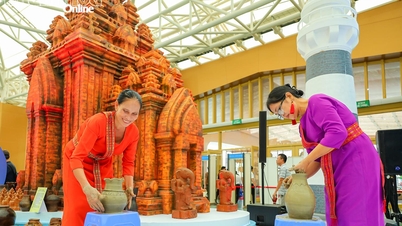
The program brings together various activities including exhibitions, experiences, public interaction, and thematic dialogues, aiming to spread social awareness about the role of intellectual property in innovation, cultural industry development, and unlocking new resources for growth.
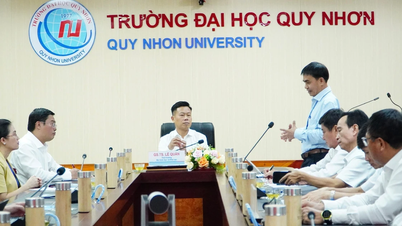
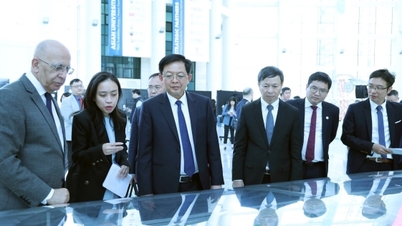
Comrade Le Quoc Minh, Member of the Central Committee of the Party, Editor-in-Chief of Nhan Dan Newspaper, Deputy Head of the Central Propaganda and Mass Mobilization Department, and President of the Vietnam Journalists Association , emphasized the necessity of the series of events as well as the role of intellectual property in the heritage economy in particular and the creative industry in general. He hoped that this series of events would become an open forum for all parties to exchange views on how intellectual property is increasingly involved in the development of culture, businesses, technology, and markets.
Vietnam is a country rich in heritage – tangible, intangible, documentary, natural, traditional crafts, folk knowledge, cultural symbols – that has endured throughout the nation's history. This is a vast cultural resource, yet it has not been adequately transformed into a driving force for development.
Resolution No. 80 of the Politburo on the development of Vietnamese culture clearly outlines the goal: developing the heritage economy, cultural industry, and creative economy based on Vietnamese cultural values. This represents a step forward in development thinking. Previously, when discussing culture, many people thought of it as an area requiring investment, support, and preservation. Now, Resolution 80 sets a higher standard: culture must become an endogenous resource for growth, directly contributing to the creation of wealth, jobs, brands, and national competitiveness.
The resolution clearly states the goal of making cultural industries a new growth engine, striving to contribute 7% of GDP by 2030 and 9% by 2045. That is a very strong policy message; within that picture, the heritage economy is a noteworthy component.
Heritage, if merely preserved, will struggle to generate new vitality. However, if properly identified, retold in contemporary language, and linked to products, services, brands, tourism, education, and technology, heritage can open up vast opportunities for development.
To seriously develop the heritage economy, we cannot ignore the role of intellectual property – a tool for establishing rights, identifying value, protecting creative achievements, and creating a legal basis for cooperation, investment, commercialization, and the distribution of legitimate rights and benefits. Without identifying the intangible asset classes within heritage, it will be very difficult to transform heritage into assets.
Cultural symbols, traditional motifs, folk tales, craft products, traditional techniques, geographical indications, designs derived from heritage materials... if not viewed from an intellectual property perspective, are easily copied, exploited arbitrarily, and even "distorted" right in their own backyard. Conversely, if properly protected, they form the foundation for new value chains: brands, products, game design, content industry, cultural tourism, experiential education, and new media platforms. If Resolution 80 is a major guideline, then intellectual property is one of the important tools to realize that guideline.
Developing the economy of heritage does not mean commercialization at all costs. Heritage cannot be turned into a simple commodity, nor can it be exploited in a short-term, arbitrary manner that negatively impacts cultural identity. If we only focus on immediate benefits, we may generate short-term revenue but lose long-term value – in that case, the losses will far outweigh the gains.
Therefore, it is necessary to build a healthy ecosystem, with the State playing a key role in perfecting institutions and policies; experts in appraisal, consultation, and critical analysis; the community – the custodians and practitioners of heritage and beneficiaries of its rights; businesses in investment, innovation, and market organization; and the press and media in disseminating correct awareness, promoting good models, and warning against deviations.
Comrade Le Quoc Minh stated: "Today's series of events is being held in anticipation of World Intellectual Property Day on April 26th. In Vietnam, this day has been observed for many years; social awareness of intellectual property is increasingly integrated into business life, innovation, technology, and communication."
This year, in the context of the recently issued Resolution 80, raising the issue of "intellectual property in the heritage economy" is very timely and necessary. It's timely because if Vietnam's cultural industry wants to develop, it cannot enter the market empty-handed – it must have intellectual property, protection capabilities, and the ability to organize creative activities based on heritage in a legal, professional, and high-value-added manner. It's necessary because this is the time to speak with a development mindset, clarify mechanisms, identify bottlenecks, and propose models that can be implemented in practice.
With that spirit in mind, Nhan Dan Newspaper is organizing this series of programs with the desire to create a forum for frank, substantive, informative exchange and to suggest solutions. If the press fulfills its role correctly, it not only reflects the reality but also contributes to paving the way for necessary social discussions.
For Nhan Dan Newspaper, organizing today's series of events is part of the responsibility of the leading media agency in accompanying the country's major issues - especially those that are posing new demands on thinking, institutions, and action.
Source: https://baotintuc.vn/thoi-su/so-huu-tri-tue-dong-luc-cho-kinh-te-sang-tao-20260424131157317.htm













































































Comment (0)