

Besides learning pottery and embroidery techniques, they also get to tour the workshops, hear about the history of the craft village, and discover the beauty of traditional culture.
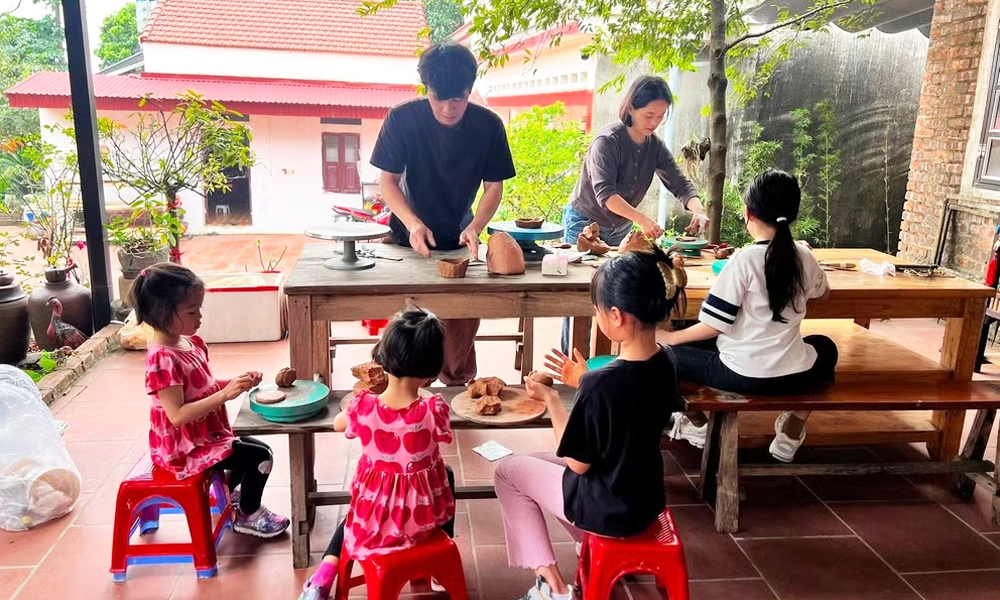 |
Experience pottery making at Huân Pottery Workshop. |
A pause with ceramics
In the quiet brick courtyard of the Huân Pottery Workshop, a group of people, covered in dirt, diligently worked at their pottery wheels, their faces revealing their delight at directly touching and feeling the softness, coolness, and damp, earthy scent of the clay. “It’s a feeling of closeness and authenticity. We’re touching the stillness of the earth,” Minh Trang, a young marketing professional, said emotionally.
Ms. Huong, the pottery artisan guiding the workshop that day, kindly introduced the pottery-making process. “When turning the pottery, you need to concentrate to adjust your hand pressure and feel the thickness of the clay,” the experienced potter shared. The vase on the potter's wheel, which was taking shape, suddenly warped on the left side due to the impatience of the young apprentice named Tuan. At noon, with a sore back, aching legs, and a rumbling stomach, his creative handcrafted product was still nowhere near completion. Tuan gained valuable experience about the craft and the creative process.
In a nearby rustic display space, the workshop owner was introducing the history of Phu Lang pottery village (now Phu Lang commune, Bac Ninh province), holding a beautifully glazed ceramic bowl with a look of satisfaction. Explaining his decision to return to his hometown of Phu Lang to open his own workshop after graduation, pottery workshop owner Bui Van Huan said it was due to fate. And because of fate, Huan chose the path of handcrafted, hand-molded pottery.
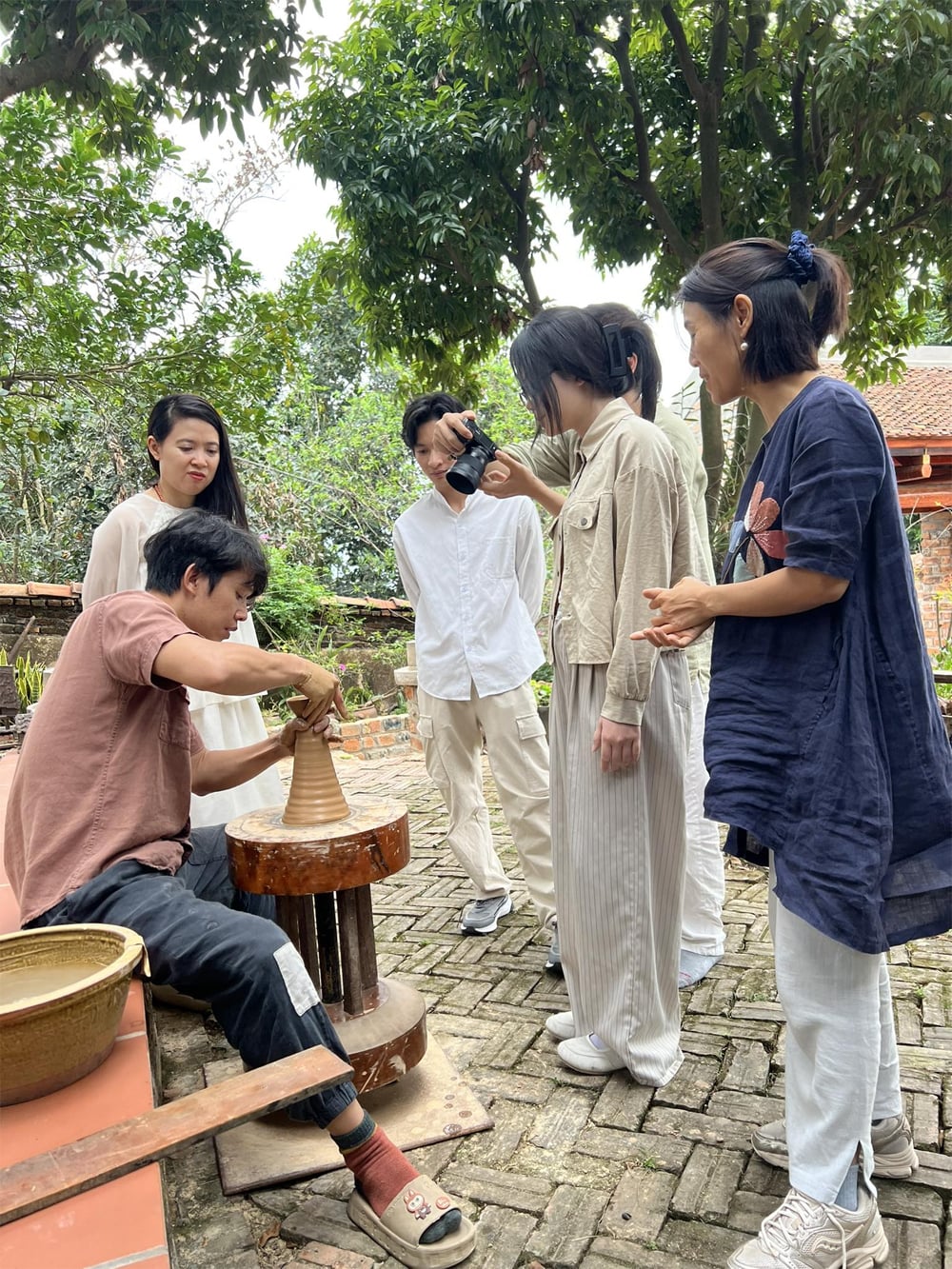 |
Young people enjoy the experience of working with handcrafted pottery. |
To date, Huân Pottery Workshop is one of the few places that still chooses the traditional wood-fired pottery technique. Although labor-intensive and risky, the spontaneous use of glaze colors creates a unique and unmistakable beauty. Many of Huân's collections have been displayed at art exhibitions and exported to Japan, South Korea, and Europe. What makes Huân most proud is "being able to make a living from his love for traditional crafts." Huân says that more and more people are appreciating and wanting to learn about handcrafted products. Parents also bring their children to visit the village and experience pottery making.
Completing a pottery product leaves the apprentices exhausted. Each product, therefore, is the culmination of patience and creativity. After drying and glazing, the apprentices' products are fired at the Phu Lang workshop. Many of the homemade products that crack or break during firing become exhibits showcasing the pottery-making process for visitors.
Many such small classes have been opened right in the artisans' yards and pottery workshops in Phu Lang. Currently, Phu Lang pottery village has about 10 establishments offering experiential tourism , combining vocational training and cultural introductions to international visitors. Visitors can try their hand at molding vases and teacups, and listen to stories about the lives and work of the artisans in the pottery village along the Cau River. Unlike the dry, mixed information flooding the internet, many people see these lively classes in a peaceful setting as a place to rediscover themselves, an opportunity to pause and feel, allowing their souls to be soothed by the simple clay in their hands.
Embroidery class
While browsing online for ideas for a jewelry design assignment, Nguyen Vu My (a third-year student at the University of Industrial Fine Arts) stumbled upon a class taught by artisan Nguyen Thi Hang, head of the My Duc Hand Embroidery Cooperative (Hanoi).
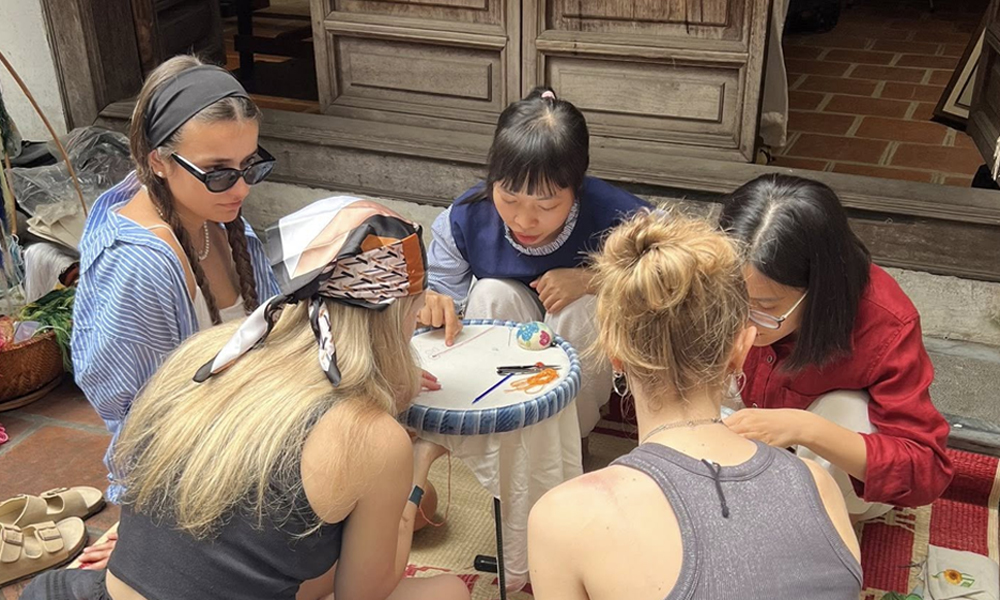 |
The embroidery class attracts many young people. |
Inspired by stories shared in her embroidery class, My traveled to meet embroidery artisans in Hoanh village (Phuc Son commune, Hanoi). For Vu My, the artisans' class was an incredibly useful practical experience. The student enjoyed learning the craft secrets of the village from the artisans and exploring local customs and traditions. Through this, she gained a deeper understanding of the profound meaning of each traditional motif and pattern.
Returning to the embroidery village many times out of curiosity and fascination, My and her friends learned more about the meticulousness and attention to detail in each stitch. For the first time, they heard about techniques such as twisted embroidery, end-to-end embroidery, cross-stitch embroidery, bead embroidery, scale embroidery, and upstitch embroidery.
In particular, they were given detailed explanations of the origins of each type of pattern and motif. Each pattern and motif is associated with a cultural story. At the embroidery frame, each artisan meticulously showed them how to apply each pattern and motif to different types of fabric, using different embroidery styles and stitches.
Attending embroidery classes isn't just for students seeking creative inspiration. Many students are office workers, freelancers, and housewives looking for a hobby. When asked, many cited the mental health benefits of pursuing handicrafts. "This work requires patience and meticulousness. Embroidery helps me concentrate; it's a way for me to escape my chaotic thoughts and focus on the task at hand," shared Vu Huyen (28 years old).
“The more I learn about traditional culture, the more I love handcrafted products. It gives me renewed energy and inspiration for my creations,” Vu My shared. She said she will learn more about traditional patterns and apply them to her jewelry designs.
Source: https://baobacninhtv.vn/song-cham-voi-workshop-thu-cong-postid444236.bbg





























![[Photo] General Secretary and President To Lam receives Amazon's Senior Vice President David Zapolsky](https://vphoto.vietnam.vn/thumb/1200x675/vietnam/resource/IMAGE/2026/05/22/1779466547770_a1-bnd-3513-6601-jpg.webp)























































Comment (0)