

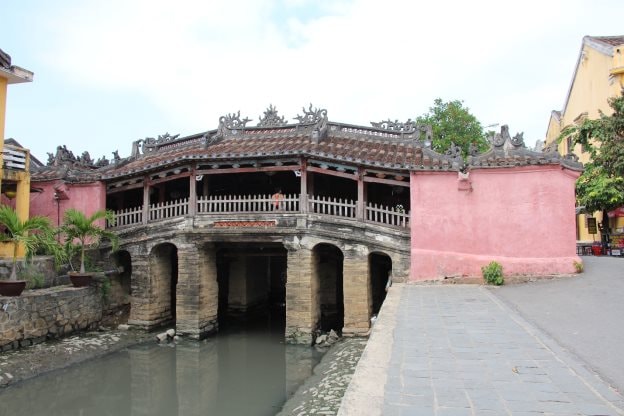
From the Namazu belief system…
Legend has it that the bridge was initiated and built by Japanese merchants who noticed that the waves on the Hoai River often formed the spine of the monster Namazu, a type of aquatic creature that the Vietnamese call "con Cu," the Japanese call "Namazu," and the Chinese call "Cau Long."
The Japanese believed that Namazu had its head in its native Japan, its tail in India, and its back stretched across a waterway (where the Japanese Bridge is built). Whenever this sea monster thrashed about, Japan would experience earthquakes and Hoi An would be disturbed. When settling in Hoi An, the Japanese built a bridge there, like a sword piercing the Namazu's back, preventing it from thrashing its tail and causing earthquakes.
In Japanese mythology, Namazu has a colossal body, so whenever it moves, its tail also moves, causing the earth to shake violently. Namazu is depicted as being imprisoned by the gods in the mud beneath the islands of Japan, but sometimes, when the gods are not vigilant, Namazu will thrash its body and cause terrible earthquakes.
...to the belief in the Northern Emperor Tran Vu
The Northern Emperor Zhenwu, also known as the Northern True Martial Mysterious Heavenly Emperor, the Northern Pole Right Holy True Lord, the Xuanwu Holy Lord, the Zhenwu Holy Lord, the Great Emperor of Creation, and the Primordial Martial God, is one of the great deities revered in Chinese Taoism. He rules the North and also governs the aquatic creatures (including the Water God).
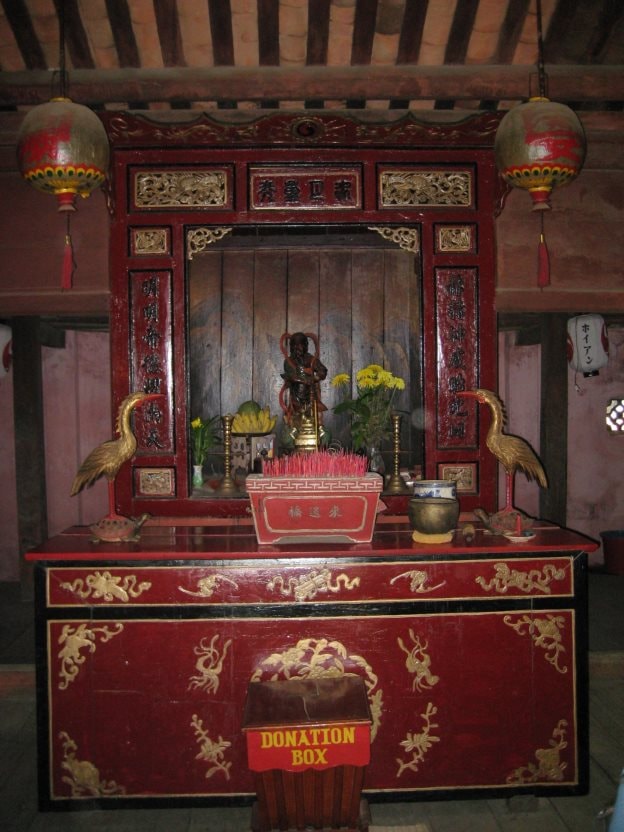
In Hoi An, the Northern Emperor Tran Vu is solemnly worshipped in the center of the main hall of the Japanese Bridge. The worship of the Northern Emperor is associated with the aspiration for flood control, as the ancient town of Hoi An is situated on a geological foundation of marine and wind origin in the alluvial plain of the lower Thu Bon River.
Every year, this area suffers from numerous floods accompanied by storms. Whenever the floodwaters rise, the rows of houses along the river are often submerged in a sea of water. Due to these harsh natural conditions, the inhabitants at that time were unable to withstand the devastation of nature, so they had to rely on supernatural forces to seek protection.
Dr. A. Sallet, a French anthropologist in Central Vietnam, arrived in Hoi An in the early 20th century. According to him: “Legend has it that when building the temple and the statue of the Northern Emperor, the purpose was to put an end to the disturbances of a demon that had made its den there. It often stirred, causing earthquakes and stirring up water, frightening passersby and people on both banks. The Northern Emperor was tasked with subduing the demon and, to ensure the fulfillment of his mission, had to bury a golden sword before construction began and place four stones inscribed with protective charms at the four corners of the foundation.”
In the past, the Chinese community in Hoi An used to hold a ceremony to worship the Northern Emperor on the 20th day of the 7th lunar month every year. The ceremony was organized as a procession of dragon boats, attracting a large number of participants, stretching through many streets, accompanied by lively traditional music, trumpets, and drums, to honor the authority of the Northern Emperor Tran Vu.
Albert Sallet added: “The ceremony honoring this deity takes place on July 20th. The ceremony is solemn and boisterous. During the ceremony, a large paper horse-drawn boat, fully equipped, is placed and burned after the ceremony.” Currently, at the Bridge Pagoda, both Vietnamese and Chinese residents come to light incense before the statue of the Northern Emperor, praying for the deity's protection.
Vietnamese, Chinese, and Japanese cultures at Cau Pagoda
According to legend, the Japanese built the bridge to ward off the sea monster Namazu, and the worship of the Northern Emperor Tran Vu at the Bridge Pagoda by the Chinese community both share a common aspiration to control floods and pray for stability in the land so that the local community can live and trade peacefully. This reflects the profound cultural exchange and transformation among the three nations: Vietnam, China, and Japan.
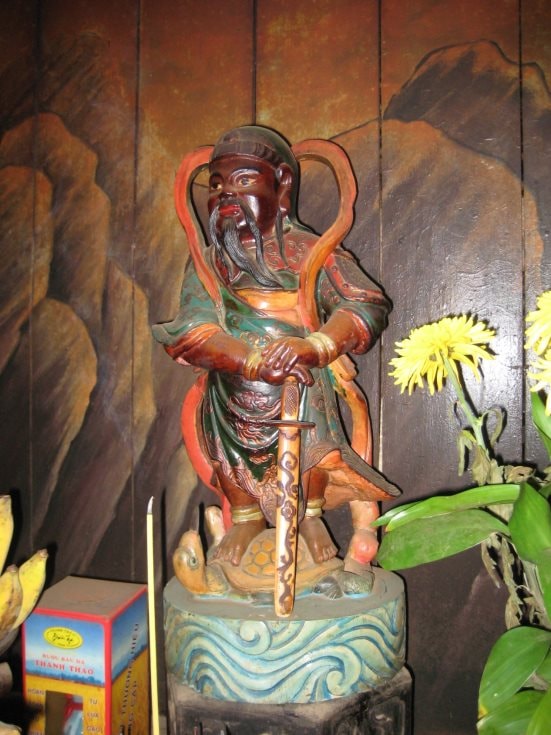
Many existing sources indicate that both the bridge and the pagoda are structures that demonstrate the collaborative and inherited spirit of the communities that once coexisted in the Hoi An trading port, with Japanese and Chinese investors and Vietnamese directly involved in the construction.
The deity Tran Vu, also known as the Northern Emperor, is believed to have the ability to subdue demons, protect the land, ward off natural disasters and calamities, and bestow joy and happiness upon people. This aligns with the common aspirations of the Vietnamese people. Thus, the worship of Tran Vu, the Northern Emperor, in Hoi An is a unique cultural feature.
It can be seen that the process of cultural exchange and interaction, through the legends about the construction of the bridge and the main deity worshipped, partly reflects the coexistence of the three ethnic groups—Vietnamese, Chinese, and Japanese—in Hoi An over the centuries.
Source: https://baodanang.vn/su-cong-cu-nhin-tu-chua-cau-3302770.html
![[Photo] Standing Committee member of the Party Central Committee Tran Cam Tu working with the Central Inspection Committee](https://vphoto.vietnam.vn/thumb/1200x675/vietnam/resource/IMAGE/2026/05/28/1779969579668_ndo_br_bnd-2495-jpg.webp)

































































Comment (0)