

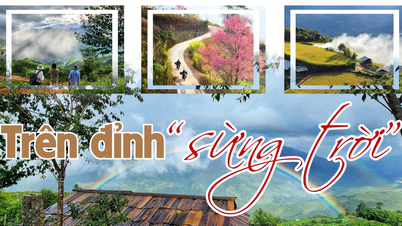
"To Day" - this endearing local name entices many tourists to travel long distances to the high mountains of Northwest Vietnam to immerse themselves in the "pink landscape" amidst the towering peaks. Similar to the cherry blossoms mentioned whenever spring arrives in Da Lat, "To Day" is considered a characteristic spring-announcing flower, blooming precisely at the end of December and around New Year's Day in Mu Cang Chai.


This woody plant's flowering pattern varies depending on altitude; typically, it blooms earlier in higher-altitude areas and the flowering season lasts until the Lunar New Year. The villages of Trống Tông and Trống Páo Sang in La Pán Tẩn commune, located above 1,000m, are the earliest blooming areas. After that, visitors can enjoy the flowers in other locations such as Thào Chua Chải village in Chế Cu Nha commune, or in the communes of Mồ Dề, Nậm Khắt, Púng Luông, Dế Xu Phình, and extending all the way to Lao Chải commune.


The thick-flowered bougainvillea has five pale pink petals with long red stamens, forming large clusters that sway in the wind. When in bloom, it's as radiant as a princess in a pink gown, dispelling the cold and gloom of winter. The patches of flowers blooming beside houses or along roadsides are like scenes from romantic films, captivating visitors.


Notably, there are ancient wild peach trees over 20 meters tall with wide canopies, possessing a resilient character that withstands harsh weather. The blooming season also attracts photographers from all over to capture stunning images. Anyone visiting for the first time is overwhelmed by the space filled with blossoming flowers, which, viewed from above, resemble a pink silk ribbon flowing across the valley.


Besides visiting Mu Cang Chai to admire the flowers, tourists can also learn about the unique traditional cultural features during the flowering season. The Hmong people believe that the beauty of the Tớ Dày flower is like a vibrant young woman, captivating the hearts of young men in the village who are in love. The blooming of the Tớ Dày flower is also the time when the Hmong people have the most joyful spring festival, when young men and women hẹn hò (date), practice the melodious sounds of the khen flute and the lively sounds of the bamboo flute, and go out to the village to play the pao throwing game.
Heritage Magazine



























































Comment (0)