

A renowned economist once told me: the state budget is limited, but the needs are numerous and urgent everywhere. For example, in a poor family with many children, smart investment means prioritizing the child who has the potential to improve the family's situation.
I kept pondering that statement while studying the draft Law on Vocational Education (amended). Clearly, this field needs to be prioritized because of its mission to the national economy. Human resources are the backbone of the economy, while vocational education is where a skilled workforce is created – a decisive factor in national competitiveness in the era of global integration.
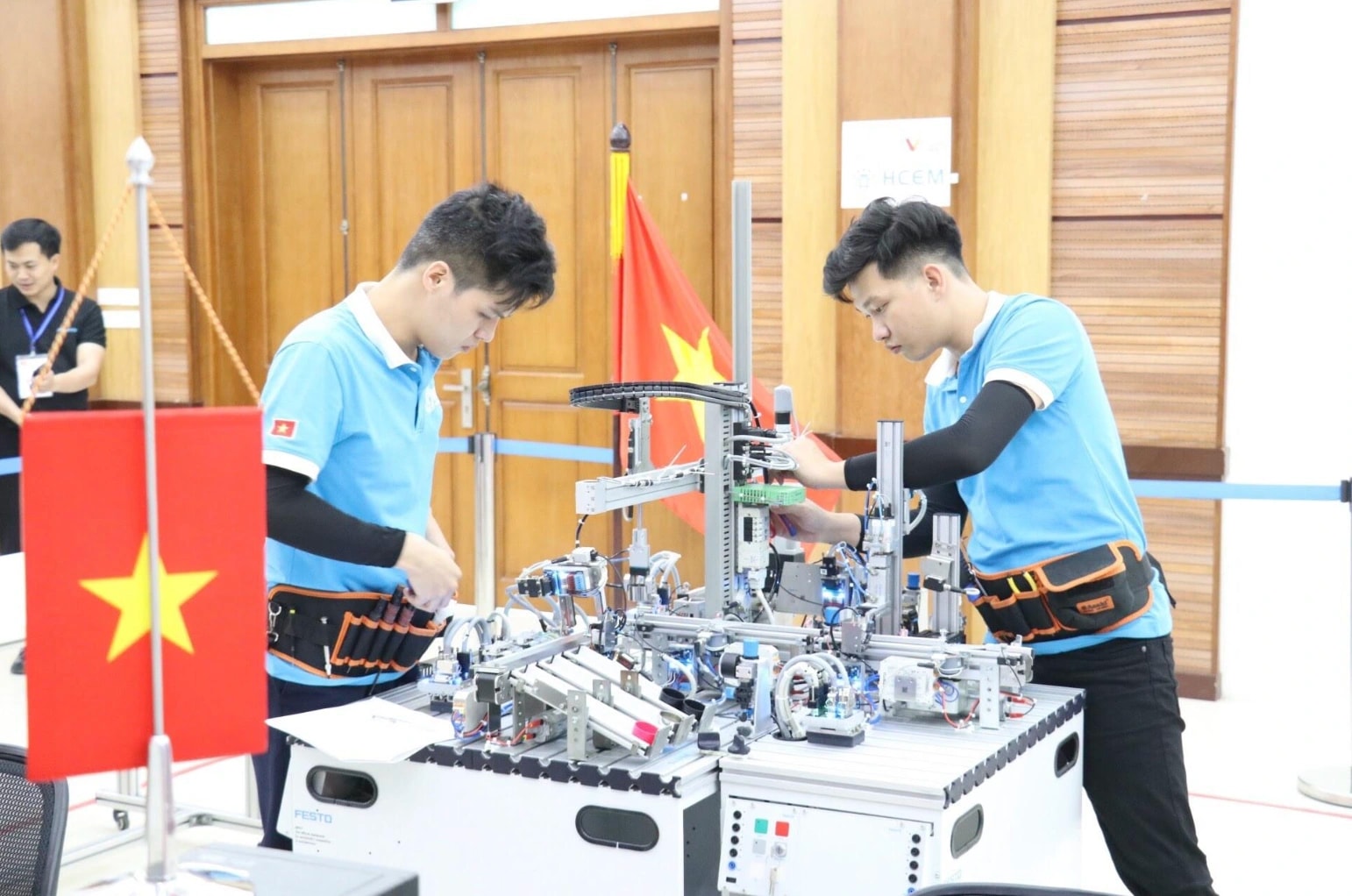
We are setting the goal of achieving double-digit economic growth. This growth is the convergence of construction sites and factories, driven by skilled craftsmen and technicians who directly operate the production machinery, transforming knowledge into products and technology into wealth.
Resolution No. 71-NQ/TW of the Politburo on breakthroughs in education and training development clearly states: "Vocational education plays a key role in developing a highly skilled workforce." The mission of vocational education has thus been affirmed!
This not only solves the human resource problem but also increases labor productivity, enhances the competitiveness of the economy, and opens up opportunities for millions of young people to establish themselves and build their careers. Essentially, it's a direct link between education and production, between the academic world and the market. It's not a "last resort" but a solid path to the future.
In the context of the Fourth Industrial Revolution, this role is becoming increasingly vital. Artificial intelligence, automation, green technology, renewable energy… are transforming the labor market. Many old professions are disappearing, while many new ones are emerging. If vocational education doesn't keep pace, it will lead to a paradox: a surplus of labor but a shortage of skilled workers. And then, opportunities for breakthroughs will slip away.
Therefore, vocational education carries a historical mission: to train a workforce that is not only skilled in their profession, but also adaptable, creative, and capable of lifelong learning, especially in the application of artificial intelligence and digital platforms. It aims not only to train skilled workers but also to train global citizens with solid careers, capable of working in any environment, domestically or internationally. This mission has both economic and social significance, and reflects the strategic vision of a nation aspiring for strength and prosperity.
To turn this mission into reality, fundamental, decisive, and long-term solutions are needed.
First and foremost , we need to put an end to the notion that "only university degrees are prestigious." The development paths of many countries like Germany, Japan, and South Korea have proven that a strong nation is one with a large workforce of skilled workers and practical engineers. Vietnam must also build a culture that honors professions and values skilled workers as much as academic intellectuals. In the current social environment, the mentality of prioritizing academic degrees is still deeply ingrained; this is not easy, but it must be done.
Secondly , there needs to be a strong reform of training content and methods. Vocational training programs must directly address market needs, be linked to businesses, and be connected to new technologies. Training based on closed curricula that are detached from reality is unacceptable. Every lesson must reflect the realities of modern production and practical application; every practical exercise must reflect the actual needs of factories and workshops. In particular, emphasis must be placed on digital technology and the application of artificial intelligence so that workers can easily adapt to changes in the labor market.
Thirdly , we need to internationalize the vocational education system. Vietnamese workers not only serve the domestic market but also participate in global value chains. Therefore, vocational qualifications must be widely recognized, and training programs must be compatible with regional and global standards. Only then can we export high-quality human resources, bringing in foreign currency for the country and enhancing the nation's standing.
Fourth , adequate investment is necessary. A quality vocational education cannot exist in outdated workshops with tools that are decades old. The state must consider this an investment in the future, not an immediate expense. At the same time, businesses need to be mobilized, as they are the direct beneficiaries of a high-quality workforce.
Finally , vocational education development strategies must be closely linked to the national human resource development strategy. Mechanisms are needed to attract experts and highly skilled professionals, both domestically and internationally, to participate in vocational training. No socio-economic goals can be achieved without competent people.
The aspiration for national strength and prosperity can only be realized through the vigorous application of science and technology, and with the brilliant minds and skilled hands of millions of well-trained workers in various fields. Vocational education must be given its rightful pioneering role to contribute to the country's breakthrough in the new era of the nation!
Source: https://daibieunhandan.vn/su-menh-cua-giao-duc-nghe-nghiep-10390686.html




![[Photo] Standing Committee member of the Party Central Committee Tran Cam Tu working with the Central Inspection Committee](https://vphoto.vietnam.vn/thumb/1200x675/vietnam/resource/IMAGE/2026/05/28/1779969579668_ndo_br_bnd-2495-jpg.webp)






























































































Comment (0)