


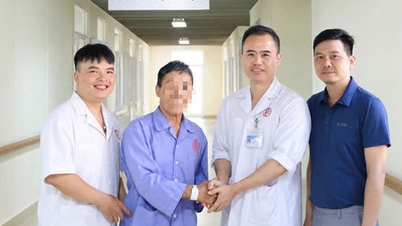
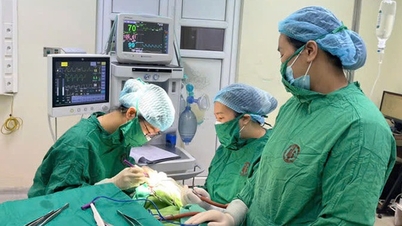
Doctors performed coronary revascularization using thrombectomy and stent placement to save the patient - Photo: Provided by the hospital
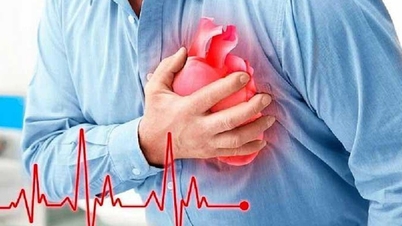
On June 2nd, Thu Duc General Hospital (Ho Chi Minh City) announced that it had successfully saved the life of a patient suffering from acute myocardial infarction, a critical condition. This was a rare and extremely dangerous case, as the patient experienced complete blockage of two major coronary arteries simultaneously.
On May 12th, male patient NNN (45 years old, Ho Chi Minh City) suddenly experienced severe left chest pain behind the sternum, radiating to the left shoulder, accompanied by sweating and shortness of breath, approximately one hour after a meal.
The patient promptly sought treatment at a local hospital, where they were diagnosed with acute myocardial infarction and immediately referred to Thu Duc General Hospital for further examination.
Upon reviewing the patient's medical history, it was revealed that patient N. had a habit of smoking heavily (approximately one pack per day) and had known about his hypertension for a long time but had neglected to seek treatment.
Tests at the hospital also revealed that the patient had dyslipidemia (high LDL-cholesterol level of 157 mg/dL) and prediabetes.
Upon admission, the patient was agitated due to persistent severe chest pain, had pale skin, and suffered from significant hypoxemia with SpO2 levels fluctuating between 85-90% despite oxygen support.
Examination revealed extensive acute myocardial infarction of the inferior and anterior walls, and ultrasound showed very poor cardiac contractility with multiple wall hypokinesia.
Recognizing this as a case of acute ST-elevation myocardial infarction with potential occlusion of multiple coronary artery branches and a rapidly progressing acute heart failure, the interventional cardiology team immediately transferred the patient to the cardiac catheterization lab.
The coronary angiography results confirmed the initial prediction: the patient had complete blockages in two out of the three main blood vessels supplying the heart, while the remaining branch was small.
In less than 60 minutes, the doctors successfully revascularized the coronary arteries by aspirating the blood clots and placing stents in both branches of the blood vessels. Immediately after blood flow was restored, the patient experienced a significant reduction in chest pain.
Due to the ongoing heart failure, he was transferred to the cardiovascular intensive care unit for close monitoring. Thanks to intensive care, just one day later, the patient stabilized, was weaned off vasopressors, and was transferred back to the cardiology-geriatrics department for further treatment. He was discharged after only 8 days of treatment in good health.
According to Dr. Dang Minh Hung, a specialist at Thu Duc General Hospital, myocardial infarction is a cardiovascular emergency with a very high rate of complications and mortality if not treated promptly in the first few hours. At this point, time is of the essence for the heart muscle, because with each passing minute, more heart muscle cells will necrose.
According to medical literature, cases of acute myocardial infarction with occlusion of two or more coronary arteries are extremely rare, accounting for only about 2.5% of patients with acute myocardial infarction who undergo primary percutaneous coronary intervention (PCI). This group of patients also has a very high risk of death due to cardiogenic shock or dangerous arrhythmias.
People should proactively get a general health check-up every year.
Dr. Dao Quang Hoang , Deputy Head of the Department of Cardiology and Geriatrics at Thu Duc General Hospital, emphasized that smoking, hypertension, and dyslipidemia are leading cardiovascular risk factors causing atherosclerosis.
However, these factors often develop silently, making them easy for patients to overlook until dangerous complications arise. Early detection, treatment, and close monitoring of risk factors are extremely important.
Doctors recommend that people proactively undergo annual general health checkups to screen for cardiovascular risk factors early, thereby receiving timely monitoring and treatment, and minimizing dangerous complications that could threaten life.
Source: https://tuoitre.vn/suyt-chet-vi-hut-thuoc-la-moi-ngay-1-goi-20260602143118765.htm

![[Photo] First session of the 14th Congress of the Vietnam Trade Union](https://vphoto.vietnam.vn/thumb/1200x675/vietnam/resource/IMAGE/2026/06/03/1780465947883_ndo_br_img-3852-jpg.webp)

![[Photo] General Secretary and President To Lam presides over a meeting with the Central Organizing Committee.](https://vphoto.vietnam.vn/thumb/1200x675/vietnam/resource/IMAGE/2026/06/03/1780482764658_a1-bnd-4741-3342-jpg.webp)
![[Photo] Secretary of the National Assembly Party Committee, Chairman of the National Assembly presides over the meeting of the Standing Committee and Executive Committee of the National Assembly Party Committee.](https://vphoto.vietnam.vn/thumb/1200x675/vietnam/resource/IMAGE/2026/06/03/1780480353201_ndo_br_bnd-2585-jpg.webp)















































![[Video] Sunset at Lap An Lagoon – Where the sun sets over the fishing nets](https://vphoto.vietnam.vn/thumb/1200x675/vietnam/resource/IMAGE/2026/05/31/1780192137701_beach-landscape-sea-water-nature-grass-745871-pxhere-com.jpeg)


































Comment (0)