

Syria is considered to be reintegrating very quickly and rising strongly in the Arab world after more than a decade of isolation.
Syrian President Bashar al-Assad beamed as he strode down the runway at Jiddah airport in Saudi Arabia on May 19. Senior Saudi officials, including Crown Prince Mohammed bin Salman, greeted him with warm embraces.
The Syrian leader traveled to Jiddah for the Arab League summit, participating in a series of meetings with other regional leaders, a sign that he has been welcomed back into Middle Eastern politics after a decade of isolation.
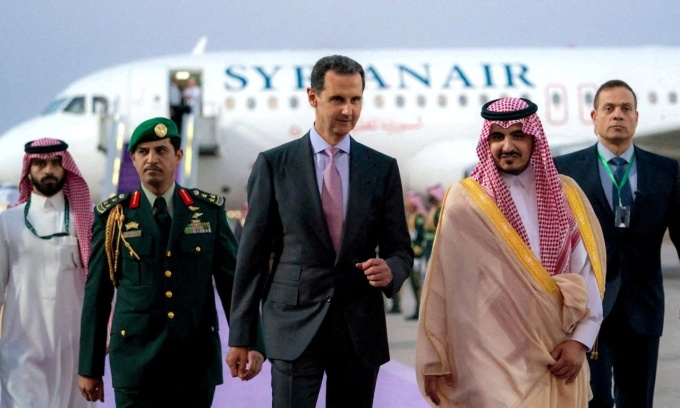
Syrian President Bashar al-Assad (third from left) arrived in Jiddah, Saudi Arabia, on May 18 to attend the Arab League summit. Photo: Reuters
In 2011, when armed conflict erupted in Syria between the government and the opposition, a number of Gulf powers turned their backs on President Assad and poured resources and weapons into the opposition in an attempt to overthrow his regime. They also froze relations with Syria, excluding the country from the Arab League over accusations of using chemical weapons against civilians.
But more than a decade later, President Assad still controls much of the country, while Syrian rebel forces have gradually been subdued and dispersed. Regional powers that once sought to remove him have now shifted their priorities elsewhere.
On May 7th, the Arab League approved a decision to readmit Syria, a move seen as a victory for President Assad after a civil war that has killed half a million people since 2011. Founded in 1945, the Arab League is an organization of Arab states in Southwest Asia, North and Northeast Africa, comprising 22 members.
According to observers, President Assad used his reappearance in Jiddah to once again assert Syria as a pillar of stability in the volatile Middle East region.
"It is important to leave internal problems to the people of Syria to handle because they are best able to handle them," he said at the conference, reiterating a long-standing message.
On the other hand, according to analysts, the devastating earthquake that struck southern Türkiye and parts of northern Syria in February also opened a new path for Assad to accelerate the process of restoring relations with neighboring countries.
Most recently, Iran and Saudi Arabia confirmed the restoration of diplomatic relations with Syria, after more than a decade of severed ties. This is considered one of the first steps on the path to bringing Damascus back onto the Middle Eastern political stage.
In the months leading up to President Assad's visit to Saudi Arabia, Syria also reached agreements to resume relations with countries such as Tunisia and Egypt.
For Riyadh, President Assad's return to Saudi Arabia for the Arab League summit is part of a larger effort to ease tensions in the Middle East, after years of regional discord fueled by geopolitical polarization, war, and social unrest.
Saudi Arabian Crown Prince Mohammed bin Salman expressed hope last weekend that President Assad's return to the Arab League could "help end the region's crisis."
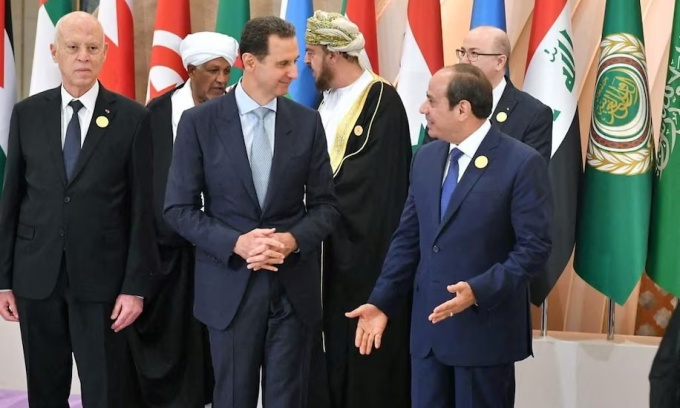
Syrian President Bashar al-Assad (center) speaks with his Egyptian counterpart Abdel Fatah el-Sisi ahead of the Arab League summit in Jiddah, Saudi Arabia, on May 19. Photo: Reuters
According to experts, recognizing that the Syrian crisis is a regional issue, Arab nations have resolved to pursue strategies to mitigate its negative impacts. They hope that by reducing conflict, Middle Eastern countries can begin to dismantle drug trafficking networks linked to Syria, stabilize the refugee crisis, strengthen border security, and address a range of other issues.
Aron Lund, a fellow at the policy and international affairs consulting firm Century International and a Middle East analyst, believes regaining membership in the Arab League is a major victory for the Syrian government, helping Damascus increase its influence in the region.
"This return shows that Syria is reintegrating into the region and other Arab leaders seem to be beginning to believe that President Assad's regime will hold firm. So, this is clearly a political victory for Damascus," he said.
The move to readmit Syria to the Arab League also stems from pragmatic calculations about Damascus's role and position, according to Al Jazeera commentators Giorgio Cafiero and Emily Milliken.
From the perspective of many Arab governments, the current strategy of the US and other Western powers to isolate Syria is unsustainable. Many regional officials now believe that such policies will only push Damascus further toward Tehran's orbit, something they never want. Furthermore, Arab nations also believe they can bring Syria back into their own sphere of influence by connecting with the Assad regime.
Meanwhile, the Syrian government needs financial support and legitimacy, both of which Damascus believes it can achieve through the resumption of diplomatic relations with Saudi Arabia and other wealthy Arab nations.
"President Assad is very pragmatic and he will take support from wherever he can, whether it's from Saudi Arabia, Iran, or Russia," said Andreas Krieg, associate professor at the Department of Defence Studies at Imperial College London. "In the current context, the Syrian regime will do whatever works for them. We've seen how confident they are in their dealings with other Arab countries, especially Egypt, declaring they will do everything for Syria's benefit but will not make any major concessions."
U.S. officials and Western diplomats are wary of Syria's growing influence in regional politics. While countries like Jordan, Algeria, and the United Arab Emirates (UAE) are calling for a relaxation of sanctions against Syria, U.S. lawmakers are stepping up efforts to pass a new round of sanctions against the Assad regime.
"The Americans are wavering," a Gulf source close to the government told Reuters . "We are the people living in the region and we are trying to address our problems as proactively as possible with the tools available."
This shift could also reflect a weakening desire for US engagement in the Middle East, as Washington shifts its focus to challenges further east and with greater impact than Arab issues, according to Washington Post analyst Ishaan Tharoor.
However, analysts also expressed skepticism about whether Syria's path back to power is sustainable.
"To gain regional attention, the Syrian regime will likely have to make certain concessions in the coming months," predicts Charles Lister, a senior fellow at the Middle East Institute in Washington. "However, President Assad is unlikely to accept major concessions, so Damascus's reintegration process could still reach a dead end."
Lister argues that Arab powers may face numerous obstacles when undertaking large-scale economic investment projects in Syria, as they may be unable to achieve them due to diplomatic concessions or be hampered by Western sanctions.
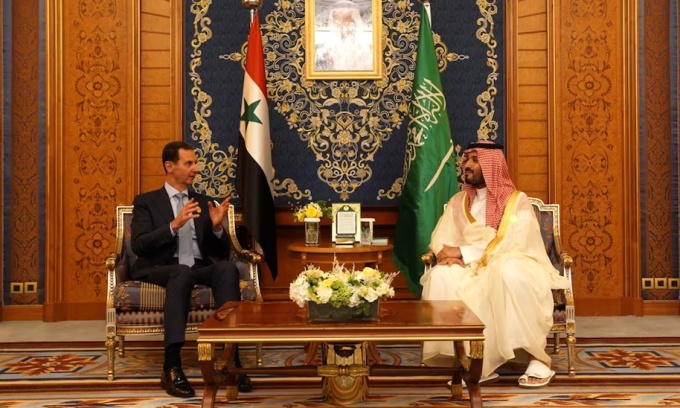
President Assad (left) holds talks with Saudi Crown Prince Mohammed bin Salman in Jiddah on May 19. Photo: AP
Nevertheless, Syria's resurgence is currently proceeding very rapidly, despite US opposition. "Arab nations are pushing for the normalization of relations with Syria because they assess that the US doesn't want to support it, but also won't do anything to stop it," emphasized William F. Wechsler, a former Pentagon official and head of the Middle East program at the Atlantic Council in Washington.
Vu Hoang (Based on Al Jazeera and Washington Post )
Source link


























































































Comment (0)