

Yesterday afternoon, December 7th, CNN reported that representatives of the opposition military coalition, led by the Hayat Tahrir al-Sham (HTS) group, announced they were conducting a siege of the Syrian capital, Damascus. The announcement claimed the "final phase" of the Damascus siege had begun, but this information could not be verified. Earlier, Reuters reported that opposition military forces launched a lightning attack on the city of Homs in central Syria on December 7th.
The regime is in disarray.
Since opposition forces seized Aleppo on November 30, government defenses have been crumbling across Syria. Besides capturing Aleppo in the north, Hama in the central region, and Deir al-Zor in the east, opposition forces are gradually gaining control of several other areas in southern Syria. Conversely, the Syrian army says it is conducting airstrikes around Hama and Homs, and intensifying counterattacks on these fronts. However, Reuters, citing Western officials, reports that the Syrian army is in a difficult situation and unable to stop the opposition forces.
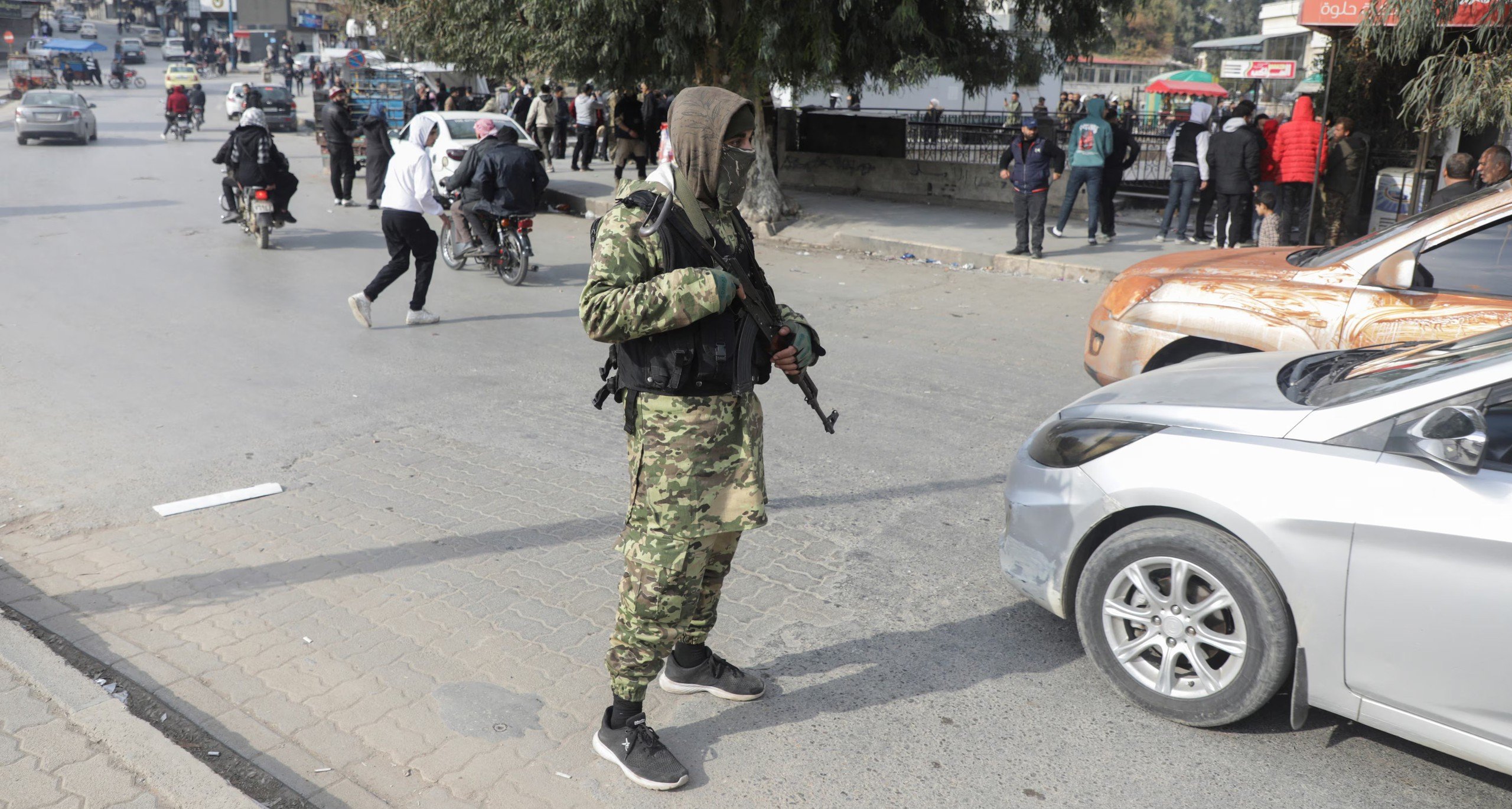
A gunman belonging to an opposition military force in Syria (photo taken on December 6).
In recent days, Iran and its close ally Hezbollah in Lebanon, allies of al-Assad's regime, have faced considerable difficulties due to pressure from Israel. Meanwhile, Russia – another important ally of the Syrian government – is also focusing its efforts on the Ukrainian battlefield. There have been many indications that Moscow has been shifting military power from Syria to Ukraine.
Therefore, support from both Iran and Russia for Syria is limited. Consequently, the current situation means that al-Assad's government is facing the risk of collapse after a period of relative stability.
Multi-party influence
If President al-Assad's government continues to lose control in more areas, Hezbollah forces in Lebanon will also be severely damaged. Syria has long been considered a strategic corridor for Iran to transfer weapons to Hezbollah.
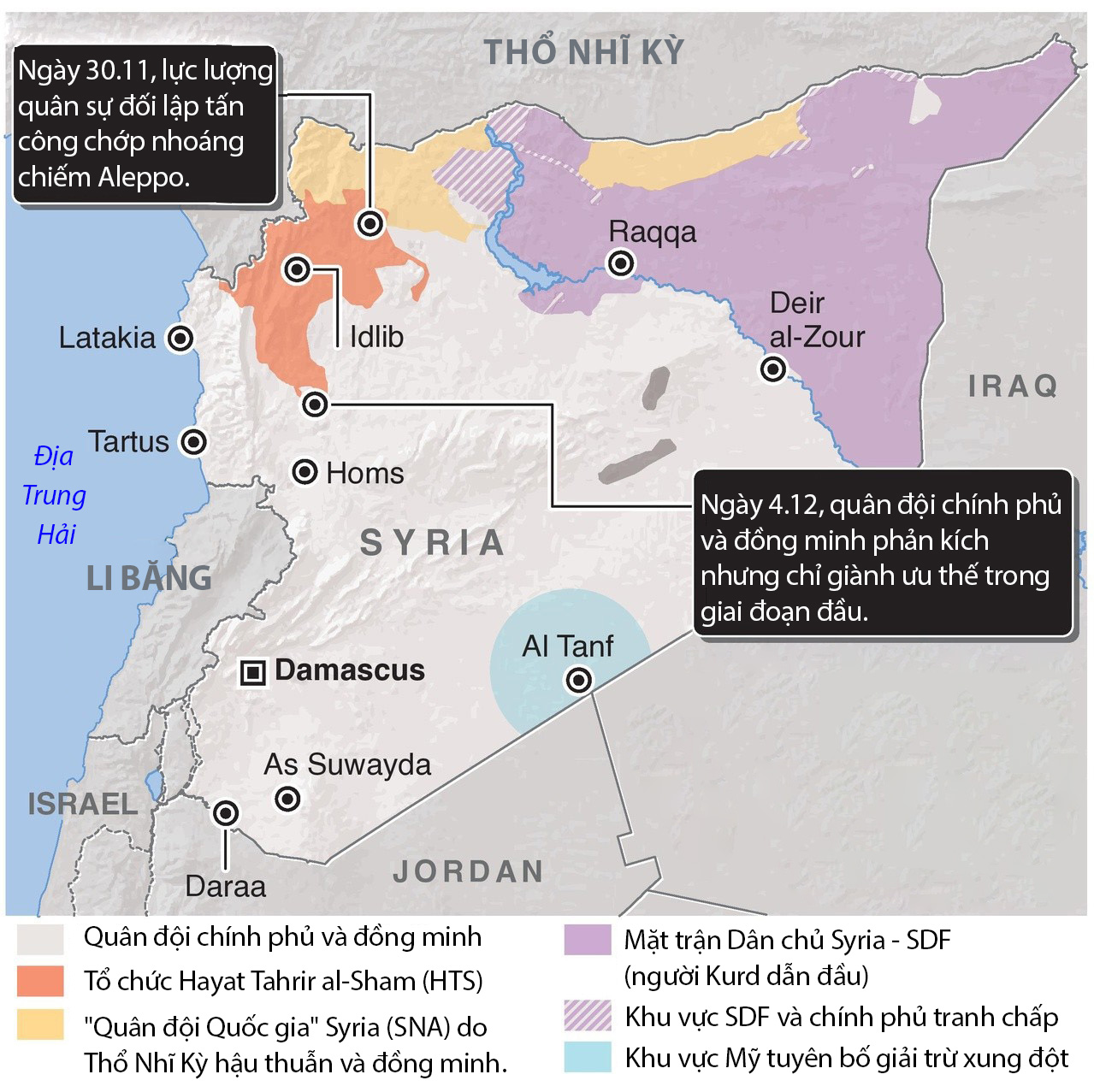
Areas under military control in Syria
Graphics: Phat Tien
In the current context, losing this strategic corridor would further put Hezbollah under Israeli pressure, especially given the fragile nature of the recently concluded ceasefire. Furthermore, as Damascus weakens, it would create a significant opportunity for Tel Aviv to launch attacks on Syrian military forces that support Hamas and Hezbollah. Simultaneously, Tehran's influence in the region would diminish, and the balance of power between Iran and Türkiye would increasingly favor Ankara.
Furthermore, if Russia fails to protect President al-Assad's regime, its influence in the Middle East and North Africa will be significantly diminished, and it may even face negative repercussions at the negotiating table regarding the Ukraine conflict.
On the other hand, if instability in Syria continues to escalate, European countries will once again face a wave of refugees from Syria, similar to what happened about 10 years ago.
Key forces in Syria

Firstly, there is the government army and several paramilitary groups close to President al-Assad, and the government also has strong support from Hezbollah in Lebanon.
Secondly, there is the Syrian Democratic Front (SDF), a Kurdish-led organization backed by the United States.
Thirdly, Hayat Tahrir al-Sham (HTS, formerly Nusra Front) was once an al-Qaeda affiliate and is now listed as a terrorist organization by several countries, including the US, Russia, and Türkiye. However, some sources claim that Türkiye still maintains channels of communication with HTS.
Fourth is the Turkish-backed Syrian National Army (SNA) along with several pro-Turkish groups.
Source: https://thanhnien.vn/tac-dong-tu-chao-lua-syria-them-kho-luong-185241207230549754.htm













































![[Video] Sunset at Lap An Lagoon – Where the sun sets over the fishing nets](https://vphoto.vietnam.vn/thumb/1200x675/vietnam/resource/IMAGE/2026/05/31/1780192137701_beach-landscape-sea-water-nature-grass-745871-pxhere-com.jpeg)




























Comment (0)