

Besides the contributions of Thoại Ngọc Hầu Nguyễn Văn Thoại, the merits of many other related officials have gradually been mentioned. However, we know less about the activities of lower-ranking figures, those who directly worked on the canal construction site.
In October 2024, we had the opportunity to meet with Mr. Le Trong Tien, a descendant of Mr. Le Van Hue - a low-ranking soldier who directly worked on the Vinh Te canal construction site - in Thot Not ( Can Tho ), and he shared with us the documents that his family was preserving.
The collection of documents includes papers related to Le Van Hue from 1814 to 1836, including three important documents that help to understand Le Van Hue's role in the third Vinh Te Canal construction, as well as the mobilization and dispersal of laborers for that construction.
Exploring the Thot Not region
According to Le Van Hue's own testimony, he was born in the year of At Ty [1785]. His parents and their background are unknown. The Le family in Thot Not remembers Le Van Hue as their ancestor. In 1806, Le Quang Dinh described the Thot Not canal as having "residents and fields on both sides". A decree from 1822 recorded Le Van Hue's birthplace as Thoi Hoa Trung village, Vinh Dinh district, Dinh Vien prefecture, Vinh Thanh province. Later, this village was renamed Thanh Hoa Trung village.
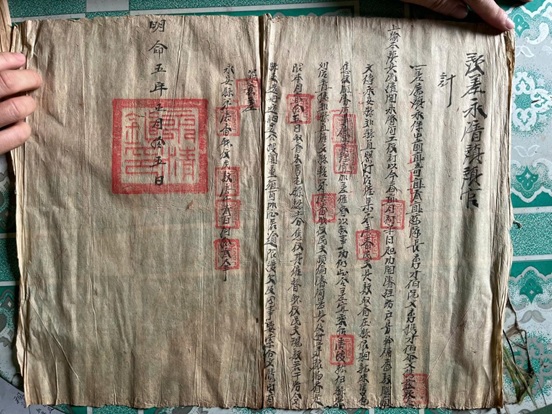
Labor mobilization order from Vinh An district to dig the Vinh Te canal.
PHOTO: LE TRONG TIEN
The 1836 land register of Thanh Hoa Trung village lists many landowners with the surname Le, such as Le Van Thong, Le Van Huyen, Le Van Van, Le Thi Phuong, etc. This detail shows that the Le family had arrived and cultivated the Thot Not area a long time ago. Le Van Hue himself also owned several plots of land and gardens. Before the land register was compiled, Le Van Hue and Nguyen Thi Loi had cultivated some farmland. In addition, he, along with three others, Van Duc Huong, Danh Quy, and Danh Dang, cultivated many more plots of land. At the time the land register was compiled, Le Van Hue also owned a 21-acre plot of land, a 30-acre plot of land (shared with Le Van Hoi), a 4-acre garden, and a 3-acre garden (shared with Le Van Hoi).
Join the army and dig the Vinh Te canal.
In 1814, at the age of 29, Le Van Hue was selected to join the army. He was assigned to the 3rd squad, Vinh Bao Tien regiment, in Vinh Thanh district. Shortly after, because of his "good work, ability, and diligence in his duties," he was appointed as the deputy squad leader of the 4th squad of that regiment, and later transferred to the 3rd squad. In 1822, during the examination period, Le Van Hue was officially appointed as the squad leader of the 3rd squad, 3rd company, Vinh Bao Tien regiment, and was granted the title of Hue Tai Ba.
At that time, the construction of the Vĩnh Tế canal was in its final stages. At the end of the 4th year of Minh Mạng's reign (1823), the king ordered the mobilization of laborers from five provinces: Phan Yên, Biên Hòa, Vĩnh Long , Định Tường, and Hà Tiên to continue the canal digging. Today, descendants of the Lê family in Thốt Nốt still possess three documents issued to Huề Tài bá Lê Văn Huề, ordering the organization of soldiers and civilians to dig the Vĩnh Tế canal. Thanks to these documents, we can understand the organizational and mobilization situation at that time.
A warrant dated January 15th, the 5th year of Minh Mạng (1824), issued by the Imperial Commissioner of Vĩnh Thanh, was given to Captain of Team 2 of Vĩnh Bảo Trung, Dũng Tài Bá Nguyễn Văn Dũng, and Captain of Team 3 of Vĩnh Bảo Tiền, Huề Tài Bá Lê Văn Huề, to supervise the District Chief of Vĩnh An in recruiting laborers. The laborers were ordered to prepare tools, along with bamboo, reeds, and thatch. The deadline was January 25th; everyone had to be present at Châu Đốc fort to receive their assigned excavation work. The number of people mobilized was 1,383, including officials and laborers.
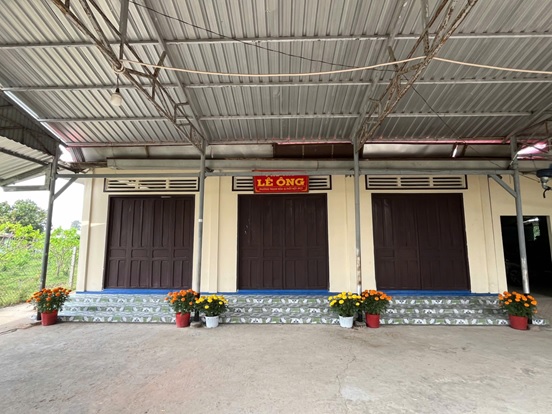
Le Van Hue shrine in Thot Not
PHOTO: LE TRONG TIEN
On January 28th, the governor of Vinh Thanh issued a warrant to Hue Tai Ba Le Van Hue to oversee the Vinh Nhat team in carrying out the canal digging. Historical records indicate that the task for this phase was to widen the remaining 1,700 trượng of canal, and then widen the canal flowing through the Nao Khau Ca Am swamp. On May 1st of the same year [1824], the Cambodian Protector Nguyen Van Thoai issued Le Van Hue a certificate confirming the completion of the work, allowing him to return to his military base to work.
The completion of the Vĩnh Tế Canal was a victory for transportation, trade, and agriculture on the Châu Đốc - Hà Tiên route. On this occasion, King Minh Mạng awarded "records" (a form of merit points) and gold and silk to those who participated according to their rank. Lê Văn Huề himself returned to the army. He served until 1832 when he was ordered to transport supplies to Huế for presentation. He then returned to the Gia Định army to suppress the Lê Văn Khôi rebellion, and later joined the An Giang army to fight against the invading Siamese forces. In 1834, Lê Văn Huề suffered from an eye disease and requested leave for treatment, eventually retiring completely in 1836. Today, descendants of the Lê family still maintain the tomb and ancestral temple of Lê Văn Huề in Thốt Nốt.
Source: https://thanhnien.vn/tai-ba-le-van-hue-nguoi-dao-kenh-vinh-te-185250208202058875.htm
![[Photo] General Secretary and President To Lam works with the Party Committee of the Ministry of Health on the work of Vietnamese traditional medicine.](https://vphoto.vietnam.vn/thumb/1200x675/vietnam/resource/IMAGE/2026/05/20/1779294323718_a1-bnd-2978-3319-jpg.webp)
![[Photo] National Assembly Chairman Tran Thanh Man working with the Standing Committee of the National Assembly's Delegation Affairs Committee.](https://vphoto.vietnam.vn/thumb/1200x675/vietnam/resource/IMAGE/2026/05/20/1779294340023_ndo_br_1-1691-jpg.webp)
![[Image] "Journey of Hope" promotes the organ and tissue donation movement in Vietnam.](https://vphoto.vietnam.vn/thumb/1200x675/vietnam/resource/IMAGE/2026/05/20/1779294400833_1-8910-jpg.webp)







![[Image] Current status of 9 quarries that have ceased operations bordering the two largest cities in southern Vietnam.](https://vphoto.vietnam.vn/thumb/402x226/vietnam/resource/IMAGE/2026/05/05/1777997717162_ndo_br_dji-20260504143355-0591-d-resize-7850-jpg.webp)















































































Comment (0)