

 |
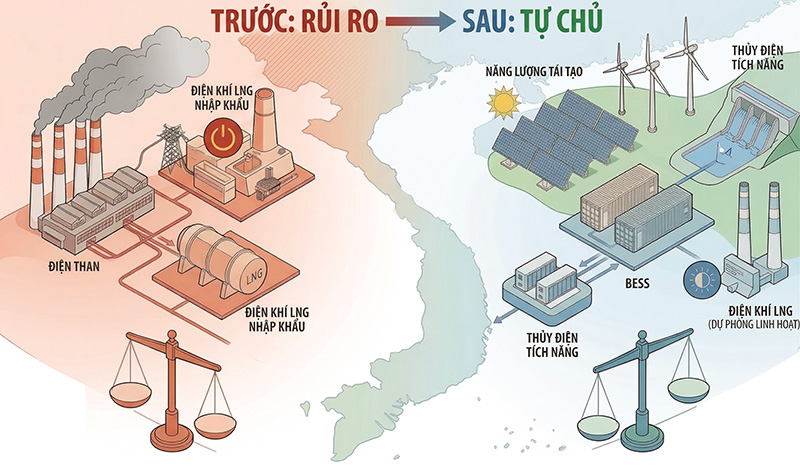
| Vietnam needs to integrate gas-fired power into a new structure, starting with redefining the role of gas-fired power through strategic pillars. |
Switch to LNG
Geopolitical tensions are driving the restructuring of supply chains on a global scale, presenting Vietnam with a golden opportunity to achieve double-digit growth and escape the middle-income trap. To realize this growth opportunity by attracting high-quality capital, Vietnam's national energy system needs to meet both green and cost-effective standards.
However, this context also presents Vietnam with a major challenge in ensuring "energy security," as unpredictable global fluctuations could disrupt imported energy supplies, leading to the risk of enormous cost volatility. Therefore, the challenge of "energy must be one step ahead," as emphasized in Resolution No. 70-NQ/TW of the Politburo on ensuring national energy security, is not simply a matter of increasing supply or expanding the transmission network. It is also a strategic security issue aimed at ensuring the self-reliance and protecting Vietnam's economy from the risks of disruption due to dependence on external fluctuations.
The National Power Development Plan VIII, as outlined in Decision 500/QD-TTg dated May 15, 2023, and subsequently adjusted by Decision 768/QD-TTg dated April 15, 2025, serves as Vietnam's strategic framework for comprehensively addressing the aforementioned challenges. Accordingly, Vietnam has clearly defined its objective of gradually reducing coal-fired power generation to fulfill international commitments on net emissions and combat climate change, thereby attracting high-quality green investment from around the world .
 According to the Power Development Plan VIII, the target for gas-fired power generation by 2030 is to reach 33,385 - 37,454 MW. Of this, LNG-fired power generation alone is planned to reach 22,524 MW.
With no further coal-fired power development planned, Vietnam's national power system needs a base power source that meets the criteria of stability, cleanliness, and flexibility. Between now and 2035, gas-fired power (including domestic gas and imported LNG) is considered a necessary transitional solution to balance the pressures of economic growth and environmental protection requirements in the short and medium term.
Nevertheless, because Vietnam's existing gas reserves are depleting faster than estimated and national gas demand is increasing to support economic growth (national gas demand is projected to increase by an average of 12% per year and could triple by the mid-2030s), Vietnam's total LNG import needs for gas-fired power plants will continue to grow.
The inevitable consequence is that Vietnam's national power grid security depends on imported LNG (from the US, Australia, and the Middle East) and global supply chains, making its energy security vulnerable to geopolitical shocks, disruptions to shipping lanes leading to supply shortages and increased costs, or exchange rate risks.
The world is witnessing intense geopolitical competition, making gas prices increasingly sensitive to global fluctuations.
Firstly, when the Russia-Ukraine conflict broke out in 2022, Europe turned its back on cheap Russian gas and massively purchased LNG on the spot market. Competition from Europe drove LNG prices in the Asian market to unprecedented record highs.
Secondly, escalating tensions in the Middle East have exposed a critical vulnerability in the global LNG supply chain. Currently, more than 20% of global LNG passes through the Strait of Hormuz, and a significant amount passes through the Red Sea. When conflict erupts and Iran declares closures and attacks on commercial vessels passing through the Strait of Hormuz, carriers are forced to reroute, increasing costs and disrupting supply.
According to international practice, for gas-fired power projects with total investments of billions of USD to secure financing, independent power developers (IPPs) and financing banks require Vietnam Electricity Group (EVN) to accept a "pass-through" mechanism for gas price risk. This means that if war in the Middle East drives LNG prices up threefold, EVN will have to buy electricity at a correspondingly higher price.
Clearly, relying on LNG could leave the national power infrastructure vulnerable to external fluctuations and inadvertently hold the economy hostage on the geopolitical chessboard of major players.
Solutions
Despite the inherent risks from the global supply chain, completely eliminating gas-fired power from planning is not feasible for Vietnam, at least in the short and medium term. Instead, Vietnam needs to integrate this power source into a new structure, starting with redefining the role of gas-fired power through the following strategic pillars:
The first pillar is to promote a distributed storage ecosystem to reposition gas-fired power plants. To reduce dependence on base-mounted gas power, Vietnam needs to prioritize the development of renewable energy models combined with battery storage systems (BESS), promote micro-grid utility models in industrial zones, and accelerate the progress of pumped-storage hydropower projects. This distributed ecosystem will help reduce the supply pressure on EVN at major load centers, while expanding the ability to attract private and FDI investment into the national energy infrastructure.
When on-site energy sources and storage systems meet a portion of the load demand, gas-fired power plants will be freed from the requirement of continuous operation. Instead, LNG power can transition to a flexible backup power role where the grid only mobilizes gas-fired power plants to their maximum capacity during periods of load stress, renewable energy shortages, or when international LNG prices fall to acceptable levels.
In this way, Vietnam will be able to limit the volume of LNG it needs to import, thereby effectively controlling the risk of fluctuations in world fuel prices. However, this shift in operating model is only financially feasible for investors if the price mechanism barriers are removed in the subsequent pillars.
The second pillar is the implementation of a two-tiered electricity pricing system. For the aforementioned flexible operating model to be feasible, a prerequisite is resolving the financial issues for gas-fired power projects. In the context of increasing renewable energy, the internationally accepted "horizontal switching" mechanism reveals limitations as it may force the system to prioritize gas-fired power plants with high fuel costs, potentially leading to cuts in renewable energy sources with lower operating costs.
The key solution to overcome this bottleneck is to apply a two-component electricity pricing mechanism. Accordingly, the price of electricity from the power plant and the price of electricity sold by EVN to end users will include two independent components: a capacity fee - a fixed payment to ensure the power plant maintains its readiness to generate electricity; and an energy fee - paid based on the actual amount of electricity generated and fed into the grid.
By separating these two components, the mechanism creates a harmonious balance of benefits whereby investors are guaranteed a financial plan for project implementation, while EVN optimizes input costs and minimizes risks due to price fluctuations. Units responsible for operating the Vietnamese system can flexibly mobilize gas-fired power only when the system actually needs it, thereby ensuring reserve capacity for grid security without increasing financial risk from unpredictable price fluctuations in the spot market.
The third pillar is the completion of a competitive electricity market and the Direct Power Purchase Agreement (DPPA). The "single buyer" model is placing significant financial and operational pressure on EVN. Therefore, removing technical obstacles to implement the DPPA mechanism through the national grid is an urgent requirement. This mechanism allows large consumers to directly negotiate and purchase electricity from renewable energy developers. The application of DPPA not only helps share infrastructure investment risks and reduce pressure on the state budget, but also meets the growing demand for clean energy from FDI enterprises to comply with global ESG standards.
The fourth pillar is ensuring the transparency and stability of the legal framework. The ability to attract large-scale investment capital for energy infrastructure and BESS projects depends heavily on controlling policy risks. Therefore, outstanding issues related to the feed-in tariff (FiT) mechanism from the previous period need to be resolved definitively to restore investor confidence. Consistently applying the principle of "non-retroactivity" in the spirit of Resolution 68/NQ-TW will contribute to strengthening a stable, transparent, and predictable investment environment, thereby creating a favorable foundation for mobilizing loans from international financial institutions.
The four aforementioned pillars of solutions are closely interconnected and need to be implemented synchronously. Improving the pricing mechanism, developing a competitive market, and stabilizing the legal framework are prerequisites for promoting the development of technological solutions (such as BESS and micro-grids). Through this synchronous integration, Vietnam's power system can effectively reposition the role of LNG power.
A well-designed energy structure will help Vietnam ensure national energy security while minimizing the risks of fluctuations from the international market.
Source: https://baodautu.vn/tai-dinh-vi-vai-role-of-electricity-d562320.html

![[Image] Hanoi's urban life under the challenge of a "scorching hot" environment](https://vphoto.vietnam.vn/thumb/1200x675/vietnam/resource/IMAGE/2026/05/25/1779706979265_nang-nong-t5-2026-minh-duy-7-4636-jpg.webp)



![[Image] Close-up view of the interchange connecting the two expressways and Long Thanh Airport.](https://vphoto.vietnam.vn/thumb/1200x675/vietnam/resource/IMAGE/2026/05/25/1779703378210_ndo_br_z7863716673926-224453a31600126cce10622af6290afd-4549-jpg.webp)























































































Comment (0)