

To get to the Taj Mahal in Agra, Uttar Pradesh, tourists usually choose day tours from Delhi to save time. But because we wanted to see the Taj Mahal at sunrise, we decided to take a train to Agra the night before.
Trains from Delhi to Agra are readily available to meet the needs of travelers, so there's no need to book online in advance. The ticket price is also very reasonable, 170 rupees (approximately 68,000 VND) for a three-hour journey. Contrary to initial concerns, the train was quite orderly and clean, with no crowds or pushing and shoving as depicted in images circulating online.
At 6 a.m., I joined the line to enter the Taj Mahal, anticipating the sunrise. Before entering the temple, visitors must go through a strict security check. Bags and backpacks are inspected, and food, drinks, cigarettes, headphones, phone chargers, drones, and tripods must be left at the ticket gate. Additionally, visitors are required to wrap their shoes in the provided bags when visiting the main mausoleum.
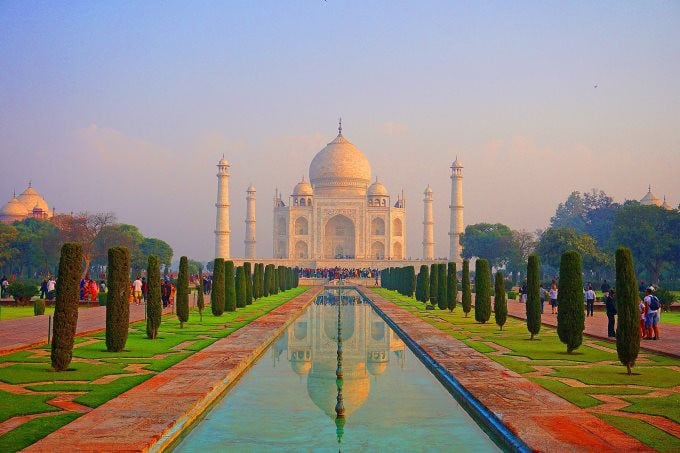
The grand gates opened just as dawn broke. The first rays of sunlight mingled with the lingering mist. Then the Taj Mahal gently transformed, beginning with a golden glow on the dome's apex. As the sun rose higher, the entire temple was bathed in pristine white.
Perhaps because it was built primarily of white marble, the Taj Mahal's color also changes with each moment of the day: blushing pink at dawn, pure white when the sun is high in the sky, and bathed in a brilliant golden light at sunset.
The Taj Mahal is a masterpiece embodying the finest aspects of Indian architectural art, leaving everyone in awe and showering it with praise. But more than that, the Taj Mahal is also associated with a tragic love story and represents the eternal values of love left behind by Emperor Shah Jahan and Mumtaz Mahal.
In 1631, Queen Mumtaz Mahan passed away. To mourn his wife, King Shah Jahan commissioned the construction of a mausoleum befitting their love. The design was entrusted to Ustad Tsa, the most talented architect in the northern hemisphere at the time. Furthermore, 32 million rupees (equivalent to $877 million today), over 20,000 laborers, and 1,000 elephants were mobilized to complete the Taj Mahal over 20 years.
But after the Taj Mahal was completed, Shah Jahan paid no attention to state affairs. He was deposed by his son and imprisoned in the Agra fortress on the other side of the river. There, the emperor gazed daily at the white marble temple. In 1666, Shah Jahan died and was brought back to the Taj Mahal to be reunited with his wife.
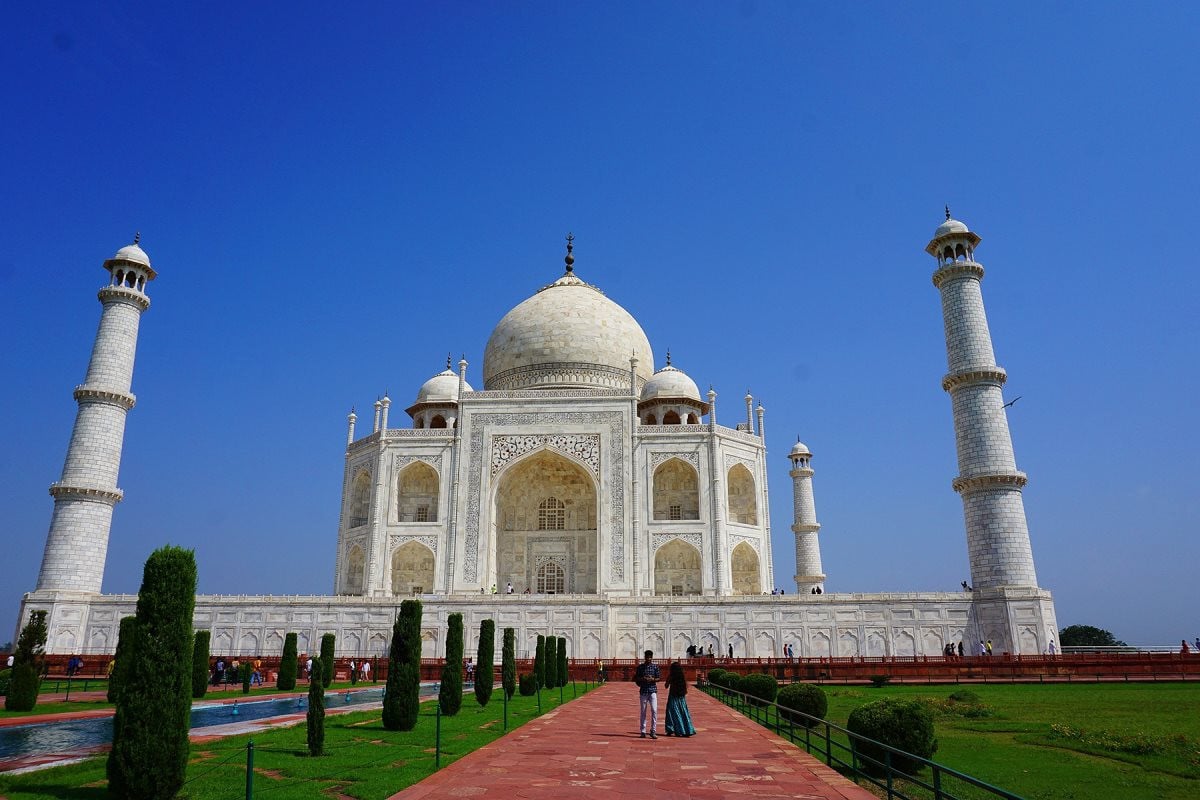
The Mughals considered symmetry a symbol of imperial harmony, so every detail of the Taj Mahal achieves perfect symmetry. Before me, the magnificent Taj Mahal is reflected in a pool of water aligned along a north-south axis, surrounded by two rows of evenly spaced green trees. At the corners of the mausoleum are four large minarets, and two red sandstone structures (a mosque and a guesthouse) are located at a symmetrical distance from the mausoleum. The four sides of the mausoleum are also identical, with arched gateways and Quranic texts carved into the stone. If viewed from below, the inscriptions around the arches appear to be the same size. However, in reality, the lower inscriptions are smaller than the upper ones to create a visual balance for the viewer.
The main part of the complex is an octagonal mausoleum, 75 meters high, with a large marble and sandstone dome decorated with a lotus flower to emphasize its height. The highest point is a gilded finial, blending Persian and Hindu styles. In the center of the main chamber lie the exquisitely decorated remains of Shah Jahan and Mumtaz Mahal. The harmonious interplay of light and shadow, and solid and void spaces, prevents the mausoleum from appearing cramped or heavy.
The Taj Mahal took me on a journey of emotions, from astonishment and amazement to awe and then serenity. The temple is not only an architectural masterpiece but also a symbol of undying love. Nearly four hundred years have passed, yet every day millions of people still travel long distances to this place to contemplate their own experiences of love.
When I visited the Taj Mahal, I met both couples and single people. And I believe that as long as people still want to love, the Taj Mahal and the love story between Shah Jahan and Mumtaz Mahal will endure through time.
Some things tourists should keep in mind when visiting the Taj Mahal.
To reach the Taj Mahal, tourists typically choose a three-hour train journey from the capital city of Delhi.
The best time to visit the Taj Mahal is at sunrise and sunset. The temple opens 30 minutes before sunrise, closes 30 minutes before sunset, and is closed on Fridays.
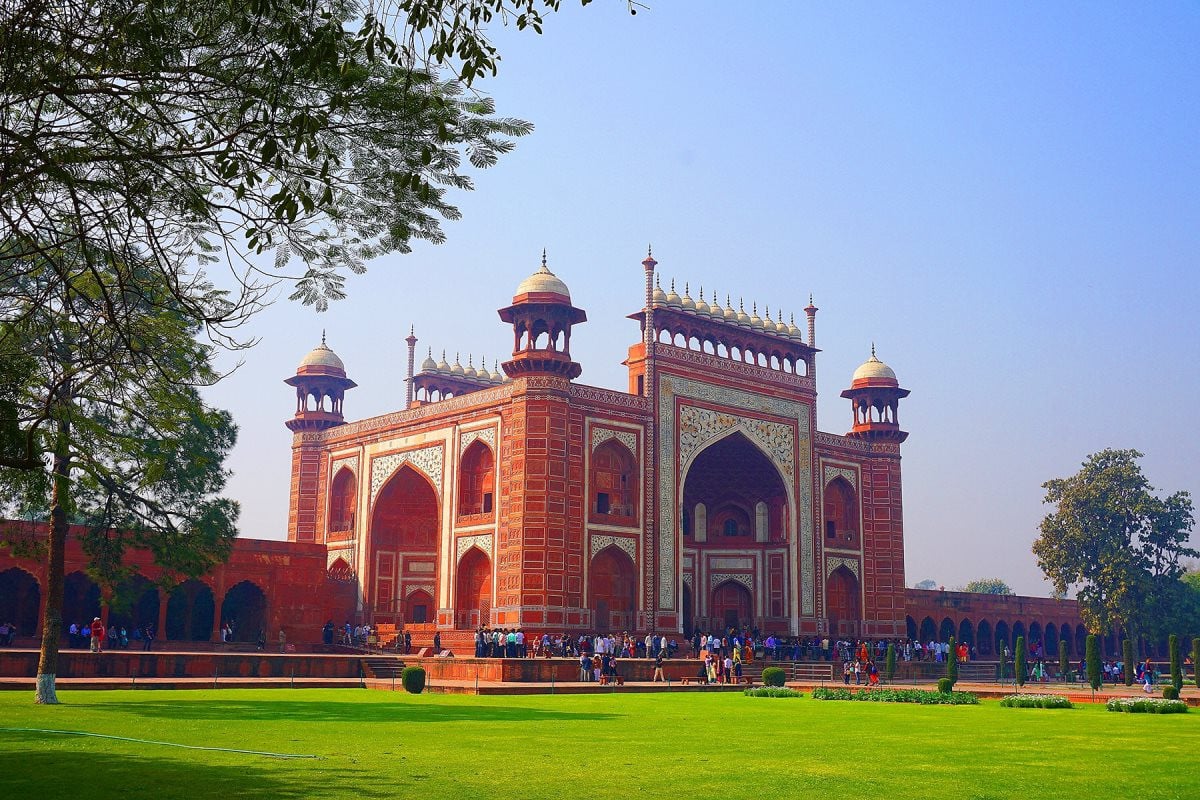
Visitors can purchase entrance tickets at all three gates of the temple (West, East, and South gates).
The entrance fee to the Taj Mahal for foreigners is 1,100 rupees (approximately 440,000 VND). Children under 15 are admitted free of charge. Each ticket allows visitors three hours of entry and includes free water, shoe covers, and a map. A QR code scanner at the entrance tracks the time; visitors exceeding the allotted time will be charged extra.
Visitors are not allowed to take photos inside the main tomb area.
TB (according to VNA)Source












































































Comment (0)