


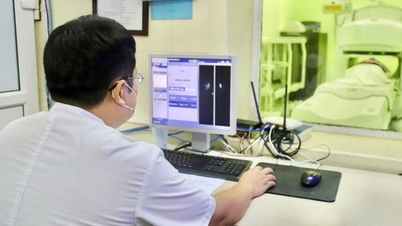
People go for medical check-ups and ultrasounds at a hospital - Photo: DUYEN PHAN
Many people, fearing cancer, actively seek out cancer screenings and tests based on recommendations, unaware that they are wasting money and bringing more worry and illness upon themselves.
What exactly does cancer screening involve?
Do not harm the patient.
Dr. Trinh The Cuong (Chemistry Department, Central E Hospital) said that he has repeatedly warned about marker tests (tumor markers) - blood tests for cancer screening - but he still frequently receives images of long lists of cancer marker test results from patients "seeking" advice.
"Many patients come to the clinic with stacks of A4 paper filled with cancer markers, and the cost of the tests is equivalent to a doctor's entire month's salary. It's heartbreaking to see," said Dr. Cuong.
Doctors say that some places exploit people's fear of cancer to advise and promote unnecessary tests. Most cancer marker tests are not used for cancer screening, but many advertisements promote things like: "5,000 free colorectal cancer screening tests (CEA) for the public..."
"There was a case where a poor elderly woman went for an ankle examination, and the cancer marker test cost 2.5 million VND, leaving her with no money to buy medicine for her foot pain. I hope doctors will think carefully before ordering cancer marker tests for patients," shared Dr. Cuong.
Should CEA tests (used to diagnose certain types of cancer) or other cancer marker tests be used indiscriminately for cancer screening?
Doctors say that only those in the profession know that it doesn't really stop there.
Specifically, consider the case of a patient undergoing lung cancer screening with a blood test showing a slightly elevated Cyfra 21-1 level...
This patient was in shock, experiencing anxiety, insomnia, neglecting work, neglecting family, and losing morale. Subsequently, they underwent a chest CT scan with contrast injection, which carries risks related to the contrast agent and radiation accumulation, resulting in health and financial losses.
Particularly concerning is the negative side effect of inappropriate cancer screening. There have been cases where pregnant women, upon returning for check-ups, were prescribed lung cancer screening using a blood test (Cyfra 21-1). The results were slightly elevated, but a CT scan of the lungs couldn't be performed during pregnancy, causing anxiety for both the family and the pregnant woman, potentially affecting the fetus.
Furthermore, using cancer markers to screen for cancer in adults is problematic, and in many cases, cancer screening tests are also being used for children.
It can be harmful.
Doctors and experts find that cancer marker levels are meaningless in cancer screening for the following three reasons:
Cancer screening is the detection of cancer before it shows clinical symptoms, meaning the tumor is still small. Small tumors generally do not increase cancer markers. Therefore, the test is only a cost.
Many types of cancer have grown to the size of a fist and metastasized to many places, yet cancer markers do not increase. Many patients have cancer marker tests that are normal, thinking they can rest assured and therefore do not undergo the recommended cancer screenings such as gastroscopy, colonoscopy, mammography, etc., until symptoms appear and the disease is already in a late stage. Thus, cancer marker testing creates a false sense of security for people.
Furthermore, cancer markers can be elevated in cancer, but they can also be elevated in other conditions such as infections and smoking. This can cause psychological distress in patients, and incorrect cancer marker testing can even be harmful.
Cancer not detected early
Dr. Tran Duc Canh (K Hospital) emphasized that cancer marker testing is unnecessary.
Dr. Canh explained that tumor markers are proteins produced and released into the bloodstream by cancer cells or by the body's own healthy cells in response to the presence of cancer cells (or in some other benign, non-cancerous conditions). These substances can be found in blood, urine, and tissues.
Tumor markers are non-specific to cancer. Therefore, their presence alone is not sufficient to diagnose cancer. Tumor markers may be elevated in non-cancerous conditions or in cases of inflammation.
Notably, tumor markers do not increase even in late-stage cancer patients. Therefore, blood tests for tumor markers are not recommended as a method for early cancer screening.
Numerous studies on cancer markers have concluded that no single blood test can provide reliable results in the early detection and screening of cancer.
For example, many people believe that a higher-than-normal level of CA 72-4 in the blood is definitely a sign of stomach cancer. This view is completely wrong. In fact, the CA 72-4 level can be elevated in several benign conditions.
CEA is a protein on the cell surface that acts as a marker for colorectal, gastrointestinal, lung, and breast cancer. Elevated CEA levels are also found in smokers, those with cirrhosis, rectal polyps, ulcerative colitis, and benign breast disease. CEA is not used for cancer screening.
Conversely, a person with stomach cancer does not necessarily have elevated CEA levels.
CA 19.9 is a marker for colorectal and pancreatic carcinoma. However, it can also be elevated in patients with hepatobiliary, gastric, and hepatocellular carcinoma, as well as many benign conditions such as pancreatitis and gastrointestinal diseases.
What tests should be done during a cancer screening?
According to health experts, for the best cancer screening and early detection, to avoid unnecessary and wasteful tests, and to save money, the following should be done:
- Ultrasound: It is recommended to perform ultrasound of the thyroid gland and cervical lymph nodes, abdominal ultrasound, uterine and adnexal ultrasound, and breast ultrasound (for women).
- Gastrointestinal endoscopy: including esophagogastroduodenoscopy and colonoscopy.
- Endoscopy of the ear, nose, and throat; colposcopy; and cervical cytology (for women).
- Chest CT scan to diagnose lung cancer, mediastinal cancer, etc.
- Perform basic blood tests: blood glucose, blood lipids, liver enzymes, kidney function, complete blood count, and urinalysis.
- Blood tests for cancer markers are not necessary because they have little diagnostic value due to low sensitivity and specificity, often leading to misdiagnosis or missed diagnoses. Blood cancer marker tests are only indicated when there is suspicion of cancer in certain conditions, such as AFP in the diagnosis of liver cancer or PSA in prostate cancer (in men).
With this screening content, it's possible to screen for over 90% of the most common cancers, leaving only a few others undetected, such as bone cancer and brain cancer.
Source: https://tuoitre.vn/tam-soat-ung-thu-hieu-dung-de-dung-phi-tien-and-them-sau-lo-20240624225516361.htm


![[Photo] Prime Minister Pham Minh Chinh attends the Conference on the Implementation of Tasks for 2026 of the Industry and Trade Sector](/_next/image?url=https%3A%2F%2Fvphoto.vietnam.vn%2Fthumb%2F1200x675%2Fvietnam%2Fresource%2FIMAGE%2F2025%2F12%2F19%2F1766159500458_ndo_br_shared31-jpg.webp&w=3840&q=75)





































































































Comment (0)